Sound: five questions to try now
Real past-paper questions, the answer key from the mark scheme, and the explanation that goes with it. No account needed to answer them.
Question 1
Which row gives typical values for the speed of sound in a solid and in a gas? Each answer gives, in order: speed of sound in a solid m / s; speed of sound in a gas m / s.

Answer: D.
Question 2
Which row gives possible values for the speed of sound? speed in gas speed in liquid speed in solid m / s m / s m / s Use the source image for W20 Paper 21, question 25.
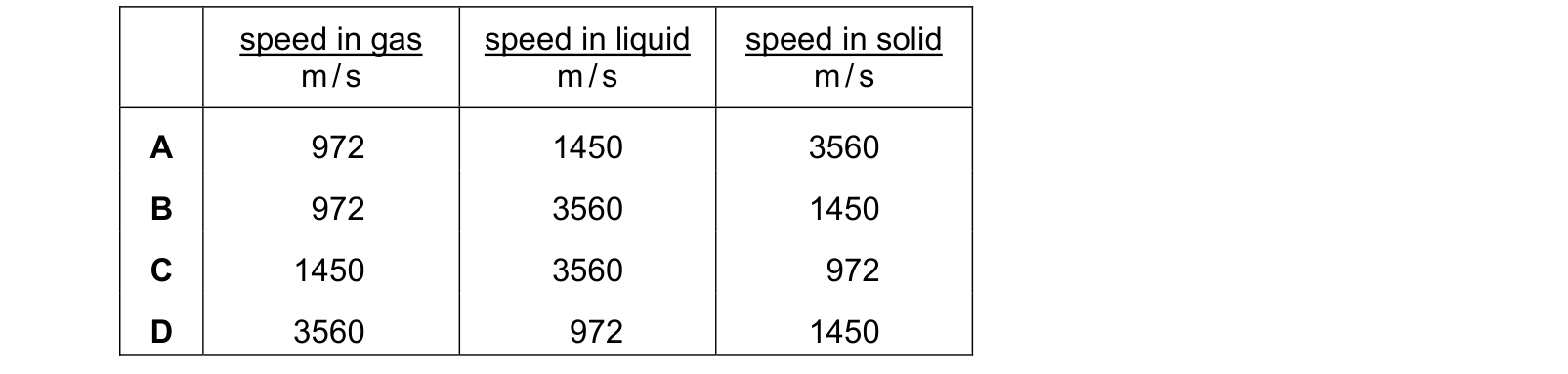
Answer: A.
Question 3
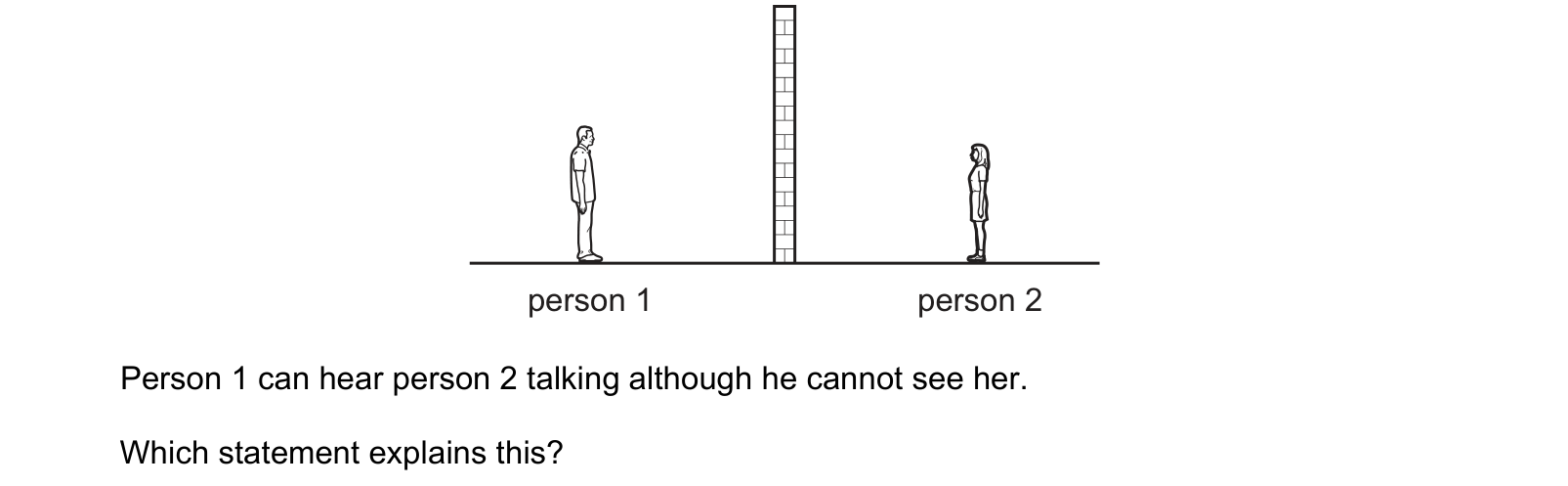
Two people are standing outdoors on either side of a high wall. Person 1 can hear person 2 talking although he cannot see her.
Which statement explains this?
Answer: A.
It works for sound and not for light because the amount of bending depends on how the wavelength compares with the obstacle. Speech has wavelengths of roughly a metre, comparable with the wall, while light has wavelengths under a millionth of a metre, so light is not noticeably diffracted and person 1 still cannot see person 2.
B claims the sound goes straight through the wall unaffected, which would make the wall pointless. C invokes reflection, but the diagram shows nothing above or beside them for the sound to bounce off. D says refraction, which needs the sound to pass into a different material and change speed, and there is only open air on both sides.
Question 4
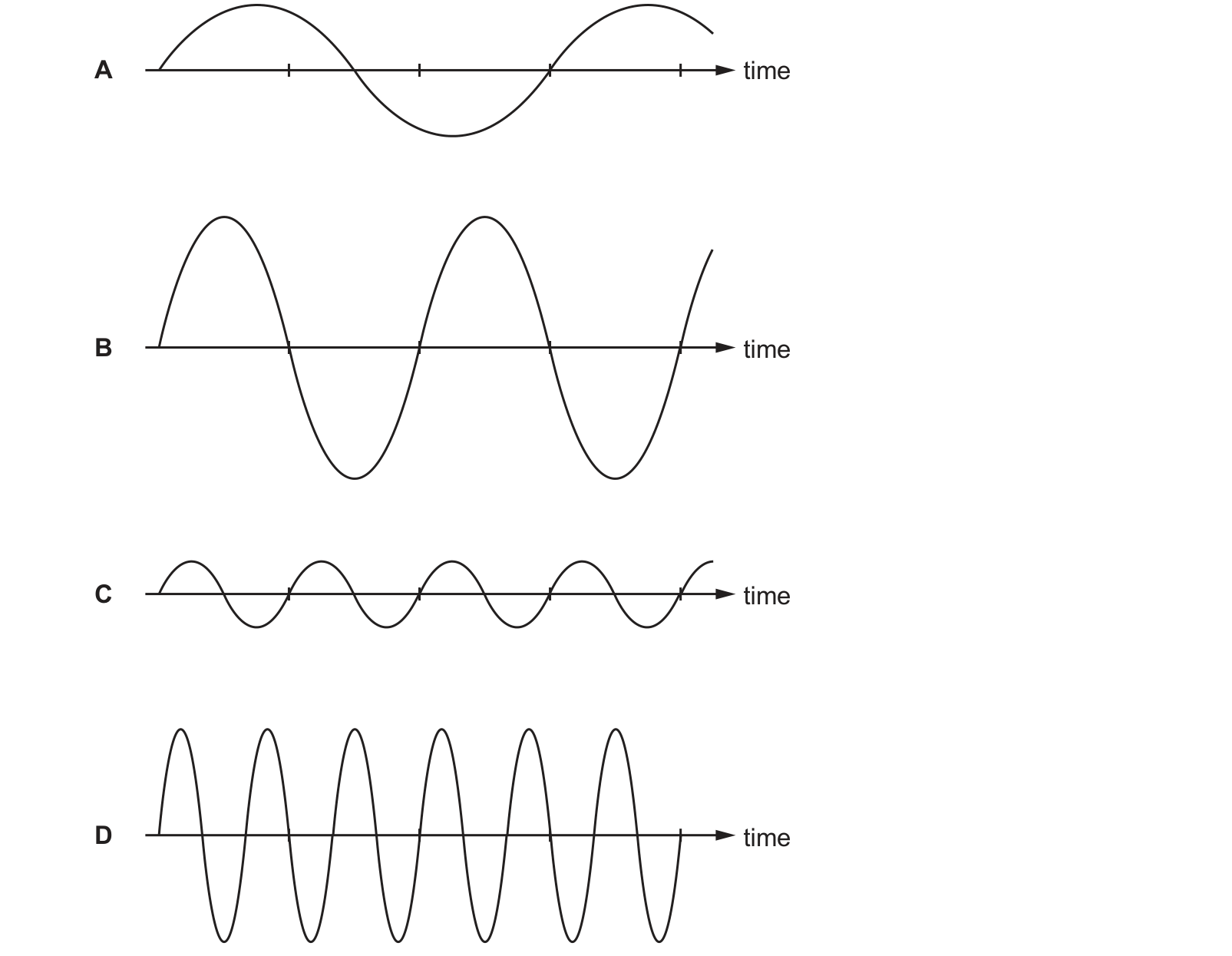
The diagrams represent the waves produced by four sources of sound. The scales are the same for all the diagrams.
Which sound has the highest frequency?
Answer: D.
Counting crests gives roughly one and a half for A, two and a half for B, five for C and six for D, so D has the shortest period and the highest frequency. Equivalently, D has the closest spacing between neighbouring crests, which is the quickest thing to judge by eye.
B is drawn with the tallest crests, which makes it look like the most energetic wave, but height is amplitude and that controls loudness, not frequency. C is the near miss, so count carefully rather than eyeballing which trace looks busiest.
Question 5
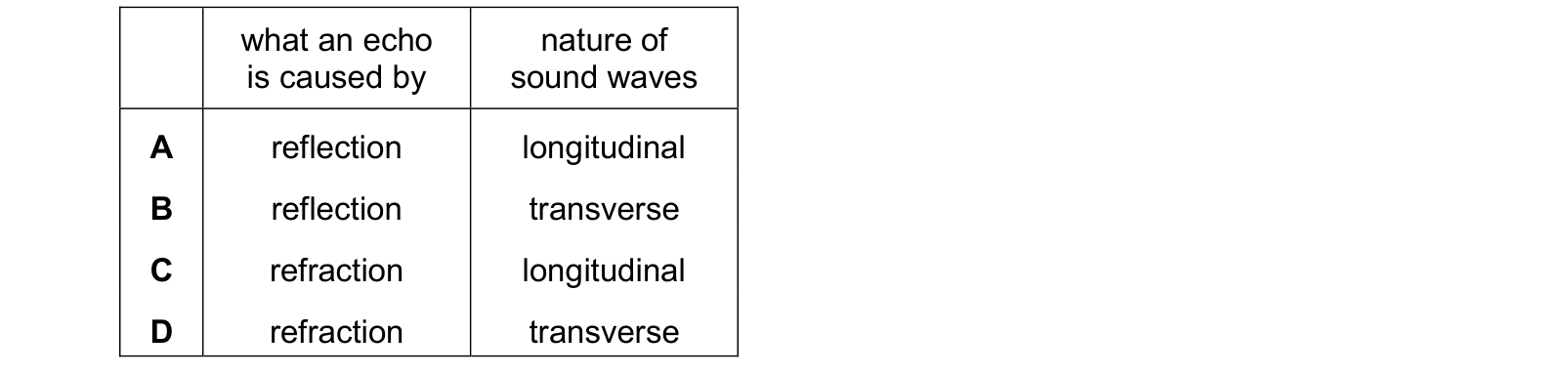
Sound waves may cause an echo. What happens to sound waves to cause an echo and what is the nature of sound waves? Each answer gives, in order: what an echo is caused by; nature of sound waves.
Answer: A.
Sound is a longitudinal wave, with the air squashed and stretched along the same line as the wave travels, so A is the row. B pairs the right cause with transverse, which describes light and water waves rather than sound.
The link worth holding on to is that sound needs particles to compress, which is why it is longitudinal and why it cannot cross a vacuum, and reflection off a hard flat surface is what turns a shout into an echo.
What this practice covers
These questions are drawn from past CIE 0625 Physics papers and filtered to sound. You answer, you find out immediately whether you were right, and you get the reasoning for the correct option and for each distractor. Wrong answers go to a mistakes locker so you can come back to exactly those.
Practice is free. You need an account only so your progress and your mistakes are still there next time.
Keep going Paper 1 and Paper 2 MCQs →
What examiners see students get wrong here
These are the errors that cost marks on sound, taken from our own topic notes. Read them before you practise and you will recognise the traps in the questions.
- Calling sound a transverse wave.
- Saying sound can travel through a vacuum.
- Saying sound travels fastest in gases, by analogy with light.
- Swapping loudness and pitch, or amplitude and frequency.
- Forgetting to halve the distance in an echo or sonar calculation.
- Using the whole reflected path when the question asks for the gap between two sounds.
- Quoting the range of hearing as 20 Hz to 20 kHz and then calling 15 kHz ultrasound.
- Adjusting an experimental speed towards the textbook value rather than reporting what the measurement gives.
Revise it first
If any of the above is unfamiliar, work through the notes before practising: Sound revision notes.