61 past-paper questions on this unit. Five of them are below. Answer on the page: each one is marked the moment you pick, the correct option is shown whether or not you found it, and the full explanation opens either way.
CIE 0625 PhysicsPaper 1 and Paper 2 MCQsFree account
Simple phenomena of magnetism: five questions to try now
Real past-paper questions, the answer key from the mark scheme, and the explanation that goes with it. No account needed to answer them.
Question 1
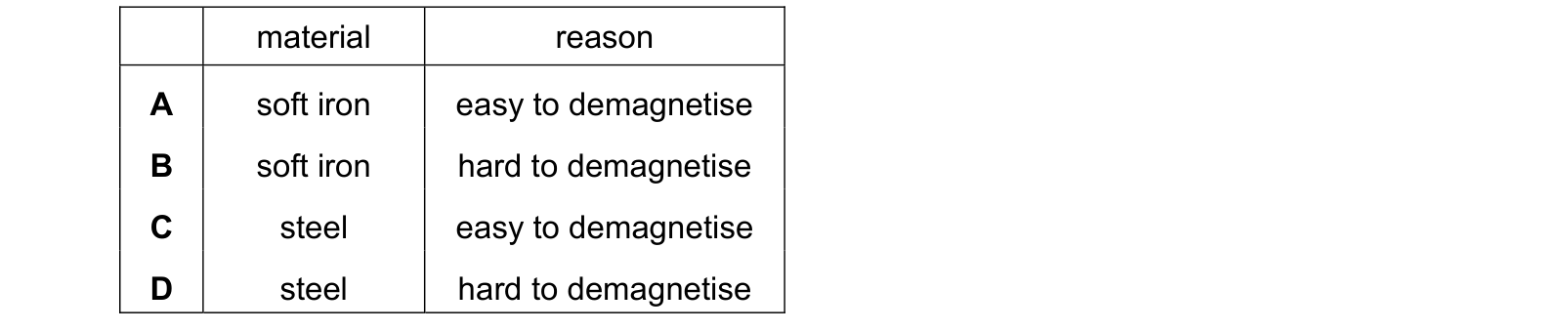
A permanent magnet is to be made. Which row gives the correct material to use and the correct reason for choosing this material? Each answer gives, in order: material; reason.
Answer: D.
A permanent magnet has to keep its magnetism once it has been made, so the useful property is being hard to demagnetise, which immediately rules out A and C. Steel is a hard magnetic material: it is harder to magnetise in the first place, but once magnetised it holds on to the alignment of its domains, so it stays a magnet. Soft iron is the opposite, magnetising and demagnetising very easily, which makes it right for the core of an electromagnet but useless for a permanent magnet, so B pairs the wrong material with the right reason. Row D gives both the material and the reason correctly.
Question 2
A current passes along a wire placed between the poles of a permanent magnet. The wire experiences a force due to the magnetic field. What will change the direction of this force?
Answer: B.
The wire runs up through the gap with the N pole on the left and the S pole on the right, so the field crosses the wire from N to S and the direction of the force follows Fleming's left hand rule. That force flips only if one of the two directions feeding the rule is flipped, so reversing the current reverses the force, which is B. A increases the current and C increases the field strength, but the size of the force depends on those quantities while its direction depends only on the directions of the current and the field, so the force just gets bigger. D adds an electromagnet with the same polarity as the permanent magnet, which reinforces the existing field in the same direction, so again only the size changes. Reversing the current and the field together would also leave the direction unchanged, because two reversals cancel.
Question 3
A bar magnet is slowly moved towards an unmagnetised metal object X. When it is a few centimetres away, the object begins to slide towards the magnet. Why does this happen?
Answer: C.
Only a magnetic material such as iron, steel, cobalt or nickel can be pulled towards a magnet, so a non-magnetic material would sit there and do nothing, which kills A and B. What happens is that the nearby N pole makes the domains in X line up, so the face of X closer to the magnet becomes a south pole: magnetism has been induced in it. Opposite poles then attract and X slides towards the magnet, so C is correct. D describes a magnetic material with no induced magnetism, and without that induced south pole there would be nothing for the magnet to pull on, so nothing would move.
Question 4
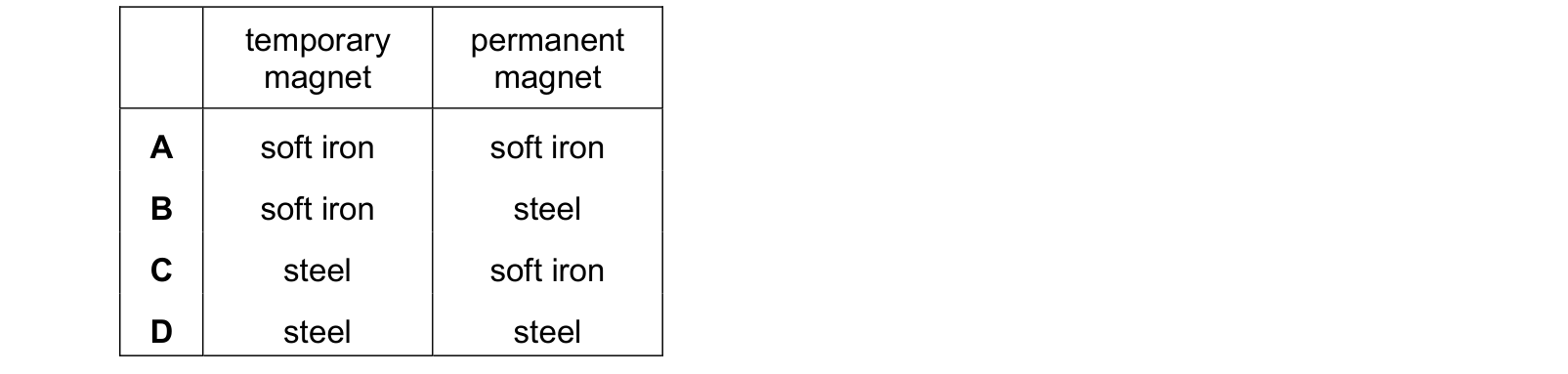
Which row describes suitable materials for use in a temporary magnet and in a permanent magnet? Each answer gives, in order: temporary magnet; permanent magnet.
Answer: B.
A temporary magnet has to lose its magnetism the moment the current or the nearby magnet is taken away, and soft iron does exactly that because it is magnetically soft and does not hold on to its alignment. A permanent magnet has to keep its magnetism, and steel is magnetically hard, so it stays magnetised once it has been magnetised. Soft iron for temporary and steel for permanent is B. C reverses the two, which would give an electromagnet core that stayed magnetised after switch-off and a bar magnet that lost its poles. A and D use the same material for both jobs, which cannot be right when the two jobs need opposite behaviour.
Question 5
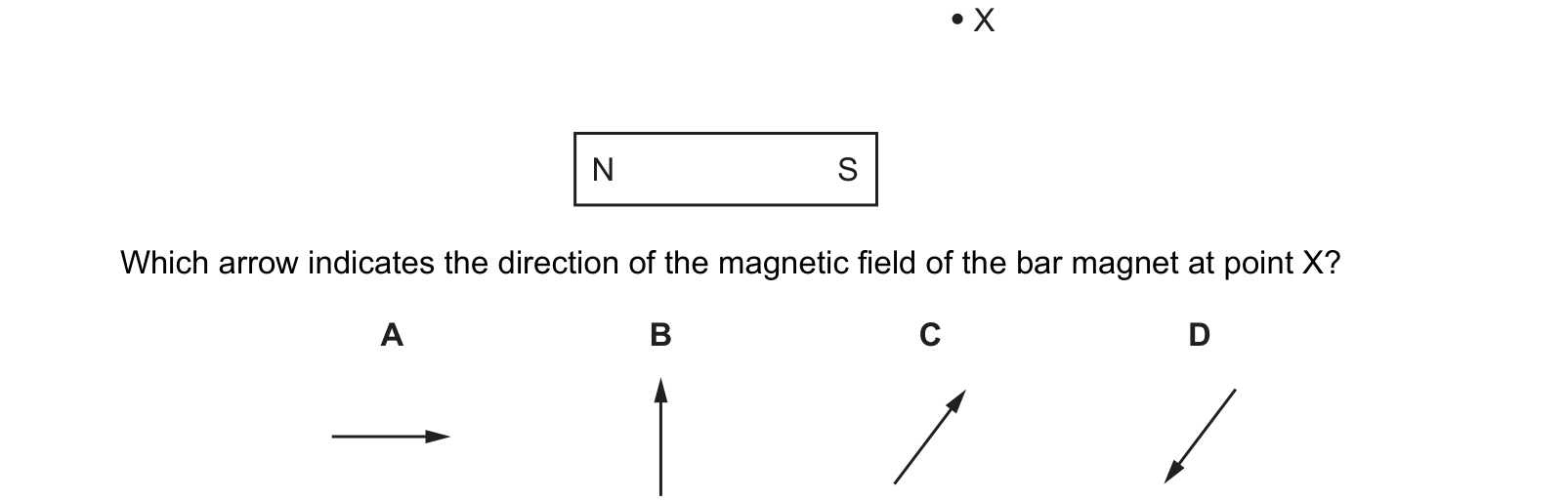
Point X is near to a bar magnet, as shown. Which arrow indicates the direction of the magnetic field of the bar magnet at point X? Use the source image for S22 Paper 11, question 26.
Answer: D.
The magnet has its N pole on the left and its S pole on the right, and outside a magnet the field lines run from the north pole round to the south pole. Point X sits above the magnet and just beyond its right-hand end, which is where those lines are curving downwards and inwards to enter the S pole. The field there points down and to the left, so arrow D is the one that matches. B points straight up, which is what you would see just off the end of a pole face rather than above it, and A points along the magnet, which is the direction of the return field over the middle rather than beyond the end. C points up and to the right, away from the S pole, which is the direction of the field at the matching point near the N end instead.
These questions are drawn from past CIE 0625 Physics papers and filtered to simple phenomena of magnetism. You answer, you find out immediately whether you were right, and you get the reasoning for the correct option and for each distractor. Wrong answers go to a mistakes locker so you can come back to exactly those.
Practice is free. You need an account only so your progress and your mistakes are still there next time.
These are the errors that cost marks on simple phenomena of magnetism, taken from our own topic notes. Read them before you practise and you will recognise the traps in the questions.
Saying attraction proves an object is a magnet; only repulsion does.
Assuming all metals are magnetic, especially copper and aluminium.
Drawing field lines from south to north outside the magnet, or letting them cross.
Saying the Earth's magnetic pole in the Arctic is a magnetic north.
Using steel for an electromagnet core, or soft iron for a permanent magnet.
Saying a cut magnet gives one north piece and one south piece.
Confusing "magnetically soft" with physically soft.