Density: five questions to try now
Real past-paper questions, the answer key from the mark scheme, and the explanation that goes with it. No account needed to answer them.
Question 1
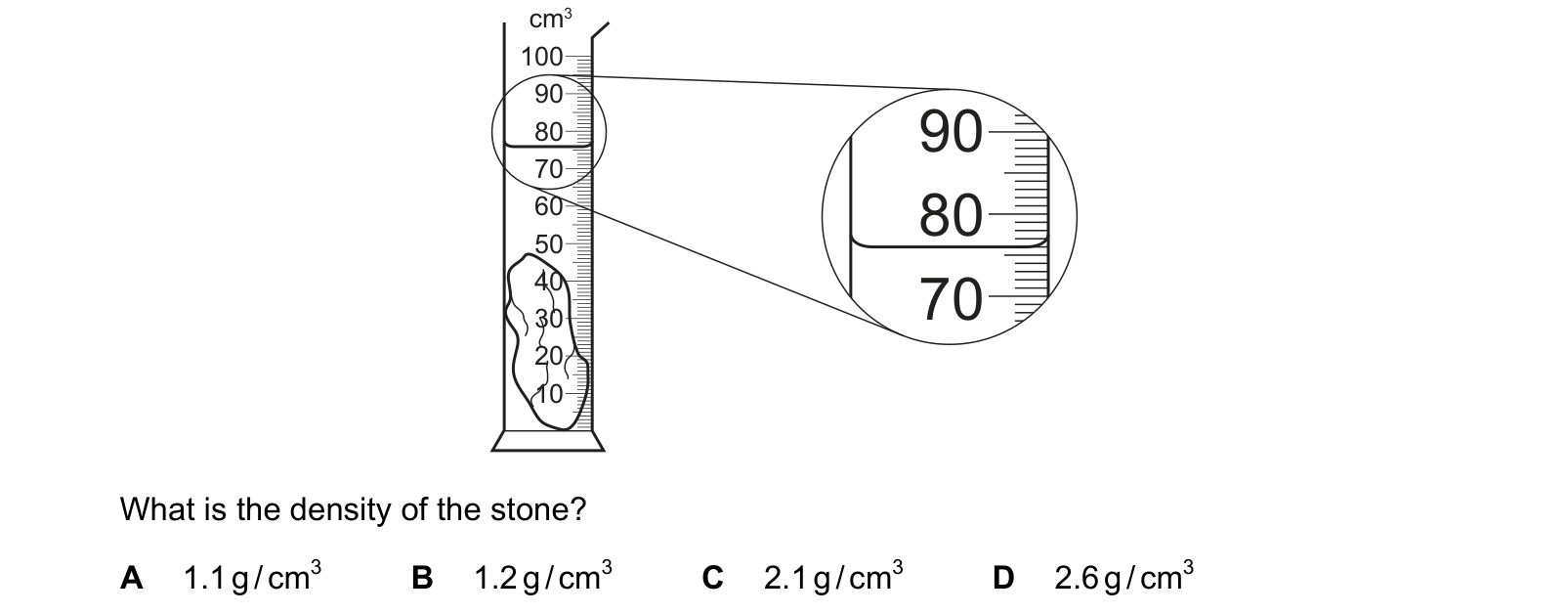
A measuring cylinder contains 40 cm³ of water.
A stone of mass 94 g is lowered into the water so that it is fully submerged as shown. What is the density of the stone?
Answer: D.
The magnified scale shows the water at 76 cm3, and it started at 40 cm3.
volume of stone = 76 - 40 = 36 cm3
density = 94 / 36 = 2.6 g / cm3, which is D.
B, 1.2 g / cm3, is 94 / 76: the final reading used as the volume with the starting 40 cm3 never subtracted. A, 1.1 g / cm3, is the same mistake from a slightly different reading.
The magnifier is there because the level does not sit on a labelled mark. Work out what one small division is worth before reading it, and remember that a density near 1 g / cm3 would mean a stone that barely sinks.
Question 2
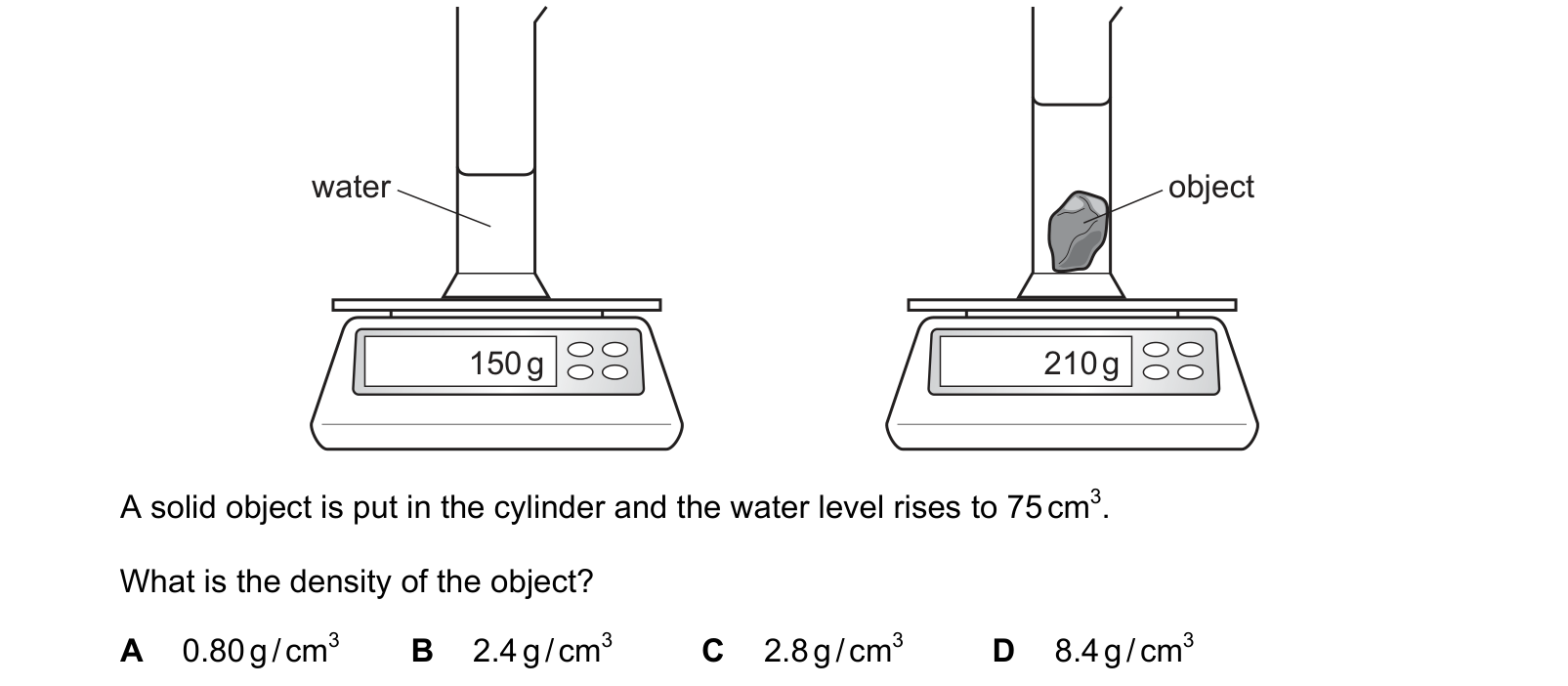
A measuring cylinder containing 50 cm³ of water is put on a balance. A solid object is put in the cylinder and the water level rises to 75 cm³. What is the density of the object?
Answer: B.
The balance goes from 150 g to 210 g, so the object's mass is 210 - 150 = 60 g.
The water rises from 50 cm3 to 75 cm3, so the object's volume is 75 - 50 = 25 cm3.
density = 60 / 25 = 2.4 g / cm3, which is B.
Each wrong option skips one of the subtractions. A, 0.80 g / cm3, is 60 / 75, using the final volume. D, 8.4 g / cm3, is 210 / 25, using the total mass on the balance. C, 2.8 g / cm3, is 210 / 75, skipping both.
The balance is weighing the cylinder and the water as well as the object, and the cylinder is full of water before the object goes in. Both readings are totals, and both need their starting value taken off.
Question 3
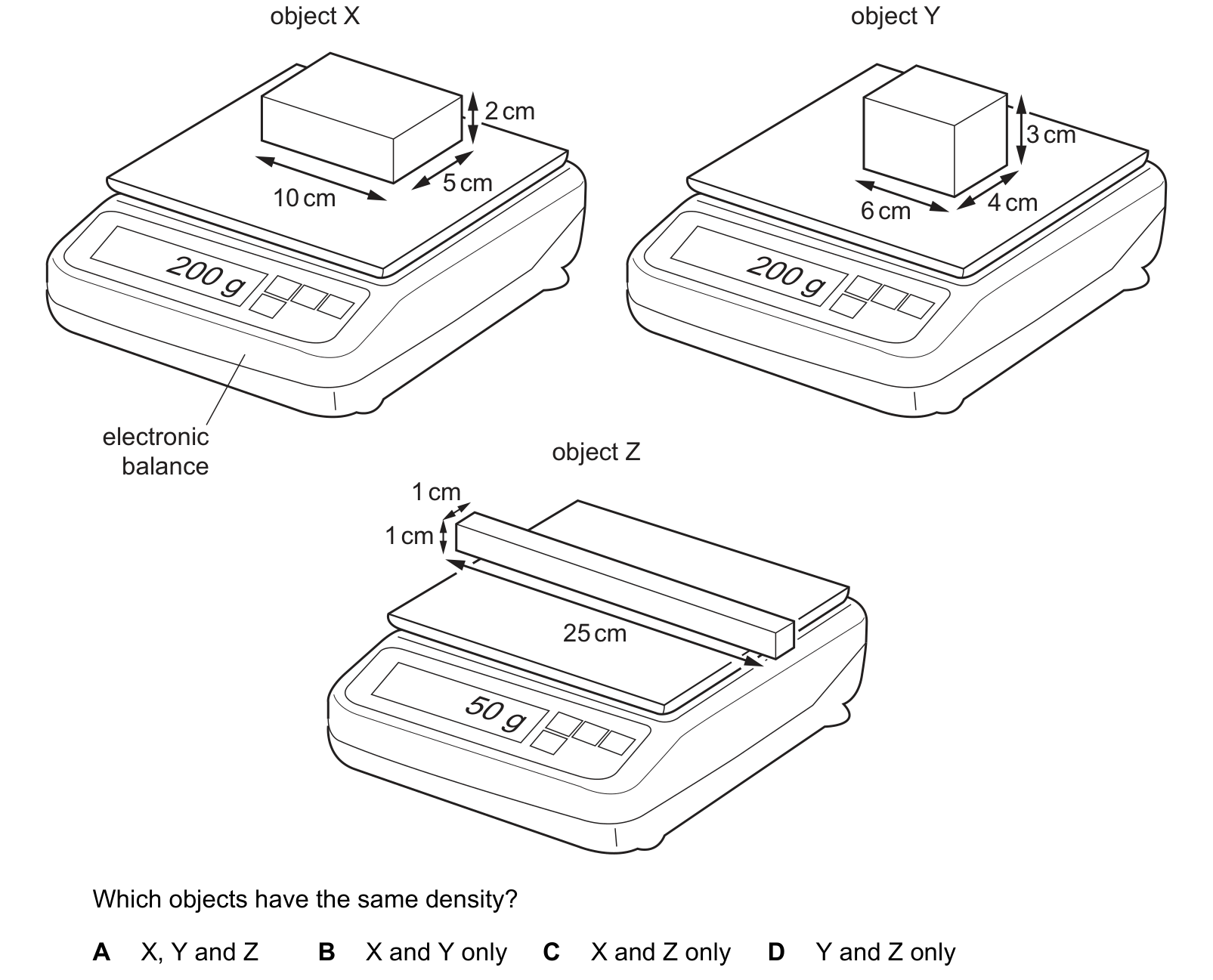
X, Y and Z are three regularly shaped solid objects.
Their dimensions and masses are shown in the diagrams.
object X object Y electronic balance Which objects have the same density?
Answer: C.
X: 10 x 5 x 2 = 100 cm3, mass 200 g, so 2.0 g / cm3
Y: 6 x 4 x 3 = 72 cm3, mass 200 g, so 2.8 g / cm3
Z: 25 x 1 x 1 = 25 cm3, mass 50 g, so 2.0 g / cm3
X and Z match at 2.0 g / cm3, so C.
B is the trap, and a well-built one: X and Y both read 200 g on the balance, so they look like a pair until you notice their volumes differ.
Z is the one people discount, because it is by far the lightest object at 50 g. But it is also much the smallest at 25 cm3, and density is the ratio, not the mass.
Equal masses do not mean equal densities. You have to divide every time.
Question 4
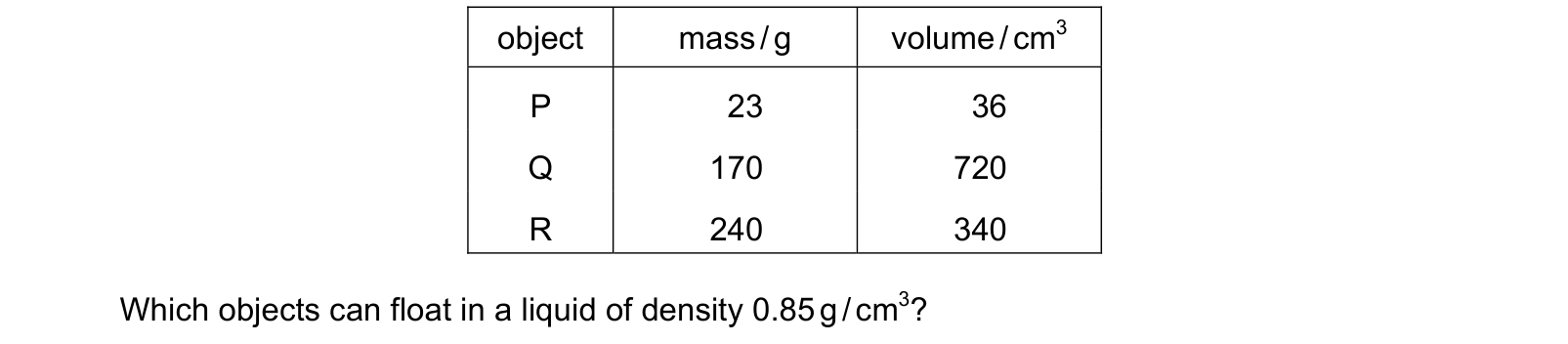
The table gives the mass and the volume of three objects P, Q and R.
object mass / g volume / cm³ P 23 36
Q 170 720
R 240 340
Which objects can float in a liquid of density 0.85 g / cm3?
Answer: D.
P: 23 / 36 = 0.64 g / cm3
Q: 170 / 720 = 0.24 g / cm3
R: 240 / 340 = 0.71 g / cm3
All three are below 0.85, so all three float, which is D.
The trap is comparing the masses or the volumes instead of the ratio. R is by far the heaviest at 240 g and it still floats, because it is bulky enough to be less dense than the liquid. Q is heavier than P and has the lowest density of the three. Neither mass alone nor volume alone predicts floating.
Doing all three divisions is the only reliable route, and it is quick if you look for rough comparisons rather than exact figures: 23 against 36 is clearly under three quarters, 170 against 720 is under a quarter, and 240 against 340 is around seven tenths.
Floating is decided by density and nothing else, which is why a steel ship floats and a steel nail does not.
Question 5
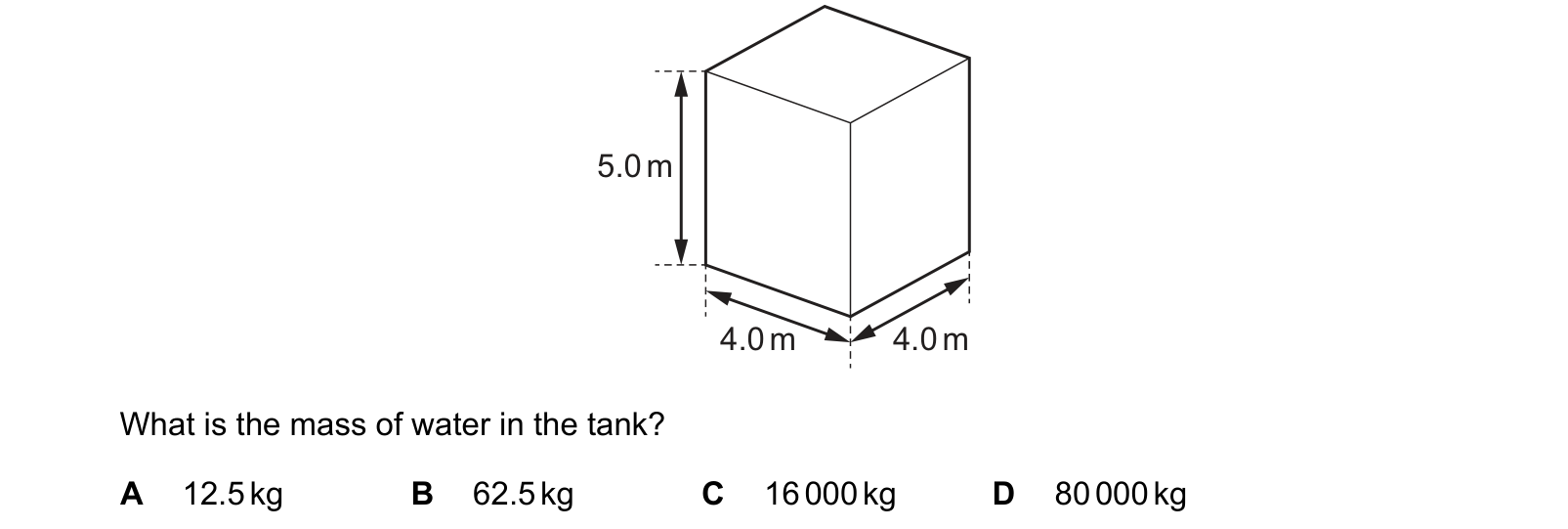
The tank shown has the dimensions 5.0 m × 4.0 m × 4.0 m.
It is completely filled with water of density 1000 kg / m³.
What is the mass of water in the tank?
Answer: D.
volume = 5.0 x 4.0 x 4.0 = 80 m3
mass = 1000 x 80 = 80 000 kg, which is D.
C, 16 000 kg, uses a volume of 16 m3, which is 4.0 x 4.0 with the length left out.
A and B are far too small to be masses of water at all. B, 62.5 kg, is 1000 / 16, dividing by the volume instead of multiplying, and A is a similar inversion.
Eighty tonnes sounds enormous and is right. A cubic metre of water is a tonne, so any tank measured in metres holds a great deal, and that is a quick way to reject the two small options on sight.
What this practice covers
These questions are drawn from past CIE 0625 Physics papers and filtered to density. You answer, you find out immediately whether you were right, and you get the reasoning for the correct option and for each distractor. Wrong answers go to a mistakes locker so you can come back to exactly those.
Practice is free. You need an account only so your progress and your mistakes are still there next time.
Keep going Paper 1 and Paper 2 MCQs →
What examiners see students get wrong here
These are the errors that cost marks on density, taken from our own topic notes. Read them before you practise and you will recognise the traps in the questions.
- Using the final level in a measuring cylinder as the volume instead of the rise.
- Forgetting to subtract the mass of the container from a stated total.
- Choosing the object with the greatest mass as the densest.
- Mixing g/cm³ and kg/m³, or missing the factor of 1000 between them.
- Dividing volume by mass instead of mass by volume; check with the units.
- Saying heating increases the density of a gas.
- Saying that compressing something increases its mass.
- Reading dimensions off a scale as endpoints rather than differences.
Revise it first
If any of the above is unfamiliar, work through the notes before practising: Density revision notes.