Forces: five questions to try now
Real past-paper questions, the answer key from the mark scheme, and the explanation that goes with it. No account needed to answer them.
Question 1
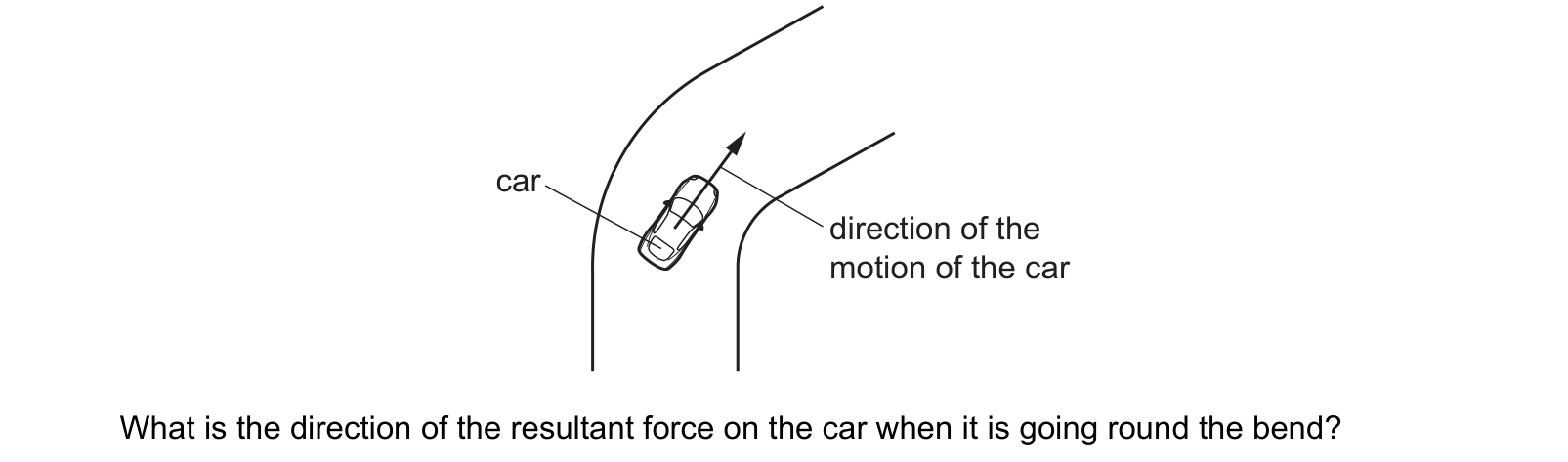
A car is driven round a bend in the road at a constant speed. What is the direction of the resultant force on the car when it is going round the bend?
Answer: C.
A force along the direction of motion would speed the car up; against it would slow the car down. The speed is constant, so the force cannot have any component along the motion at all. It must be perpendicular to it. That eliminates A and B.
Of the two perpendicular options, the force points towards the inside of the bend, which is the centre of the circle it is turning around. That is C.
D is the popular wrong answer, and it comes from the feeling of being thrown outwards in a turning car. That feeling is your own inertia trying to carry you straight on while the car turns underneath you. There is no outward force; the door pushes you inwards, which is exactly what keeps you on the curve.
For a car the inward force is friction between the tyres and the road, which is why a wet or icy bend is dangerous.
Question 2
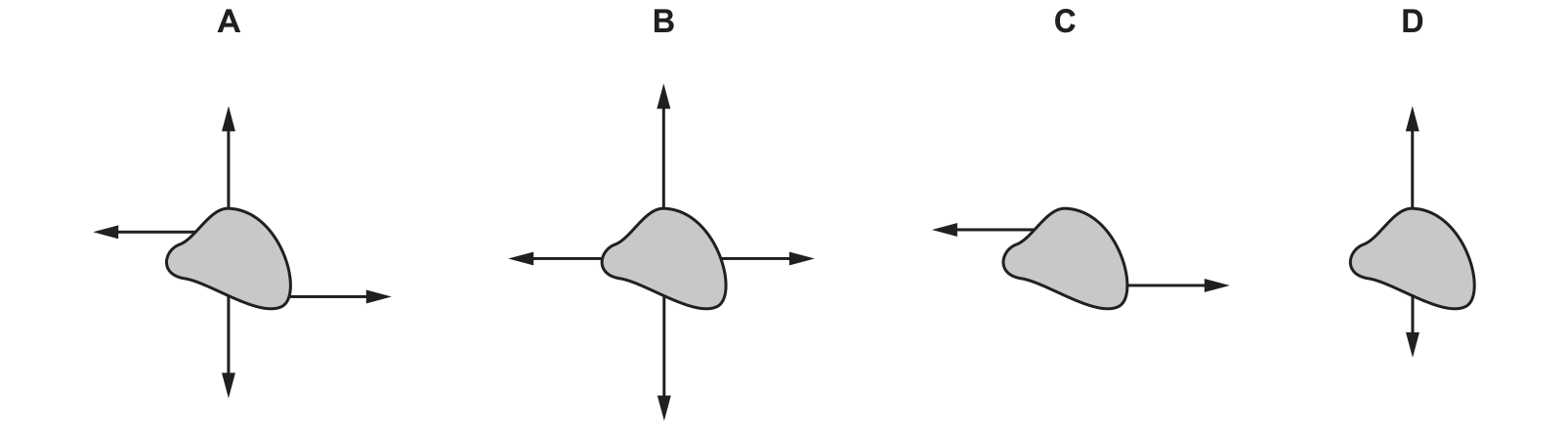
Forces are applied to four identical objects. The lengths of the arrows indicate the magnitude of each force. Which object is in equilibrium? Use the source image for S20 Paper 11, question 8.
Answer: B.
In B the four arrows meet at the centre of the object: the two horizontal ones share a line, the two vertical ones share a line, and each pair is drawn the same length. Nothing is left over to push it or to turn it.
A has the same four directions and its horizontal arrows are drawn at different heights, so they do not share a line of action. Equal and opposite but offset is a couple, and the object turns.
C has only a horizontal pair, again offset from each other, so it turns as well.
D has only a vertical pair, and the two arrows are not the same length, so a resultant is left pulling it one way.
When a question draws the arrows to scale, it wants you to compare lengths as well as directions. Where those arrows meet matters just as much.
Question 3
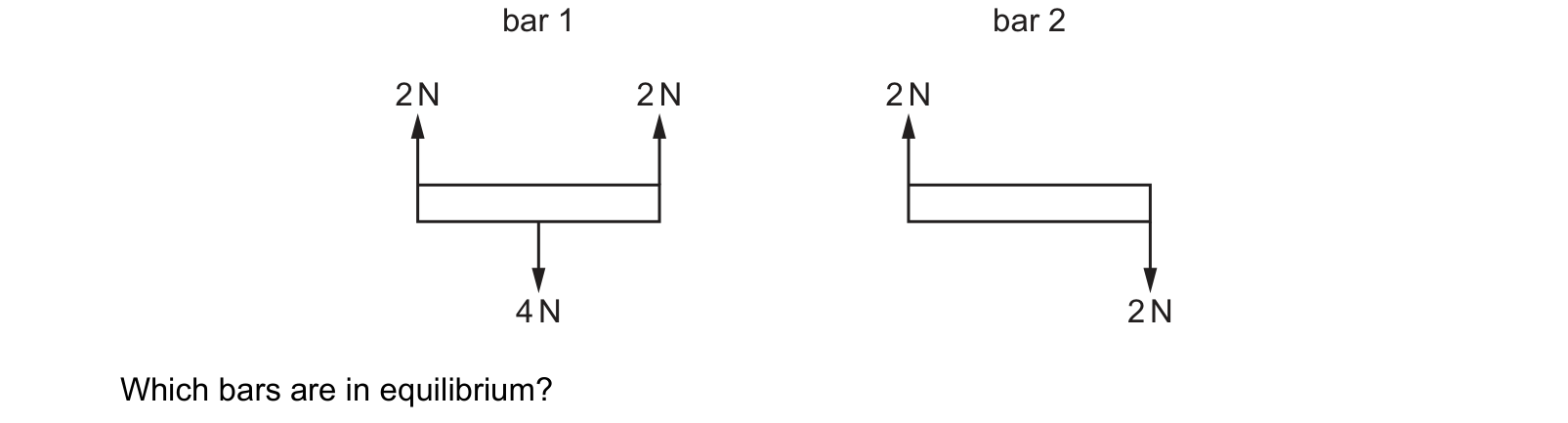
The diagram shows two identical bars of negligible weight. All the forces acting on each bar are marked.
bar 1 bar 2 Which bars are in equilibrium?
Answer: B.
Bar 1 has 2 N up at each end and 4 N down in the middle. Up and down both total 4 N, so the forces cancel. Taking moments about the centre, the two 2 N forces sit the same distance out on opposite sides and turn the bar in opposite senses, so they cancel too. The 4 N acts at the centre and has no moment about it. Bar 1 is in equilibrium.
Bar 2 has 2 N up at the left end and 2 N down at the right end. Those also cancel as forces, and this is exactly where it fails. They are offset from each other rather than acting along one line, so together they form a couple and the bar rotates.
Bar 1 only, which is B.
The pair is set up to make one point: zero resultant force is not enough. Equilibrium needs no resultant turning effect as well, and bar 2 is what a zero-force, non-zero-moment object looks like.
Question 4
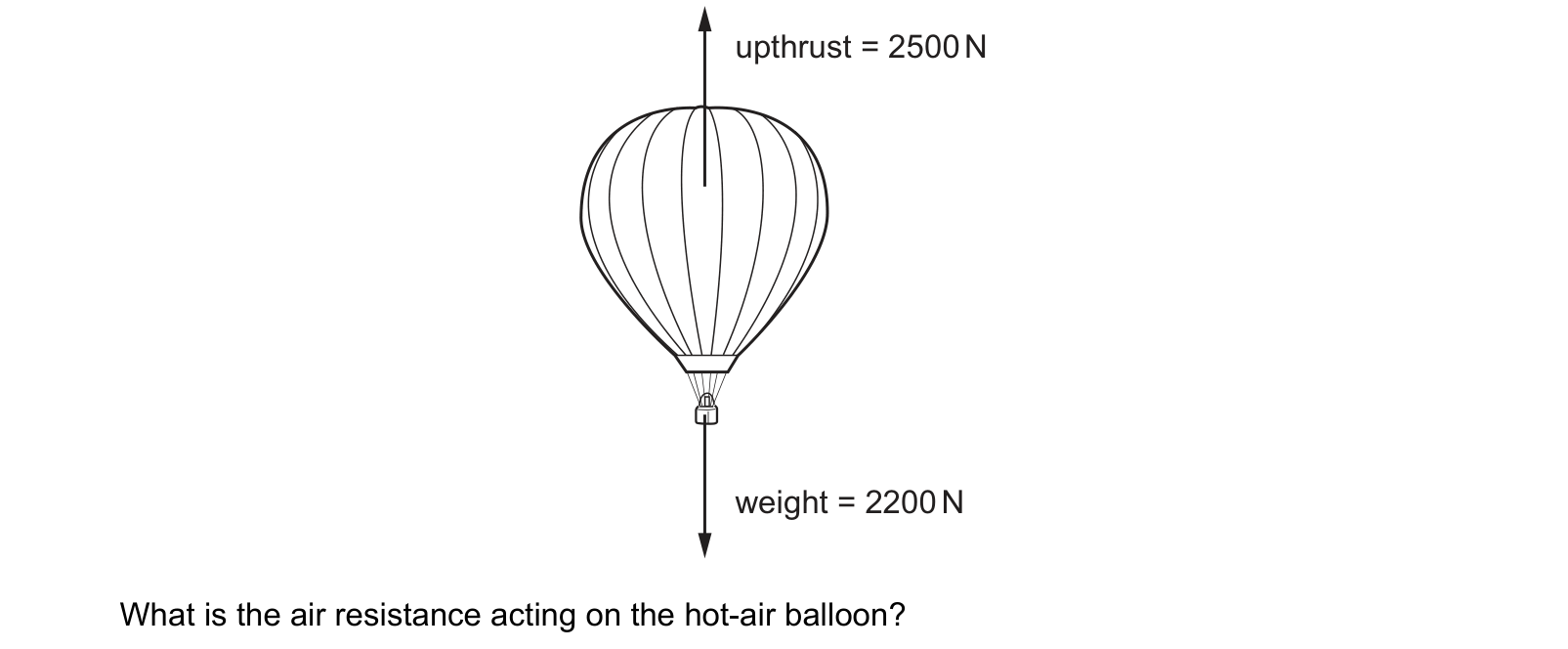
The diagram shows two of the three vertical forces acting on a hot-air balloon. The hot-air balloon is moving upwards at constant speed. What is the air resistance acting on the hot-air balloon?
Answer: A.
From the diagram the upthrust is 2500 N up and the weight is 2200 N down, so up currently exceeds down by 300 N.
The missing force must remove that difference, so it is 300 N downwards, which is A.
B has the right size and the wrong direction, which would leave 800 N of resultant lift.
C and D use 4700 N, which is 2500 + 2200: adding two forces that point in opposite directions.
The direction also follows from what air resistance does. It always opposes the motion, the balloon is going up, so it acts down. Both routes give the same answer, which is a useful check.
Question 5
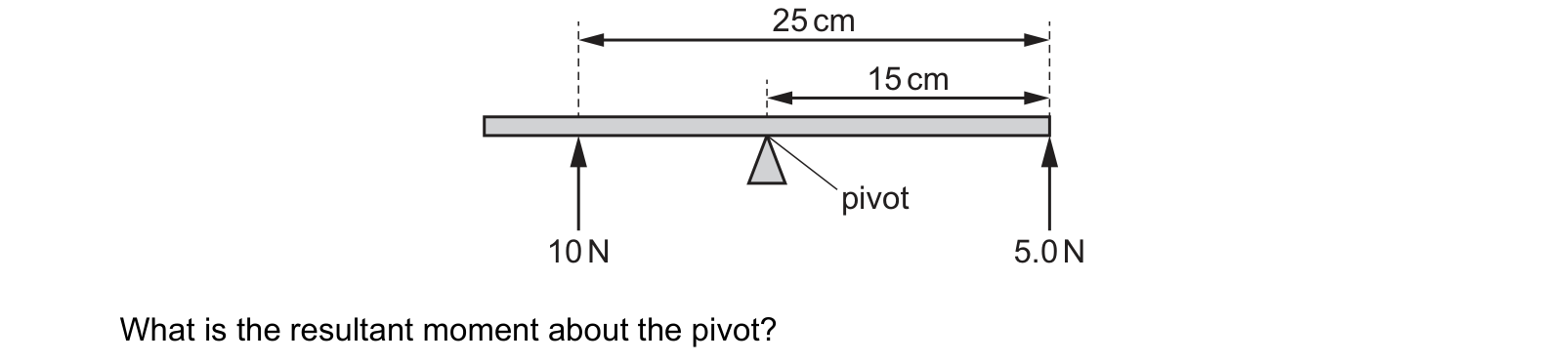
A beam is pivoted at its centre of mass.
It is acted upon by two forces, 10 N and 5.0 N, as shown. What is the resultant moment about the pivot?
Answer: B.
The 25 cm spans the two forces and the 15 cm runs from the pivot to the 5.0 N force. So the 10 N force sits 25 - 15 = 10 cm on the other side of the pivot.
moment of the 10 N force = 10 x 10 = 100 N cm
moment of the 5.0 N force = 5.0 x 15 = 75 N cm
Both forces point upwards but they are on opposite sides of the pivot, so they turn the beam in opposite senses. The 10 N force is the bigger moment and it acts clockwise, so the resultant is 100 - 75 = 25 N cm clockwise, which is B.
A has the right size in the wrong sense. C and D use 175 N cm, which is 100 + 75: adding is only right when both moments turn the same way, and here they do not.
The 25 cm is deliberately not a distance from the pivot. Subtracting to find the 10 cm is the step the question is really testing.
What this practice covers
These questions are drawn from past CIE 0625 Physics papers and filtered to forces. You answer, you find out immediately whether you were right, and you get the reasoning for the correct option and for each distractor. Wrong answers go to a mistakes locker so you can come back to exactly those.
Practice is free. You need an account only so your progress and your mistakes are still there next time.
Keep going Paper 1 and Paper 2 MCQs →
What examiners see students get wrong here
These are the errors that cost marks on forces, taken from our own topic notes. Read them before you practise and you will recognise the traps in the questions.
- Putting a single force into F = ma instead of the resultant.
- Using the stretched length instead of the extension in Hooke's law.
- Taking the spring constant from a reading past the limit of proportionality.
- Accepting a case as equilibrium when the forces cancel but form a couple.
- Using a distance that is not perpendicular to the force when finding a moment.
- Saying the centre of gravity is at the point of suspension, or halfway down the vertical.
- Drawing the force on an object in circular motion outwards or along the tangent.
- Saying an object at constant speed has no forces acting on it.
Revise it first
If any of the above is unfamiliar, work through the notes before practising: Forces revision notes.