Pressure: five questions to try now
Real past-paper questions, the answer key from the mark scheme, and the explanation that goes with it. No account needed to answer them.
Question 1
A mercury barometer is used to measure atmospheric pressure. Which distance gives a measure of the atmospheric pressure? Use the source image for S21 Paper 11, question 13.

Answer: B.
That is the distance from the mercury level in the dish up to the top of the mercury in the tube, which the diagram labels B.
A runs from the reservoir surface to the closed top of the glass tube, so it includes the empty space above the mercury. That space is a vacuum and exerts no pressure, so counting it would overstate the reading.
C is just that vacuum gap on its own.
D runs from the top of the mercury down to the bottom end of the tube, which is below the reservoir surface. The mercury below the surface is supported by the mercury around it, not by the atmosphere, so that extra length does not belong in the measurement.
Only the mercury standing above the outside level is being held up by the air, and that is what p = rho g h applies to.
Question 2
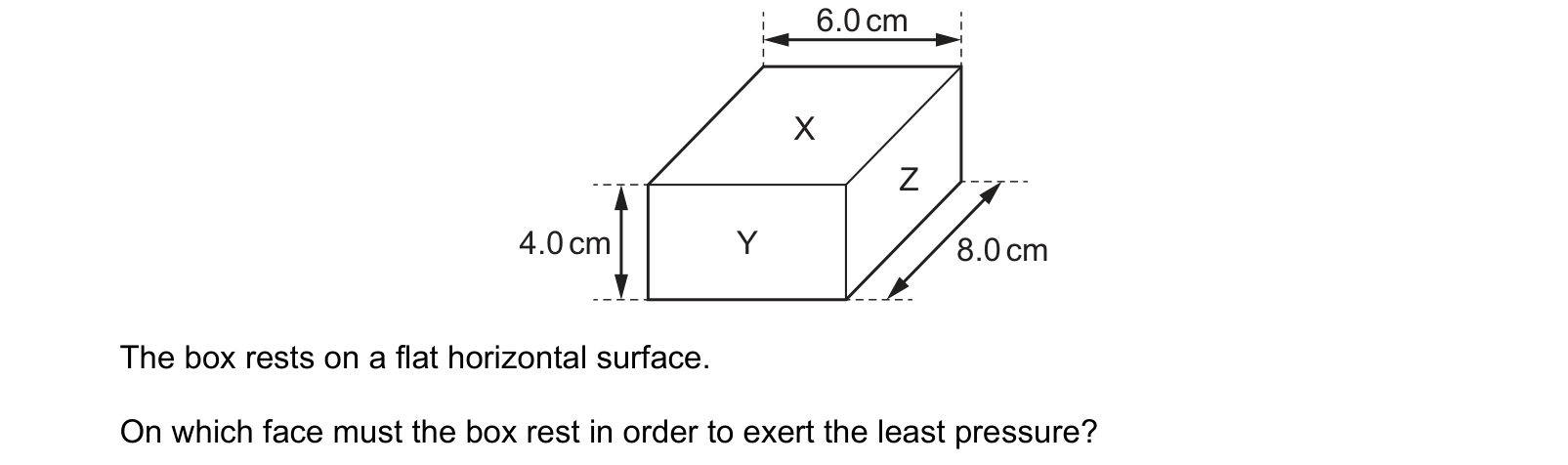
The diagram shows a box of dimensions 6.0 cm × 8.0 cm × 4.0 cm.
The box rests on a flat horizontal surface.
On which face must the box rest in order to exert the least pressure?
Answer: A.
Work out all three from the dimensions 6.0 x 8.0 x 4.0 cm:
X, the top face: 6.0 x 8.0 = 48 cm2
Y, the front face: 6.0 x 4.0 = 24 cm2
Z, the side face: 8.0 x 4.0 = 32 cm2
X is the largest, so resting on X gives the least pressure. That is A.
The face made from the two longest edges is always the biggest, so you can often spot it without multiplying: 6.0 and 8.0 are the two largest dimensions, and X is the face they bound.
Y, made from the longest and shortest edges, is the smallest and would give the greatest pressure.
D suggests the pressure is the same on all faces, which would only be true for a cube. This box has three different face areas and therefore three different pressures, ranging by a factor of two from Y to X.
Question 3
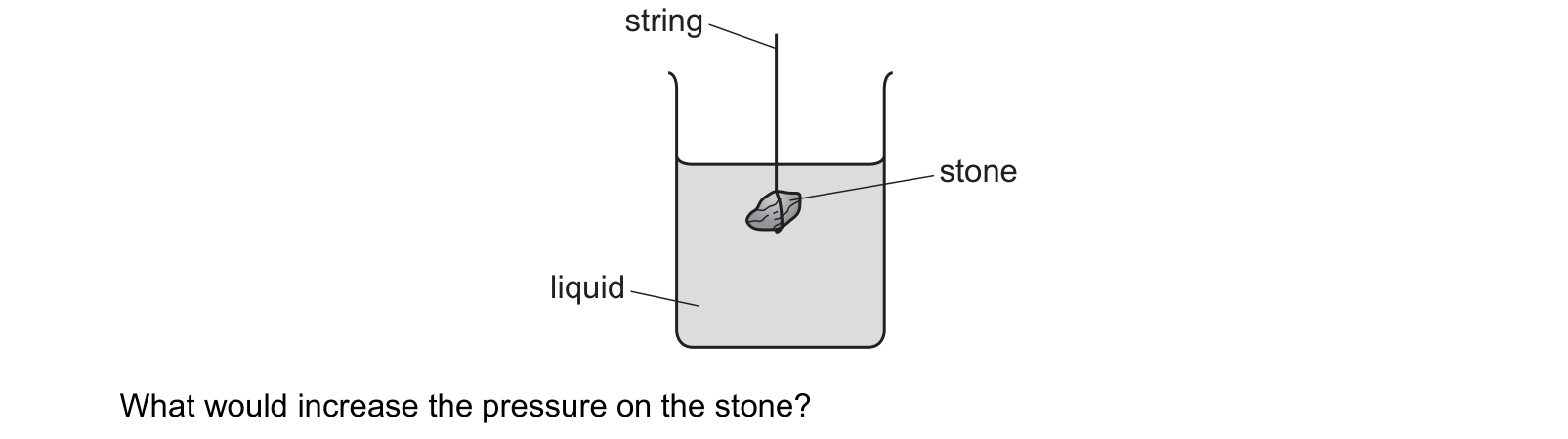
The diagram shows a stone suspended on a string under the surface of a liquid. The stone experiences a pressure caused by the liquid. What would increase the pressure on the stone?
Answer: C.
Lowering the stone deeper increases h, so the pressure on it increases: C.
D does the opposite. A liquid of lower density gives a smaller rho and so less pressure at the same depth.
A and B are about the stone rather than the liquid. Pressure at a point in a fluid does not depend on the size, shape or mass of the object sitting there, so changing the stone's surface area or mass changes nothing.
That last point is worth holding on to. The stone's own weight matters for whether it sinks, but not at all for the pressure the liquid exerts on it.
Question 4
The diagram shows a mercury barometer. At which point is the pressure greater than atmospheric pressure? Use the source image for S21 Paper 21, question 13.

Answer: D.
A sits in the space above the mercury in the tube. That space is a vacuum, so the pressure there is essentially zero.
B is part way up the mercury column, above the level in the dish. Pressure falls as you rise through a liquid, so B is below atmospheric.
C is at the surface of the mercury in the dish, where the air is pressing down. That is atmospheric pressure exactly.
D is deep in the mercury in the dish, below that surface. It carries the weight of the atmosphere plus the weight of the mercury above it, so it is greater than atmospheric. That makes it D.
The useful rule is that pressure in a fluid increases with depth below the free surface and decreases with height above it. Only D is below the surface, so only D can beat atmospheric.
Question 5
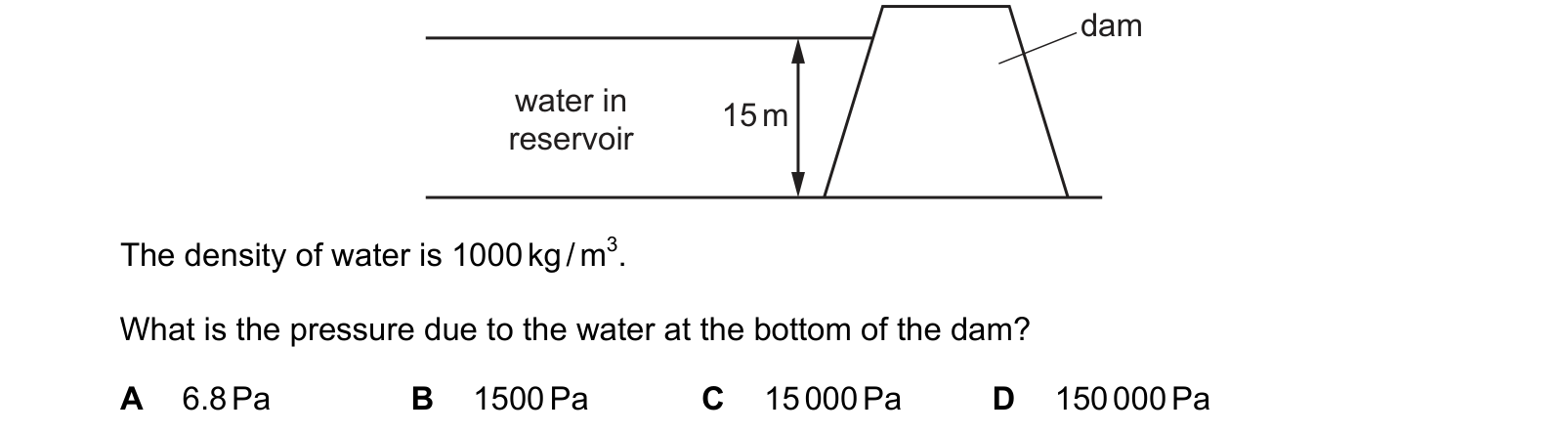
A dam holds water in a reservoir. The height of the water in the reservoir is 15 m. The density of water is 1000 kg / m³. What is the pressure due to the water at the bottom of the dam?
Answer: D.
p = 15 x 1000 x 10 = 150 000 Pa, which is D.
C, 15 000 Pa, is out by a factor of ten, from dropping the g or from a slip in the powers of ten.
B, 1500 Pa, and A are smaller still.
Nothing about the reservoir's width, length or total volume appears in the calculation, and none of it matters. The pressure at the bottom of a dam depends only on how deep the water is, not on how much of it there is. A narrow pond 15 m deep presses on its floor exactly as hard as a reservoir of the same depth stretching for miles.
That is why dams are built thick at the bottom and thin at the top: the pressure grows steadily with depth, so the wall must be strongest where the water is deepest.
For scale, 150 000 Pa is about one and a half atmospheres, which is what 15 m of water adds on top of the air already pressing down.
What this practice covers
These questions are drawn from past CIE 0625 Physics papers and filtered to pressure. You answer, you find out immediately whether you were right, and you get the reasoning for the correct option and for each distractor. Wrong answers go to a mistakes locker so you can come back to exactly those.
Practice is free. You need an account only so your progress and your mistakes are still there next time.
Keep going Paper 1 and Paper 2 MCQs →
What examiners see students get wrong here
These are the errors that cost marks on pressure, taken from our own topic notes. Read them before you practise and you will recognise the traps in the questions.
- Putting a mass in kilograms into p = F/A instead of a weight in newtons.
- Choosing the smallest face when asked for the least pressure.
- Using the height of a block rather than the dimensions of its base.
- Leaving a depth in centimetres in p = hρg.
- Thinking a bigger reservoir or a wider container gives a greater pressure at the bottom.
- Reading a single level on a manometer rather than the difference between the two.
- Including the vacuum space when reading a barometer.
- Giving the pressure change rather than the final pressure, or the other way round, without checking which was asked.
Revise it first
If any of the above is unfamiliar, work through the notes before practising: Pressure revision notes.