102 past-paper questions on this unit. Five of them are below. Answer on the page: each one is marked the moment you pick, the correct option is shown whether or not you found it, and the full explanation opens either way.
CIE 0625 PhysicsPaper 1 and Paper 2 MCQsFree account
Thermal properties and temperature: five questions to try now
Real past-paper questions, the answer key from the mark scheme, and the explanation that goes with it. No account needed to answer them.
Question 1
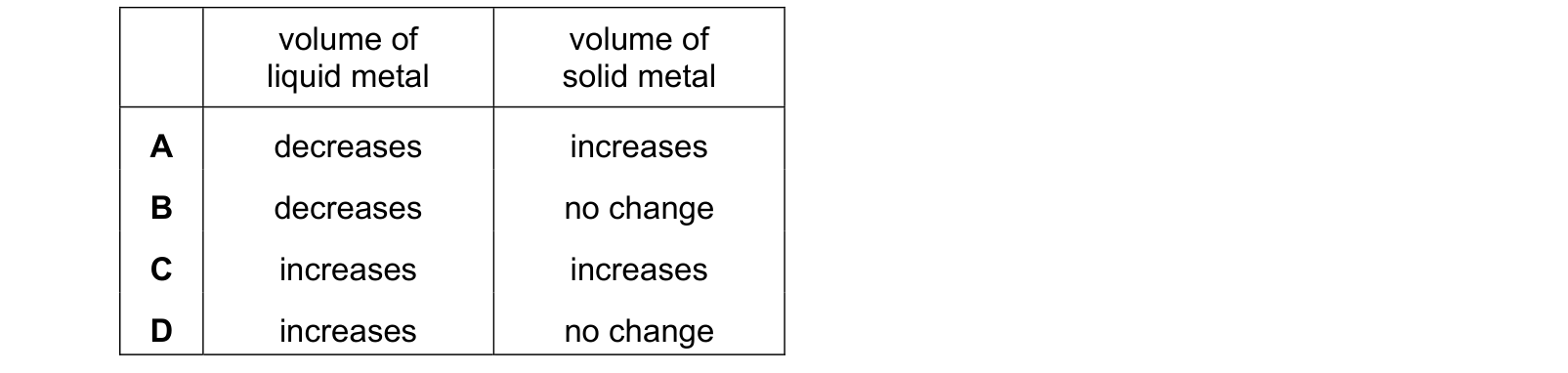
What happens to the volumes of liquid metal and of solid metal when heated at constant pressure? Each answer gives, in order: volume of liquid metal; volume of solid metal.
Answer: C.
Heating any material at constant pressure makes its particles vibrate or move about more vigorously and take up slightly more room on average, so both the liquid metal and the solid metal expand. Increases for both is row C. B and D claim the solid does not change, but solids certainly do expand, which is why railway lines and bridges are built with expansion gaps. A and B have the liquid contracting, and contraction is what cooling produces. For the same temperature rise the liquid expands more than the solid, because its particles are less tightly bound, but the question asks only for the direction of each change.
Question 2
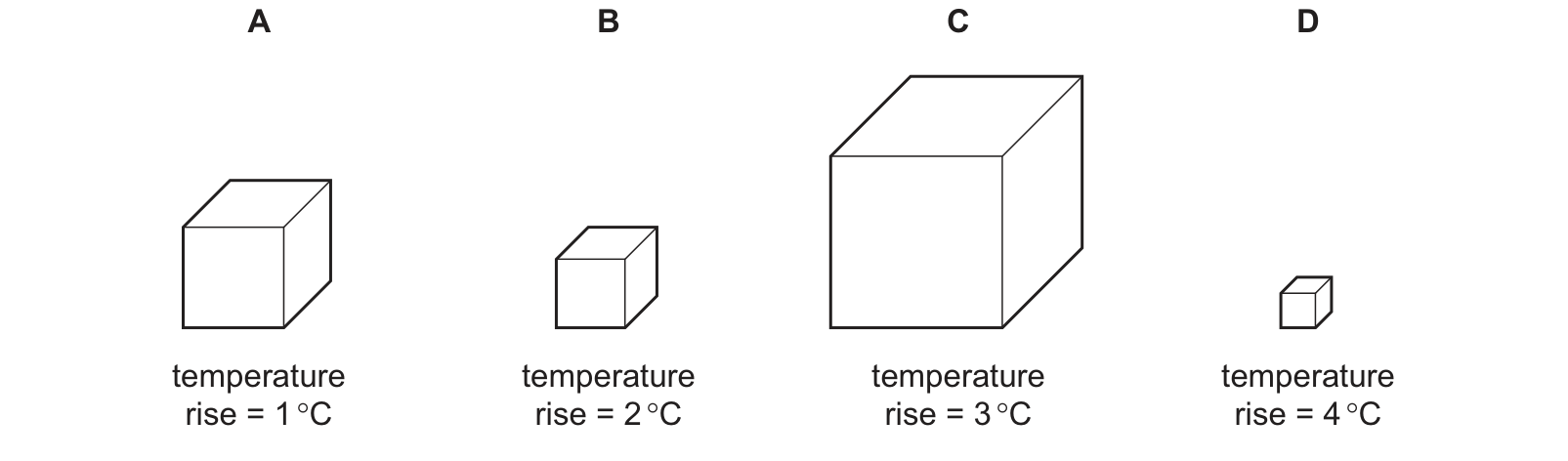
Four different metal blocks are given the same quantity of thermal energy. Which block has the greatest thermal capacity? Use the source image for M20 Paper 12, question 17.
Answer: A.
Thermal capacity is the energy needed to raise an object's temperature by 1 degree C, so it equals E divided by the temperature change. All four blocks in the picture receive the same quantity of energy, so the greatest thermal capacity belongs to the block whose temperature climbed the least. Block A warmed by only 1 degree C, the smallest change of the four, so A has the greatest thermal capacity. C is tempting because it is drawn as much the biggest cube, but size is not what is asked: C gained 3 degrees C from the same energy, so its thermal capacity is only a third of A's. D is the tiniest block and shows the biggest change of 4 degrees C, which makes it the smallest thermal capacity in the set rather than the largest.
Question 3
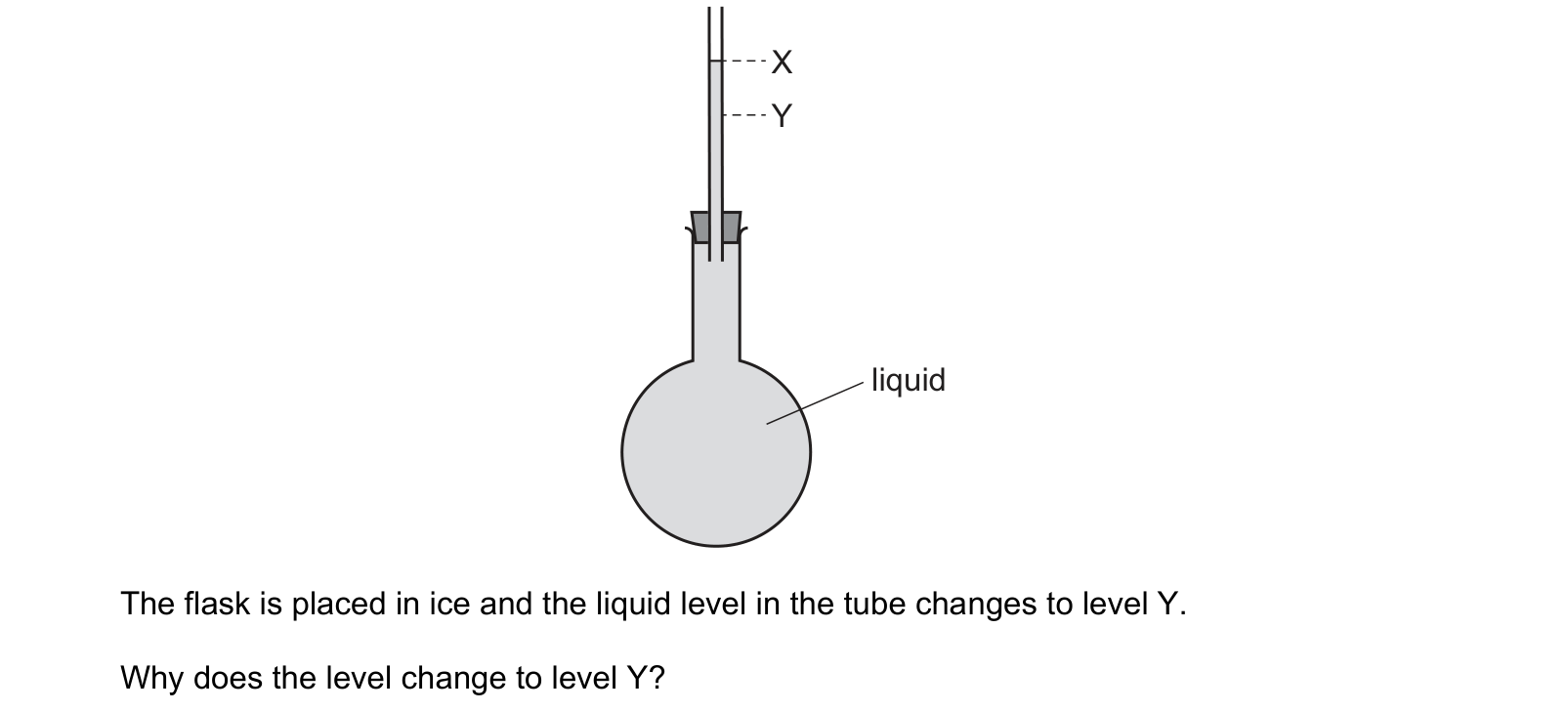
A liquid at room temperature fills a flask and a glass tube to level X. The flask is placed in ice and the liquid level in the tube changes to level Y. Why does the level change to level Y?
Answer: C.
In the diagram X is the upper mark on the tube and Y is the lower one, so putting the flask in ice has made the level fall. Cooling makes the liquid contract, so it occupies less room and its surface drops down the tube, which is C. D has the liquid expanding, and expansion would push the level up instead. A is the subtle trap: the glass flask does contract a little as well, but a smaller flask would squeeze the liquid higher up the tube, so flask contraction pushes the level the wrong way. B has the flask expanding, which cooling does not do, and for the same temperature change the liquid's volume changes far more than the glass, which is why the liquid decides what you see.
Question 4
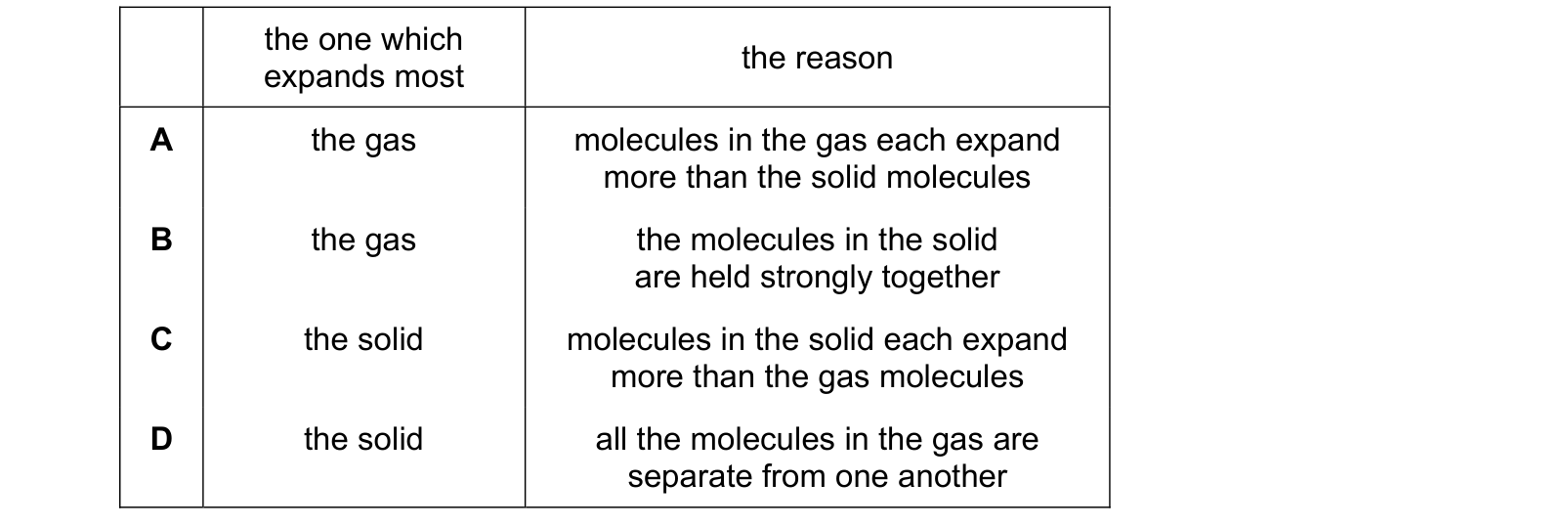
A solid and a gas are each given the same increase in temperature. The gas is kept at a constant pressure. Which row is correct? Each answer gives, in order: the one which expands most; the reason.
Answer: B.
Gases expand far more than solids for the same temperature rise, so the gas is the one that expands most and C and D are out immediately. The reason lies in the forces between the particles: in a solid the molecules are held strongly together, so even vibrating harder they push their neighbours only a tiny bit further apart, while a gas has almost nothing holding its molecules back and can swell freely at constant pressure. Row B gives that reason. A picks the gas but explains it by saying the individual molecules expand, and molecules do not change size when heated: what grows is the space between them. C repeats that error about solid molecules on top of choosing the wrong substance.
Question 5
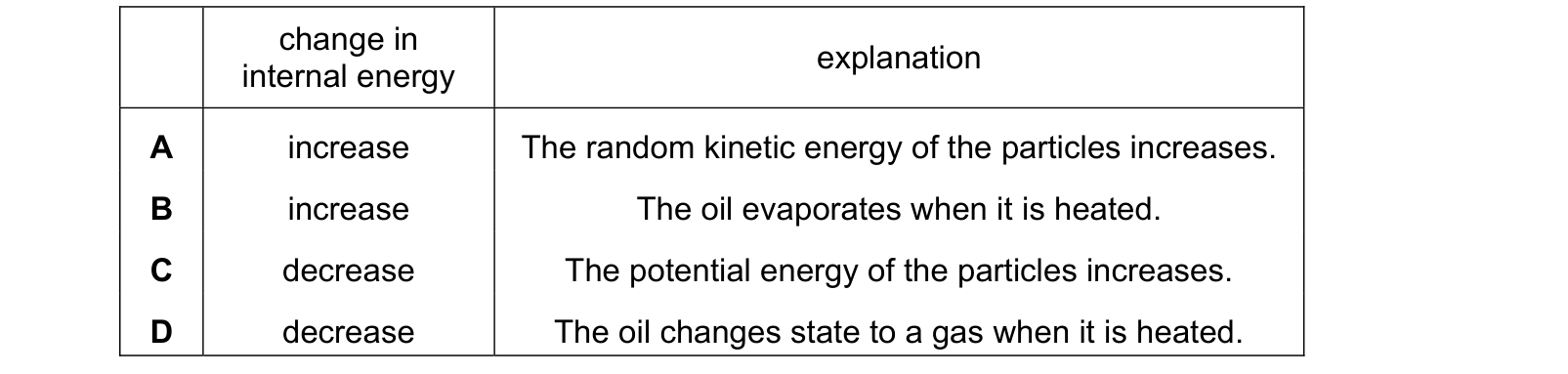
An engineer investigates the increase in temperature of the oil in a car engine when it is first switched on. Which row is correct? Each answer gives, in order: change in internal energy; explanation.
Answer: A.
Internal energy is the total of the kinetic and potential energies of all the particles in the oil, and warming the oil raises it. The mechanism is that the particles move faster in their random motion, so their random kinetic energy goes up, which is exactly row A. C and D both claim the internal energy falls, which cannot happen while the oil is getting hotter. B has the right direction with a wrong mechanism, since engine oil warming up from cold does not evaporate, and any vapour that did form would carry energy away rather than store it. D repeats that mistake with the oil changing to a gas, and oil at warm-up temperatures stays firmly liquid.
These questions are drawn from past CIE 0625 Physics papers and filtered to thermal properties and temperature. You answer, you find out immediately whether you were right, and you get the reasoning for the correct option and for each distractor. Wrong answers go to a mistakes locker so you can come back to exactly those.
Practice is free. You need an account only so your progress and your mistakes are still there next time.
These are the errors that cost marks on thermal properties and temperature, taken from our own topic notes. Read them before you practise and you will recognise the traps in the questions.
Saying the particles themselves expand when a substance is heated.
Using the final temperature instead of the temperature change in E = mcΔθ.
Leaving a mass in grams when c is in J/(kg °C).
Saying the temperature rises during melting or boiling.
Saying a narrower capillary tube increases the range; it increases sensitivity and reduces range.
Saying a bimetallic strip bends towards the metal that expands more.
Forgetting that water contracts between 0 °C and 4 °C.