Cells as the basic units of living organisms: five questions to try now
Real past-paper questions, the answer key from the mark scheme, and the explanation that goes with it. No account needed to answer them.
Question 1
Which row is correct for the structures present in typical plant cells and typical animal cells? Each answer gives, in order: cell structure; plant cell; animal cell.
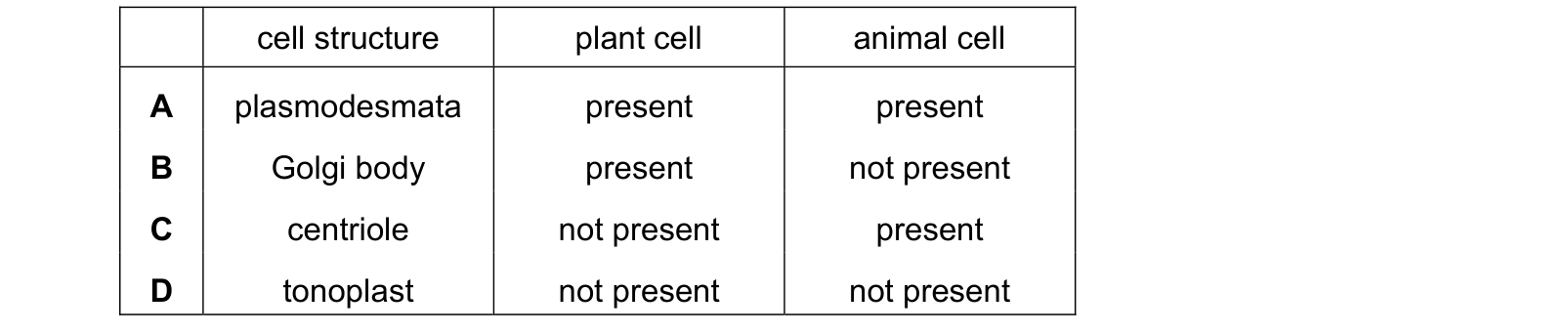
Answer: C.
Plant cells manage mitosis perfectly well without them, forming a spindle from microtubules organised at the poles, which shows centrioles are not essential to the process.
A is wrong on the animal column. Plasmodesmata pass through cell walls, and animal cells have none.
B is wrong because the Golgi body is in both; it is a universal eukaryotic organelle.
D is wrong on the plant column. The tonoplast is the membrane around the large central vacuole, which is a defining plant feature.
Three of the four rows misplace a structure that is genuinely distinctive, which is what makes them plausible.
Question 2
The diagram shows some cell structures of one type of cell. Which labelled cell structures are present in typical eukaryotic cells and typical bacterial cells?
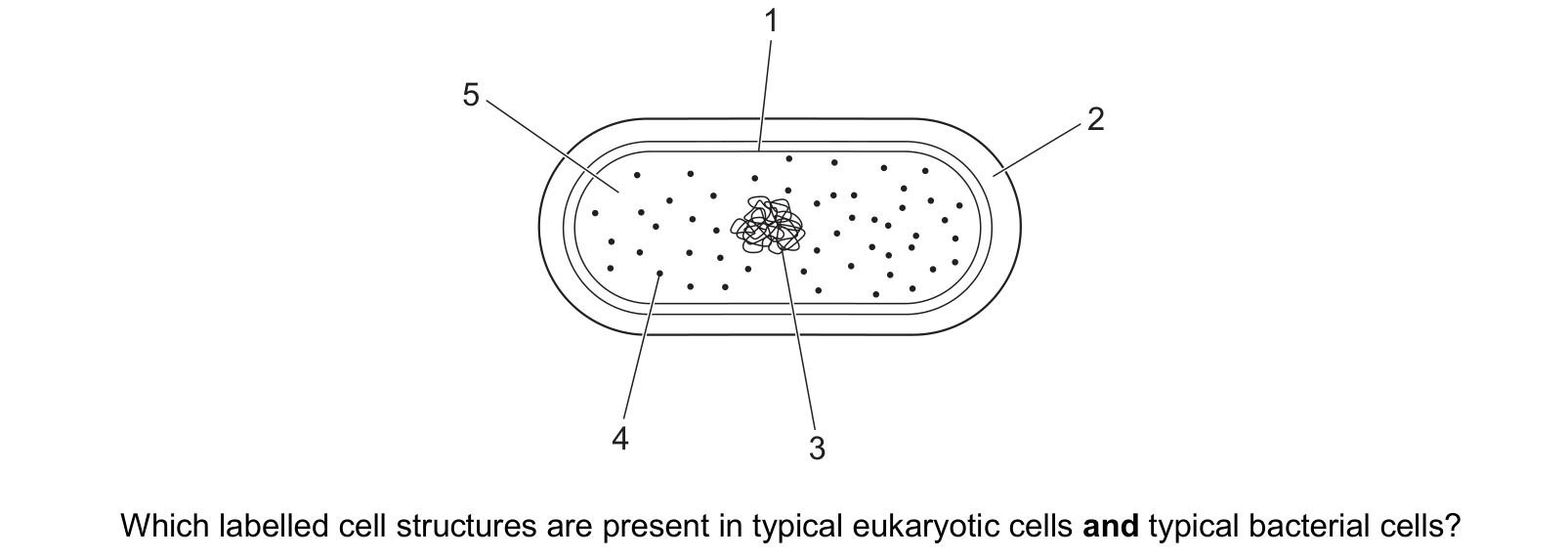
Answer: B.
Now ask which of those a typical eukaryotic cell also has.
1 ribosomes: yes. Every cell that makes protein has them. A bacterium's are 70S and a eukaryote's cytoplasmic ones are 80S, but both are ribosomes.
3 DNA: yes. Bacterial DNA is circular and free in the cytoplasm, eukaryotic DNA is linear and inside a nucleus, but both are DNA.
4 cell surface membrane: yes. No cell of any kind exists without one.
5 cytoplasm: yes.
2 cell wall: no, and that is the whole question. Bacteria have one, made of peptidoglycan. Plants and fungi have one too, but a typical eukaryotic cell is not necessarily a plant cell, and animal cells have no wall at all. So a wall is not something the two kinds of cell share.
1, 3, 4 and 5, which is B.
Notice what is not in the list: no nucleus, no mitochondria, no endoplasmic reticulum, no Golgi. Everything a prokaryote has, a eukaryote has too. The difference runs the other way.
Question 3
Which row shows a comparison that is not correct between a typical prokaryotic cell and a typical eukaryotic plant cell? Each answer gives, in order: prokaryotic cell; eukaryotic plant cell.
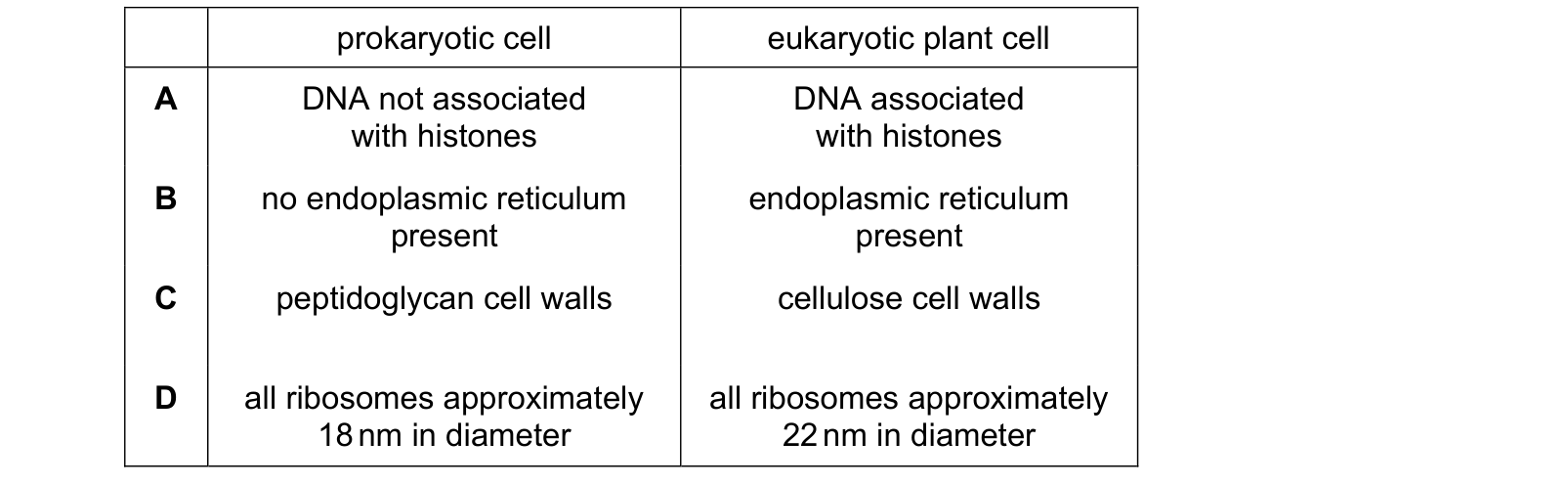
Answer: D.
A eukaryotic plant cell contains two sizes of ribosome: 80S in the cytoplasm, and 70S inside its mitochondria and chloroplasts. So 'all ribosomes approximately 22 nm' is false for a plant cell, whatever the exact figures.
A is a correct comparison: prokaryotic DNA is not wound around histones and eukaryotic DNA is.
B is correct: prokaryotes have no endoplasmic reticulum.
C is correct: bacterial walls are peptidoglycan and plant walls are cellulose.
The question rewards spotting that the smaller ribosome is present in both cell types, which is the same fact the endosymbiotic theory rests on.
Question 4
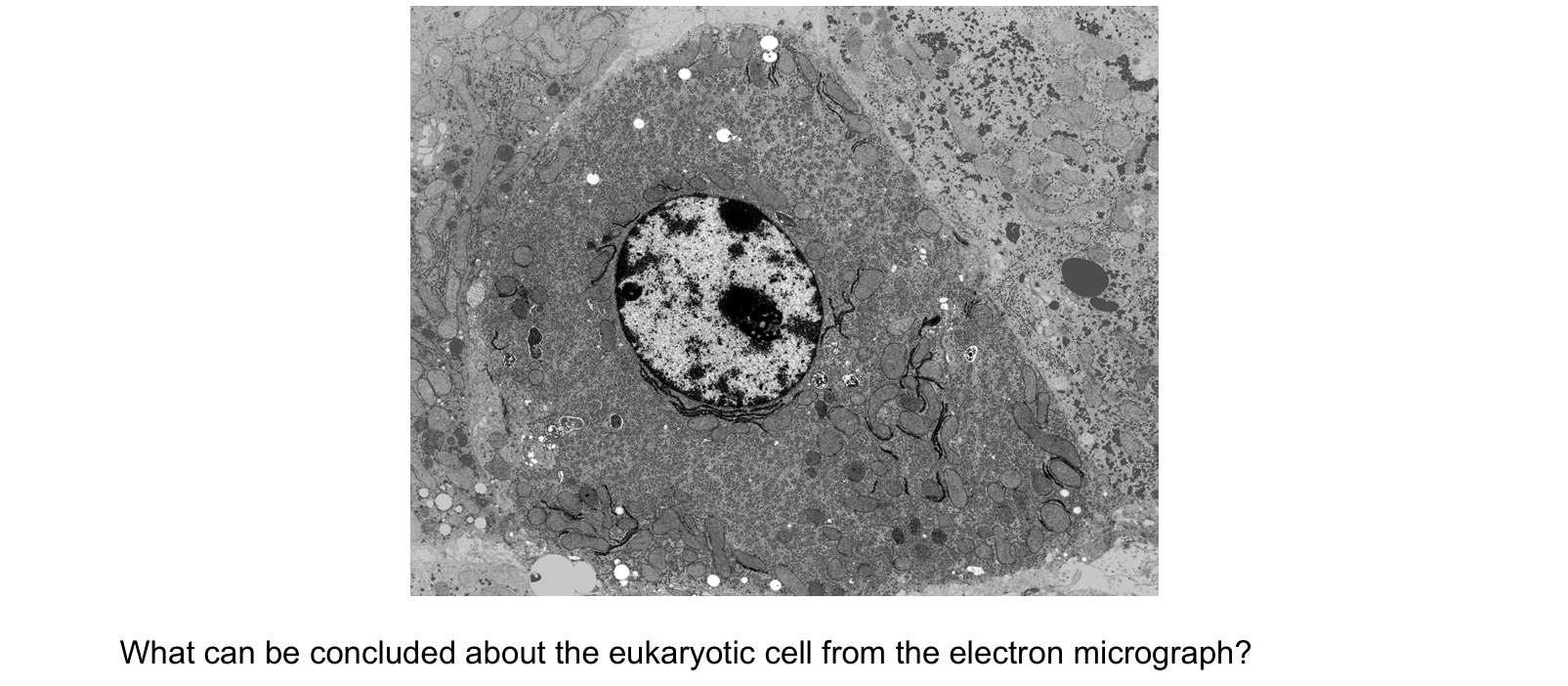
The image is an electron micrograph of a typical eukaryotic cell.
What can be concluded about the eukaryotic cell from the electron micrograph?
Answer: A.
The micrograph shows a nucleus with a nucleolus, mitochondria and endoplasmic reticulum, and at the edge of the cell just a thin membrane. There is no thick rigid layer outside it, so there is no cell wall, and a eukaryotic cell with no cell wall is an animal cell. That is A.
B has the right conclusion and an argument that contradicts it. A large permanent vacuole is a feature of plant cells, so it could never be a reason for calling something an animal cell. There is no permanent vacuole here either.
C and D both conclude plant. There are no chloroplasts in the image, and in any case chloroplasts only appear in the green parts of a plant, so their absence never proves a cell is not a plant cell. Lysosomes are not a plant feature at all; if anything they are more associated with animal cells.
The general point is that an absence is weaker evidence than a presence, with one exception: the cell wall. A plant cell always has one, so its absence is conclusive, and that is exactly the reasoning A uses.
Question 5
Which row is correct for typical prokaryotic cells and mitochondria? Each answer gives, in order: feature; prokaryotic cells; mitochondria.
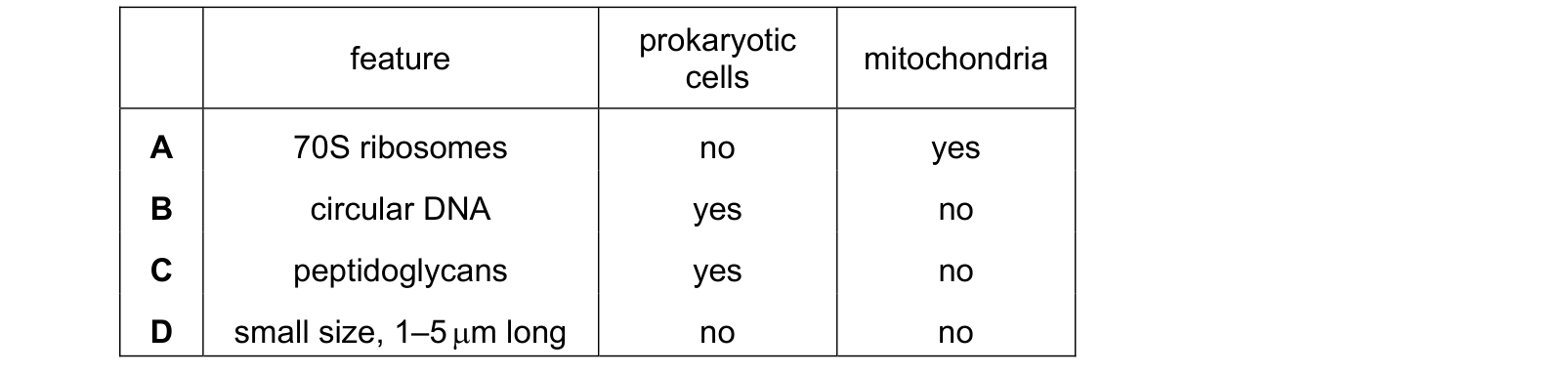
Answer: C.
It is also the feature a mitochondrion lost, and the reason it could afford to. A free-living bacterium needs a wall to resist osmotic pressure; an organelle inside a cell does not.
A is wrong in both columns: 70S ribosomes are in both.
B is wrong in the second: mitochondria have circular DNA too.
D is wrong in both: mitochondria are indeed about 1 to 5 µm, the same size as a bacterium, and so are prokaryotes.
So three rows list a feature the two genuinely share, which is the whole point: the similarities are extensive and the wall is one of the few real differences.
What this practice covers
These questions are drawn from past CIE 9700 Biology papers and filtered to cells as the basic units of living organisms. You answer, you find out immediately whether you were right, and you get the reasoning for the correct option and for each distractor. Wrong answers go to a mistakes locker so you can come back to exactly those.
Practice is free. You need an account only so your progress and your mistakes are still there next time.
What examiners see students get wrong here
These are the errors that cost marks on cells as the basic units of living organisms, taken from our own topic notes. Read them before you practise and you will recognise the traps in the questions.
- Answering "no nucleus" alone for the prokaryote difference, and omitting the absence of membrane-bound organelles.
- Saying prokaryotes have no ribosomes. They have ribosomes, and those ribosomes are 70S.
- Giving centrioles to plant cells, or chloroplasts to every plant cell including root cells.
- Calling the nuclear envelope a single membrane. It is double, and it is pierced by pores.
- Saying a virus is a small cell, or that a virus contains both DNA and RNA.
- Describing the function of the Golgi as "storage". It modifies, packages and exports.
Revise it first
If any of the above is unfamiliar, work through the notes before practising: Cells as the basic units of living organisms revision notes.