Transport of oxygen and carbon dioxide: five questions to try now
Real past-paper questions, the answer key from the mark scheme, and the explanation that goes with it. No account needed to answer them.
Question 1
Which row shows the change in concentration of some substances in red blood cells when carbon dioxide diffuses from active cells? Each answer gives, in order: carbonic anhydrase; hydrogencarbonate ions; hydrogen ions.
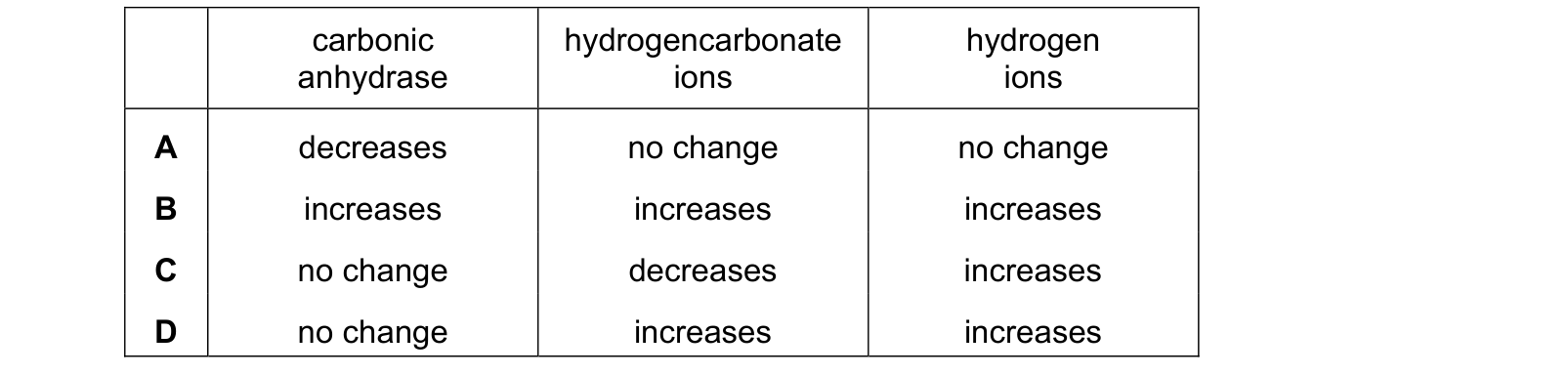
Answer: D.
Carbonic anhydrase catalyses the reaction and is not consumed by it, so no change. That is the one that separates D from the other rows.
Carbon dioxide plus water gives carbonic acid, which dissociates, so both hydrogencarbonate ions increase and hydrogen ions increase.
No change, increases, increases, which is D.
Row B raises the enzyme concentration along with everything else, which would require the cell to be synthesising more enzyme, and a mature red blood cell has no nucleus or ribosomes and cannot make any protein at all.
Question 2
Sulthiame is a molecule that inhibits carbonic anhydrase.
Which effect would sulthiame have inside a red blood cell in muscle tissue that is respiring at a high rate?
Answer: A.
Haemoglobinic acid is haemoglobin that has taken up hydrogen ions, so with fewer available its rate of formation falls, which is A.
B predicts a decrease in pH. Fewer hydrogen ions means the pH would rise inside the cell, not fall.
C predicts more chloride shift. The chloride shift balances the charge of hydrogencarbonate leaving, and less hydrogencarbonate is being made, so it would slow.
D predicts more oxygen released. Oxygen release in the tissues is driven by hydrogen ions through the Bohr effect, so fewer of them means less dissociation, which is the opposite.
Question 3
An increase in carbon dioxide in human blood shifts the oxyhaemoglobin dissociation curve to the right.
What is the explanation for this effect?
Answer: D.
Carbon dioxide dissolves and forms carbonic acid, which dissociates and raises the hydrogen ion concentration. Those hydrogen ions bind to haemoglobin and change its tertiary structure, which lowers its affinity for oxygen so more is released. That is D.
A is about breathing rate, which is a whole-body response and does not act on the haemoglobin molecule.
B has carbon dioxide displacing oxygen. The two bind at different sites: oxygen at the haem groups, carbon dioxide at the amino groups. It is not competition.
C is about the rate of diffusion at the alveolus, which does not change the shape of the dissociation curve.
Question 4
Scientists have shown that the oxygen dissociation curves for haemoglobin of smaller mammals are to the right of those of larger mammals.
What does this suggest about the haemoglobin of smaller mammals?
Answer: C.
That makes biological sense for a small mammal. A shrew has a very high metabolic rate for its size, so its tissues need oxygen unloaded readily, and haemoglobin that gives it up easily is exactly the adaptation for that.
A and B both describe a leftward shift: binding more strongly and saturating at lower partial pressures. That is fetal haemoglobin's property, not a small mammal's.
D confuses the position of the curve with its height. Shifting left or right changes the affinity at a given partial pressure; it does not change how much oxygen a molecule of haemoglobin can carry, which is four either way.
Question 5
Which statement is correct about a red blood cell that has just entered a capillary in a respiring muscle?
Answer: D.
Some of it binds directly to the amino groups of haemoglobin, so there is a net increase in carbaminohaemoglobin, which is D.
A predicts fewer chloride ions. Hydrogencarbonate is leaving the cell, so chloride ions move in to balance the charge: an increase.
B predicts less haemoglobinic acid. More carbon dioxide means more hydrogen ions, so more of it forms: an increase.
C predicts more carbonic anhydrase. It is an enzyme and is not consumed, and a mature red blood cell has no ribosomes to make more, so its concentration cannot rise.
What this practice covers
These questions are drawn from past CIE 9700 Biology papers and filtered to transport of oxygen and carbon dioxide. You answer, you find out immediately whether you were right, and you get the reasoning for the correct option and for each distractor. Wrong answers go to a mistakes locker so you can come back to exactly those.
Practice is free. You need an account only so your progress and your mistakes are still there next time.
What examiners see students get wrong here
These are the errors that cost marks on transport of oxygen and carbon dioxide, taken from our own topic notes. Read them before you practise and you will recognise the traps in the questions.
- Saying haemoglobin carries four oxygen atoms. It carries four molecules, so eight atoms.
- Reading a right shift as higher affinity. Right means lower affinity and easier release.
- Saying carbon dioxide binds to the haem group. Oxygen binds to haem; carbon dioxide binds to the amino groups of the protein.
- Saying the Bohr effect is caused by carbon dioxide directly. It works through the hydrogen ions produced from it.
- Saying fetal haemoglobin has a lower affinity so oxygen passes to it. It is higher.
Revise it first
If any of the above is unfamiliar, work through the notes before practising: Transport of oxygen and carbon dioxide revision notes.