Business ownership and legal form: two questions to try now
Real past-paper questions, the answer key from the mark scheme, and the explanation that goes with it. No account needed to answer them.
Question 1
Which row correctly describes an advantage and a disadvantage of a partnership? Each answer gives, in order: advantage; disadvantage.
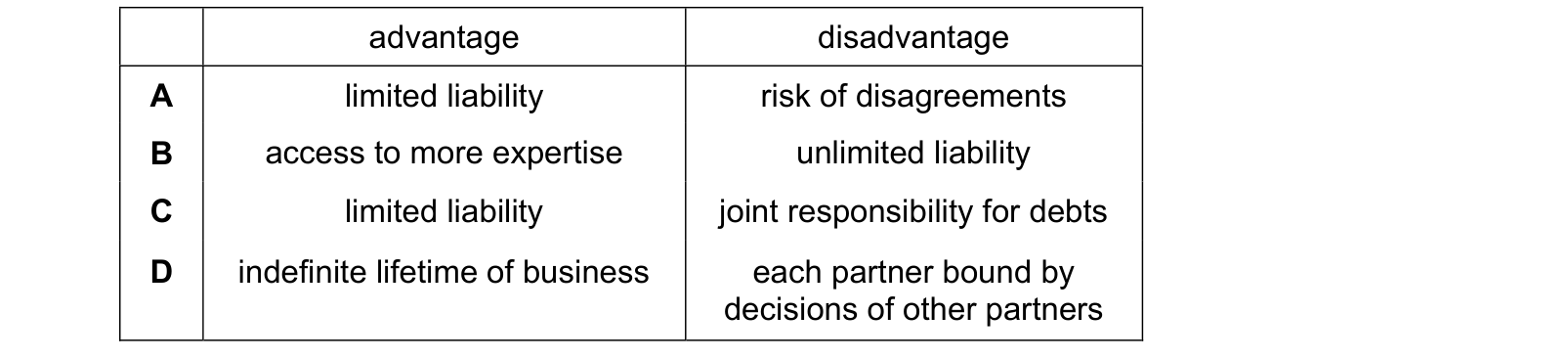
Answer: B.
Question 2
Joe is a sole trader. Which statement(s) relating to his business are not correct?
1 Joe can receive a bank loan for the business.
2 Joe’s drawings are transferred to his capital account.
3 Joe’s personal expenses are included in his income statement.
Answer: D.
What this practice covers
These questions are drawn from past CIE 9706 Accounting papers and filtered to business ownership and legal form. You answer, you find out immediately whether you were right, and you get the reasoning for the correct option and for each distractor. Wrong answers go to a mistakes locker so you can come back to exactly those.
Practice is free. You need an account only so your progress and your mistakes are still there next time.
What examiners see students get wrong here
These are the errors that cost marks on business ownership and legal form, taken from our own topic notes. Read them before you practise and you will recognise the traps in the questions.
- Saying limited liability means the company is not liable for its debts.
- Treating a sole trader's drawings, or a company's dividends, as an expense.
- Saying a public limited company is owned by the government.
- Giving a sole trader a salary in the income statement.
- Confusing the capital of a partnership with the current accounts of the partners.
- Saying a partnership has separate legal identity.
Revise it first
If any of the above is unfamiliar, work through the notes before practising: Business ownership and legal form revision notes.