Business ownership and legal form
Contents: 7 sections
The three forms
| Sole trader | Partnership | Limited company | |
|---|---|---|---|
| Owners | One | Usually 2 to 20 | Shareholders, any number |
| Legal identity | Same as owner | Same as partners | Separate from owners |
| Liability | Unlimited | Usually unlimited | Limited to amount unpaid on shares |
| Capital raised from | Owner and loans | Partners and loans | Shares, debentures and loans |
| Accounts published? | No | No | Yes, for a public company |
| Profit belongs to | The owner | Shared per the agreement | The company, until a dividend is declared |
The row that drives almost everything else is separate legal identity. A company is a legal person in its own right: it owns the assets, owes the debts, and can sue and be sued. A sole trader and their business are the same person in law, which is why the owner's private assets are at risk.
Limited and unlimited liability
Unlimited liability means the owner is personally responsible for all the debts of the business. If the business cannot pay, creditors can pursue the owner's house, car and savings.
Limited liability means a shareholder can lose at most what they agreed to pay for their shares. Once shares are fully paid, the shareholder owes nothing further, whatever the company owes.
Two things this does not mean, and both are examined:
- Limited liability does not limit the company's liability. The company owes its debts in full; it is the shareholders who are protected.
- Limited liability does not mean the company is low risk. It shifts risk from the shareholders to the creditors, which is precisely why companies must publish accounts and sole traders need not.
Private and public companies
- A private limited company (Ltd) cannot offer shares to the general public. Shares are usually transferred privately, often within a family.
- A public limited company (plc) may offer shares to the public and may be listed on a stock exchange. It faces stricter disclosure requirements and a higher minimum share capital.
Being a plc does not mean being state-owned, and it does not mean the shares are listed. Those are separate questions.
Why the legal form changes the accounts
The financial statements differ in the capital section, and hardly anywhere else. The trading and profit calculation is much the same for all three.
- A sole trader has one capital account: opening capital, plus profit, less drawings.
- A partnership has a capital account and usually a current account for each partner, plus an appropriation account that divides the profit.
- A company has share capital, share premium, reserves and retained earnings. The owners take dividends, not drawings, and dividends are an appropriation of profit rather than an expense.
That last distinction is worth holding on to. A sole trader's drawings and a company's dividends both take value out to the owners, and neither is ever an expense in the income statement.
Directors' salaries are an expense, because directors are employees of the company. A sole trader cannot pay themselves a salary in the accounting sense, because they cannot be their own employee; what looks like a wage is drawings.
Advantages and disadvantages
Sole trader: quick and cheap to set up, complete control, privacy. Against that, unlimited liability, limited capital, and the business ends with the owner.
Partnership: more capital and shared expertise, and the workload is spread. Against that, unlimited liability, profits are shared, and one partner's actions bind the others.
Limited company: limited liability, easier to raise large capital, continuity beyond any individual. Against that, formation and filing costs, public disclosure, and a separation between ownership and control that can create conflicts.
Common mistakes
- Saying limited liability means the company is not liable for its debts.
- Treating a sole trader's drawings, or a company's dividends, as an expense.
- Saying a public limited company is owned by the government.
- Giving a sole trader a salary in the income statement.
- Confusing the capital of a partnership with the current accounts of the partners.
- Saying a partnership has separate legal identity.
Check you have it
Question 1
Which row correctly describes an advantage and a disadvantage of a partnership? Each answer gives, in order: advantage; disadvantage.
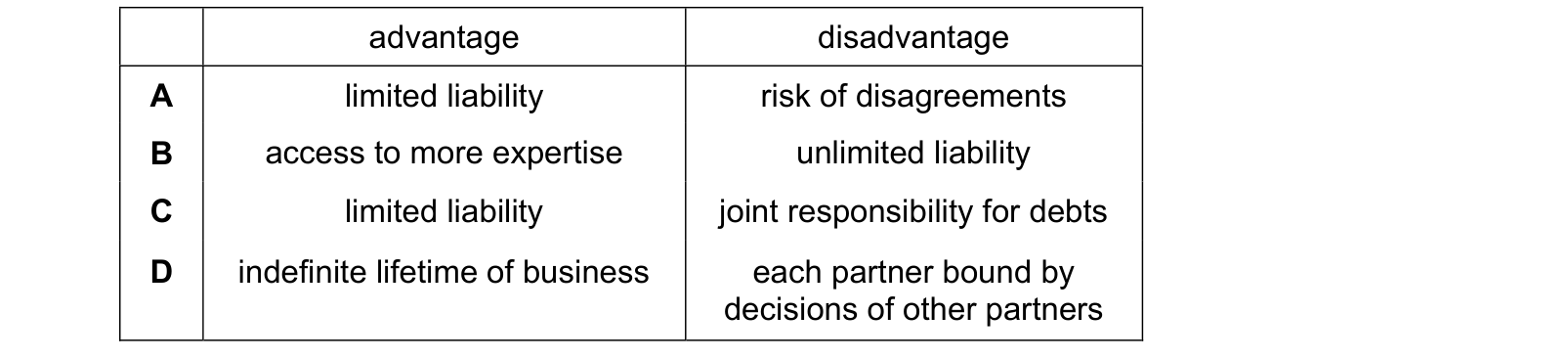
Answer: B.
Question 2
Joe is a sole trader. Which statement(s) relating to his business are not correct?
1 Joe can receive a bank loan for the business.
2 Joe’s drawings are transferred to his capital account.
3 Joe’s personal expenses are included in his income statement.
Answer: D.
What the syllabus asks for on this topicSyllabus points
Syllabus points
- Describe the features of sole traders, partnerships and limited companies.
- Explain limited and unlimited liability, and the concept of separate legal identity.
- Distinguish private limited companies from public limited companies.
- Explain how the legal form of a business affects the financial statements it prepares.
Related CIE 9706 Accounting topics
Not the topic you were looking for? Describe what you are stuck on in your own words and we will take you to the notes that answer it.