Materials and inventory valuation
Contents: 7 sections
The problem the methods solve
When identical materials are bought at different prices, the physical items cannot be told apart, so the business must assume an order in which they are used. The assumption changes the cost of the issue, and therefore both the profit and the closing inventory figure.
Two methods are examinable.
FIFO, first in first out, assumes the oldest goods are issued first. Closing inventory is therefore made up of the most recent purchases.
AVCO, average cost, recalculates a weighted average cost after every receipt, and issues at that average.
LIFO, last in first out, is not permitted for financial statements. It can be mentioned in a comparison, but it must not be used to value inventory.
A stores ledger card
Opening inventory 100 units at $10. Then: buy 200 at $12, issue 250, buy 150 at $14, issue 100.
Under FIFO
The issue of 250 takes the 100 oldest units at $10, which is $1 000, then 150 units at $12, which is $1 800, a total issue cost of $2 800. That leaves 50 units at $12.
After buying 150 at $14, the inventory is 50 at $12 plus 150 at $14.
The issue of 100 takes the 50 at $12, which is $600, then 50 at $14, which is $700, a total of $1 300.
Closing inventory is 100 units at $14, which is $1 400.
Under AVCO
Opening is 100 at $10, which is $1 000. Buying 200 at $12 adds $2 400, giving 300 units costing $3 400, so the average is $11.333 per unit.
The issue of 250 costs 250 times 11.333, which is $2 833 to the nearest dollar. Remaining: 50 units, costing $567.
Buying 150 at $14 adds $2 100, giving 200 units costing $2 667, so the new average is $13.333.
The issue of 100 costs $1 333, leaving 100 units at $13.333, so closing inventory is $1 333.
The comparison
FIFO gives a closing inventory of $1 400 and AVCO gives $1 333. Total issue costs are $4 100 under FIFO and $4 167 under AVCO. The difference in closing inventory, $67, is exactly the difference in issue costs, because the same total of $5 500 has been divided two ways.
Which gives the higher profit
The whole comparison hangs on one thing: the direction prices are moving.
| Prices are | FIFO issues | FIFO closing inventory | FIFO profit |
|---|---|---|---|
| Rising | Older, cheaper | Recent, higher | Higher |
| Falling | Older, dearer | Recent, lower | Lower |
AVCO sits between the two in both cases, because averaging smooths out the movement.
Do not memorise "FIFO gives higher profit". It is true only when prices are rising, which questions rely on.
Comparing the methods
FIFO. It follows the physical flow of most real inventories, especially perishables, so the closing inventory figure is close to current cost and therefore realistic in the statement of financial position. Against that, the cost charged against revenue is out of date, and in a period of rising prices profit is flattered by matching old costs against current selling prices.
AVCO. It smooths out price fluctuations, so profit is less erratic, and it does not require identical items to be tracked in batches. Against that, the average rarely equals any price actually paid, and the recalculation after every receipt is more work.
Consistency applies. A business may not switch methods to suit the profit it wants to report.
The rule for the financial statements
Whichever method produced the cost, the closing inventory in the financial statements is valued at the lower of cost and net realisable value, applied line by line. So FIFO or AVCO gives the cost, and prudence may then reduce it.
Net realisable value is the expected selling price less any costs still to be incurred to make the sale.
Getting the inventory figure wrong hits both statements. Overvaluing closing inventory understates cost of sales, so profit and current assets are both overstated, and next year's opening inventory is then too high, so next year's profit is understated. One error, three misstatements.
Common mistakes
- Using LIFO to value inventory in the financial statements.
- Recalculating the AVCO average after an issue. The average changes only when goods are received.
- Valuing closing inventory at selling price.
- Saying FIFO always gives a higher profit, without naming rising prices.
- Applying the lower of cost and net realisable value to the total rather than to each line.
- Forgetting that the two methods give the same total cost over the life of the business. They only change which period the cost falls in.
Check you have it
Question 1
The inventory movements of a business in a three-month period are shown. receipts issues month cost per units units unit January 100 $5 January 200 $6 February 50 March 200 The business uses the first in first out (FIFO) method of inventory valuation. What was the value of inventory at the end of March?
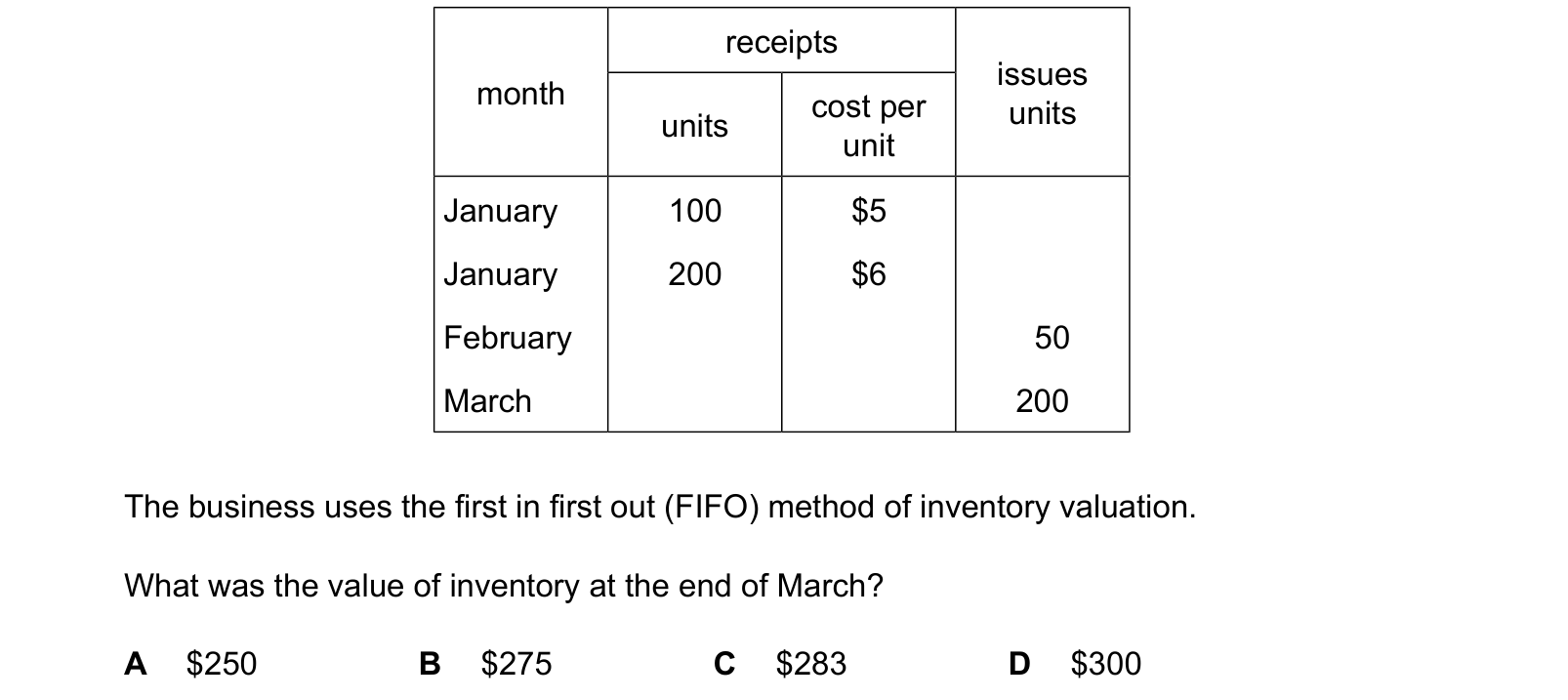
Answer: D.
Question 2
A business uses the weighted average cost (AVCO) method of inventory valuation.
date units $ per unit
1 September purchased 50 4.00
10 September purchased 30 4.80
21 September sold 15
What was the cost of each unit sold?
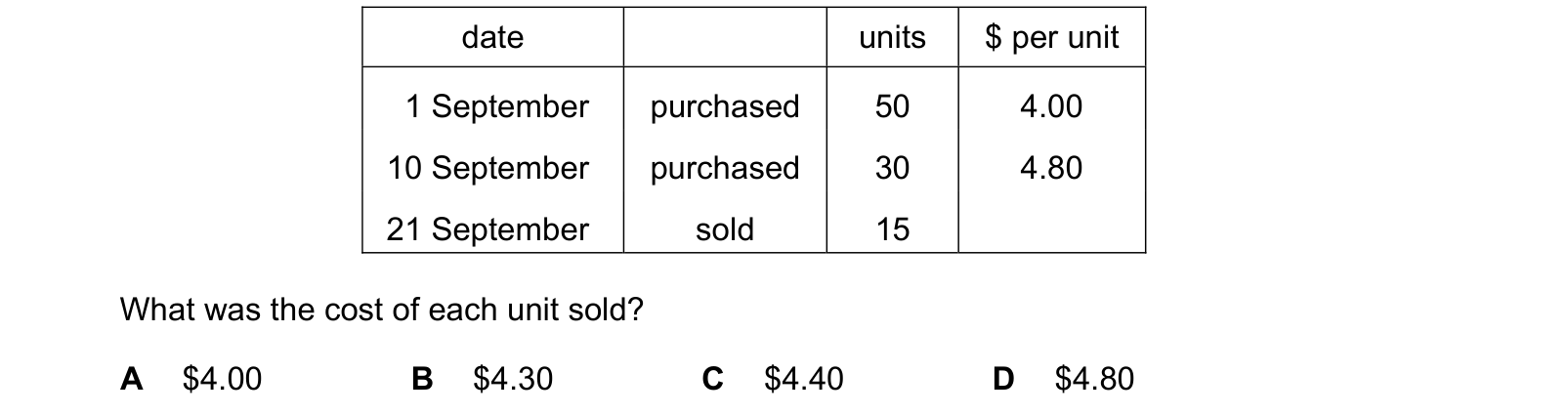
Answer: B.
Question 3
A business commenced trading on 1 January. The purchases and sales of inventory for January were as follows:
date purchases sales
January 4 3 at $200 each – 13 – 2 at $400 each
26 3 at $250 each – 28 – 2 at $400 each
The business used the first in first out (FIFO) method of inventory valuation.
What was the gross profit for January?
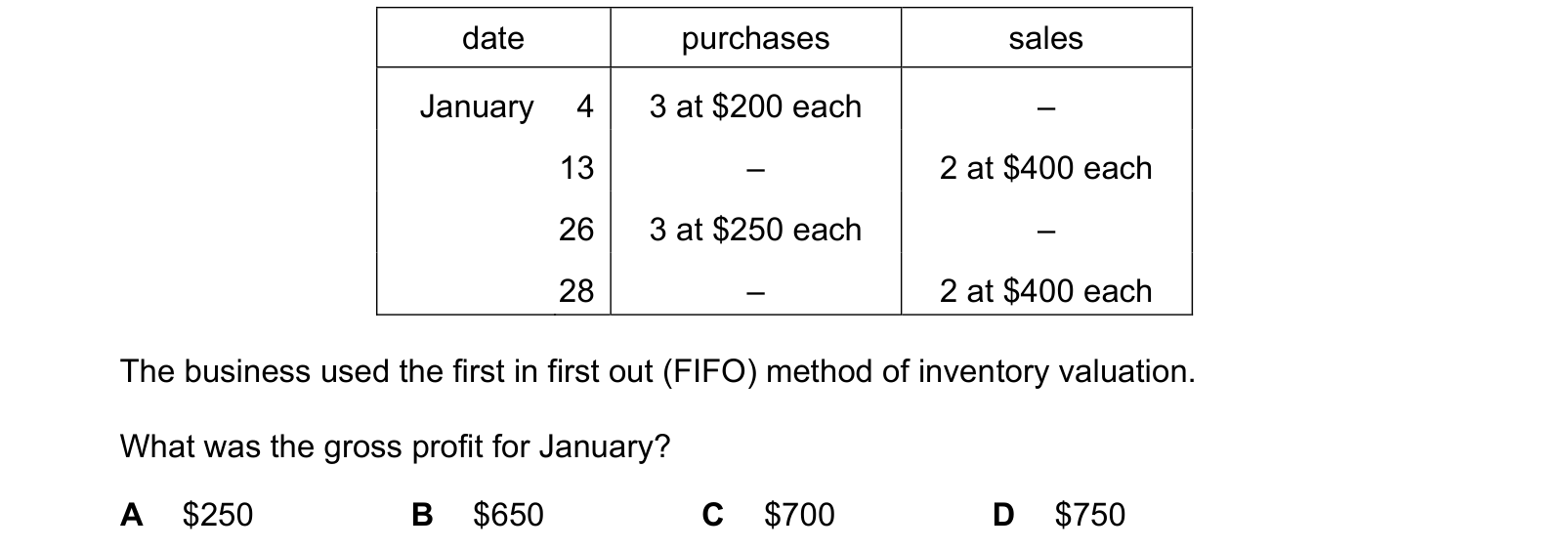
Answer: D.
What the syllabus asks for on this topicSyllabus points
Syllabus points
- Value inventory issues and closing inventory using FIFO and AVCO.
- Prepare a stores ledger card.
- Compare the methods and explain their effect on profit.
- Explain the valuation rule for closing inventory in the financial statements.
Related CIE 9706 Accounting topics
Not the topic you were looking for? Describe what you are stuck on in your own words and we will take you to the notes that answer it.