27 past-paper questions on this unit. Five of them are below. Answer on the page: each one is marked the moment you pick, the correct option is shown whether or not you found it, and the full explanation opens either way.
CIE 9706 AccountingPaper 1 MCQsFree account
Materials and inventory valuation: five questions to try now
Real past-paper questions, the answer key from the mark scheme, and the explanation that goes with it. No account needed to answer them.
Question 1
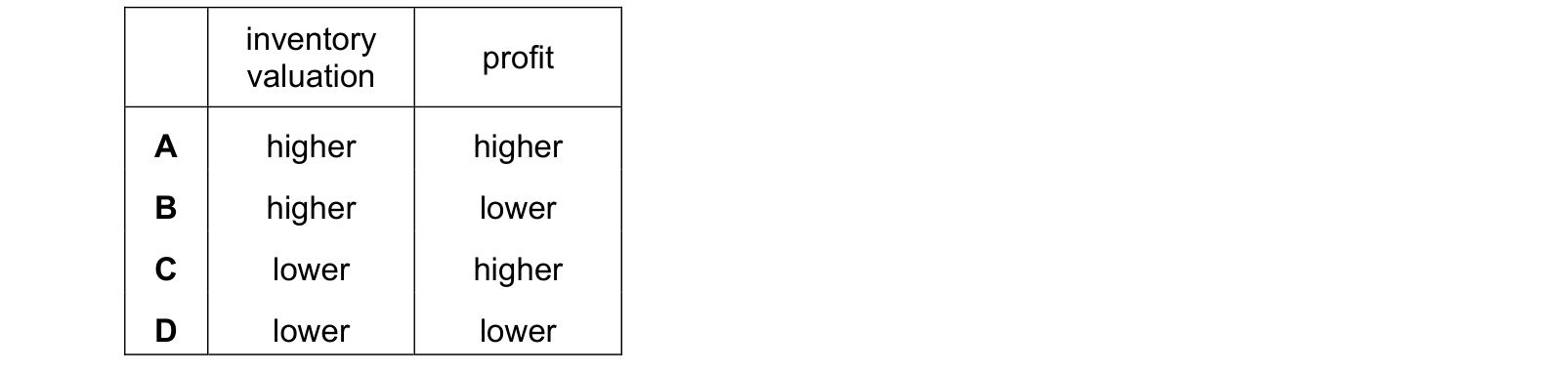
Inventory cost prices are rising for a business. The company uses AVCO rather than FIFO to value its inventory. What is the effect on inventory valuation and profit of using AVCO rather than FIFO? Each answer gives, in order: inventory valuation; profit.
Answer: D.
When prices are rising, FIFO issues the oldest and cheapest units first, so what remains in inventory is the newest and dearest, and FIFO therefore gives the higher closing valuation. AVCO blends the old cheap units with the new dear ones, so its closing valuation sits below the FIFO figure, making inventory valuation LOWER. A lower closing inventory means a higher cost of sales, and a higher cost of sales means a smaller gross profit, so profit is lower too, which is D. B and C split the pair, but the two always move in the same direction, because closing inventory is deducted in arriving at cost of sales. A puts AVCO above FIFO, which happens only when prices are FALLING.
Question 2
Julia is a retailer of electronic equipment. She decides to introduce a system of just-in-time inventory management. Which benefit can she expect from this?
Answer: A.
Just in time keeps almost no inventory, so Julia is never left holding old stock when a manufacturer releases an improved model, and she can switch to it at once. That responsiveness is the benefit. The other options describe the advantages of holding MORE inventory: buying in bulk earns bigger trade discounts, stockpiling before a price rise limits its effect, and a buffer stock protects against shortages. Just in time deliberately gives all three up in exchange for lower holding costs and flexibility.
Question 3
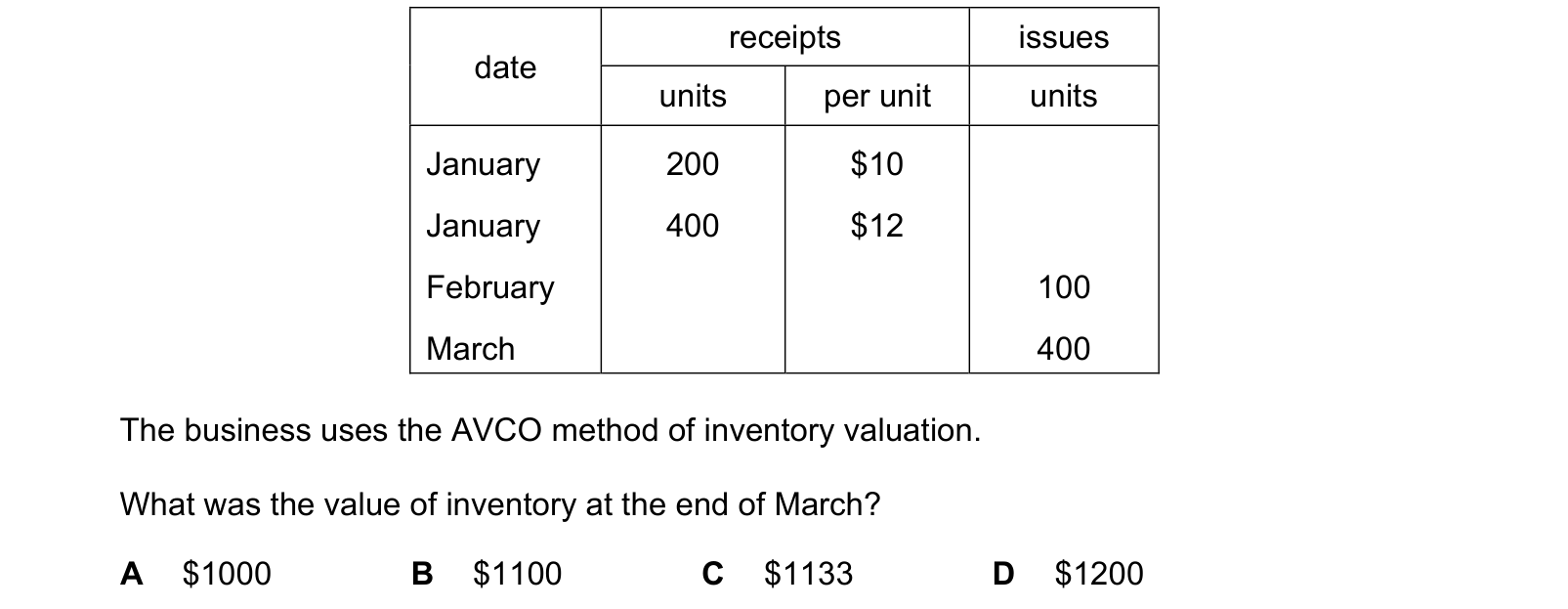
The inventory movements of a business in a three-month period are shown. receipts issues date units per unit units January 200 $10 January 400 $12 February 100 March 400 The business uses the AVCO method of inventory valuation. What was the value of inventory at the end of March?
Answer: C.
AVCO recalculates a weighted average cost every time goods come in. The two January receipts give 600 units costing $2000 plus $4800, so $6800, and $6800 over 600 units is $11.33 per unit. The February issue of 100 units and the March issue of 400 both leave at that same $11.33, since no later receipt arrived to change the average, and 600 less 500 leaves 100 units at $11.33, which is $1133, answer C. D of $1200 values the remaining units at $12, which is what FIFO would give, and A of $1000 values them at $10, which is the LIFO figure. B of $1100 takes a plain average of $10 and $12 without weighting for the 200 and 400 units bought, and weighting is the whole point: the 400 units at the higher price count twice as heavily.
Question 4
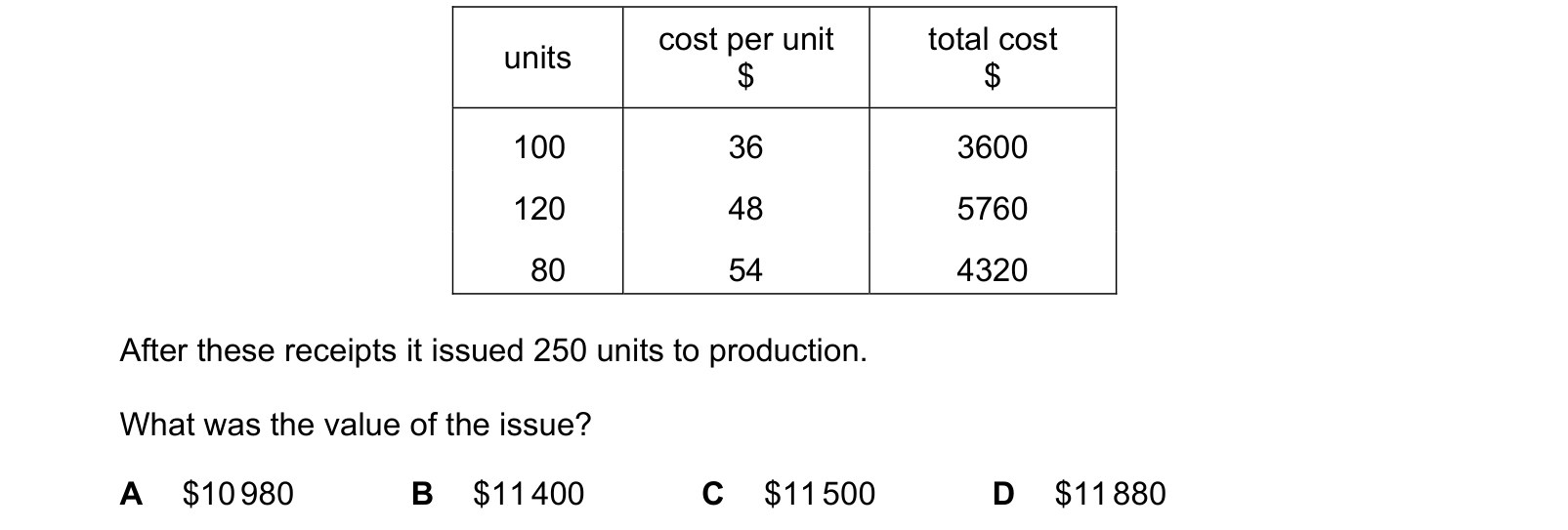
A business uses the weighted average (AVCO) method to value its inventory. It purchased the following units of inventory. cost per unit total cost units $ $ 100 36 3600 120 48 5760 80 54 4320 After these receipts it issued 250 units to production. What was the value of the issue?
Answer: B.
AVCO values every issue at one weighted average struck across all the goods held. The three receipts are 300 units in total costing $3600 plus $5760 plus $4320, which is $13 680, and $13 680 over 300 units is $45.60 per unit. The issue of 250 units is therefore 250 times $45.60, which is $11 400, answer B. C of $11 500 averages the three unit prices of $36, $48 and $54 to get $46, ignoring that far more units were bought at $48 than at either of the others. A of $10 980 is the FIFO answer, taking the 100 at $36, the 120 at $48 and 30 at $54, and D of $11 880 is LIFO, working down from the $54 batch instead.
Question 5
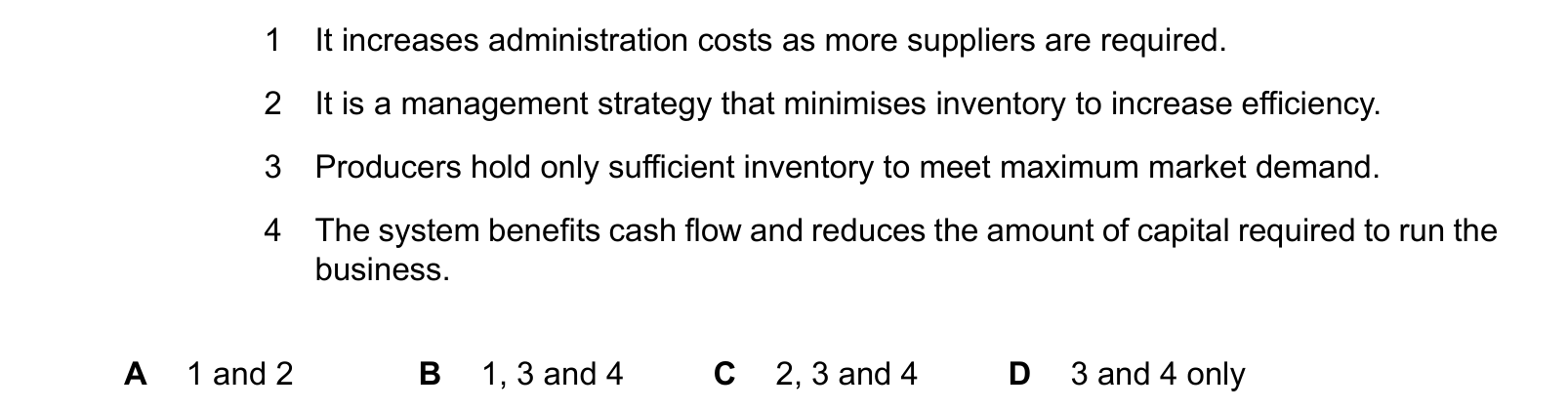
Which statements describe just in time (JIT) management of inventory?
Answer: C.
2, 3 and 4. Just in time is exactly a strategy of holding as little inventory as possible, ordering only what current demand needs, and the money not tied up in stock stays available, which eases cash flow and cuts the capital the business must fund. Statement 1 gets the supplier relationship backwards: just in time depends on FEWER suppliers, chosen for reliability and close coordination, because deliveries have to arrive exactly when required. Spreading orders across many suppliers is what a business does when it is buying in bulk for storage.
These questions are drawn from past CIE 9706 Accounting papers and filtered to materials and inventory valuation. You answer, you find out immediately whether you were right, and you get the reasoning for the correct option and for each distractor. Wrong answers go to a mistakes locker so you can come back to exactly those.
Practice is free. You need an account only so your progress and your mistakes are still there next time.
These are the errors that cost marks on materials and inventory valuation, taken from our own topic notes. Read them before you practise and you will recognise the traps in the questions.
Using LIFO to value inventory in the financial statements.
Recalculating the AVCO average after an issue. The average changes only when goods are received.
Valuing closing inventory at selling price.
Saying FIFO always gives a higher profit, without naming rising prices.
Applying the lower of cost and net realisable value to the total rather than to each line.
Forgetting that the two methods give the same total cost over the life of the business. They only change which period the cost falls in.