Classification and behaviour of costs
Contents: 7 sections
Three ways to classify the same cost
Every cost can be sorted three different ways, and the question tells you which one it wants.
By element: materials, labour, other expenses.
By function: production, administration, selling and distribution, finance.
By behaviour: fixed, variable, semi-variable, stepped.
A factory supervisor's wage is labour by element, production by function, and fixed by behaviour. All three are true at once, and answering with the wrong classification loses the mark even though the description is accurate.
Direct and indirect
Direct costs can be traced to one unit of output: the timber in a table, the wages of the carpenter who made it, a royalty paid per unit.
Indirect costs, together called overheads, cannot be traced to a single unit: factory rent, the supervisor's salary, machine maintenance, the glue used across a hundred tables.
Prime cost is the total of the direct costs: direct materials plus direct labour plus direct expenses.
Glue is the useful example. It is physically in the product, so it looks direct, but tracing it to one table costs more than the glue is worth, so it is treated as an indirect material. Traceability in practice, not in principle, is the test.
Fixed, variable, semi-variable, stepped
Variable costs change in total in proportion to output, and stay constant per unit. Direct materials, direct labour paid per piece, power used by machines.
Fixed costs stay the same in total whatever the output, and therefore fall per unit as output rises. Rent, insurance, straight-line depreciation, salaries.
The pair of sentences above is the most examined idea in the topic, and it is easy to state backwards. Say it as a table and it stays straight:
| Total | Per unit | |
|---|---|---|
| Variable cost | Rises with output | Constant |
| Fixed cost | Constant | Falls as output rises |
Semi-variable costs, also called mixed costs, have both parts: a telephone bill with a line rental plus a charge per call, or a delivery van with road tax plus fuel.
Stepped fixed costs are fixed over a range and then jump: one supervisor can handle up to 20 workers, so a twenty-first worker adds a whole extra salary.
All of this holds only within the relevant range, the span of output the business normally operates in. Double the output and the rent is no longer fixed, because another factory would be needed.
The high-low method
Semi-variable costs must be split before any marginal costing can be done. The high-low method uses only the highest and lowest output levels.
variable cost per unit = (cost at highest output − cost at lowest output) / (highest output − lowest output)
Then substitute back into either level to find the fixed element.
Output of 8 000 units cost $54 000; output of 3 000 units cost $29 000.
The difference in cost is 54 000 minus 29 000, which is $25 000, over a difference in output of 5 000 units. The variable cost per unit is 25 000 divided by 5 000, which is $5.
At the high point, the variable cost is 8 000 times 5, which is $40 000, so the fixed cost is 54 000 minus 40 000, which is $14 000.
Check it at the low point: 3 000 times 5 is 15 000, plus 14 000, which is $29 000. It agrees, and checking the second point takes ten seconds and catches most arithmetic slips.
The method's weakness is worth a sentence in a written answer: it uses two observations and ignores every other one, so an unusual month at either extreme distorts the result, and it assumes a straight line where the real relationship may not be.
Other classifications examined
- Product costs attach to the goods and sit in inventory until sold. Period costs are charged in the period they arise. This is why factory rent ends up inside closing inventory while office rent does not.
- Controllable costs can be influenced by a particular manager; uncontrollable costs cannot. A manager should be judged only on the first.
- Relevant costs are future cash flows that change with the decision. Sunk costs, already spent, are never relevant.
- Opportunity cost is the benefit given up by choosing one option over the next best one. It appears in no ledger and still belongs in a decision.
Common mistakes
- Saying fixed costs are constant per unit, or that variable costs are constant in total.
- Calling every material cost direct.
- Forgetting that classifications depend on the purpose, so one cost can be direct for a department and indirect for a unit.
- Using an output level other than the true highest and lowest in the high-low method.
- Finding the variable cost and stopping, without substituting back for the fixed element.
- Including a sunk cost in a decision.
- Ignoring the relevant range when saying a fixed cost never changes.
Check you have it
Question 1
Which costs increase when a home business doubles output and rents a workshop? Use the complete source image for the figures and answer choices.
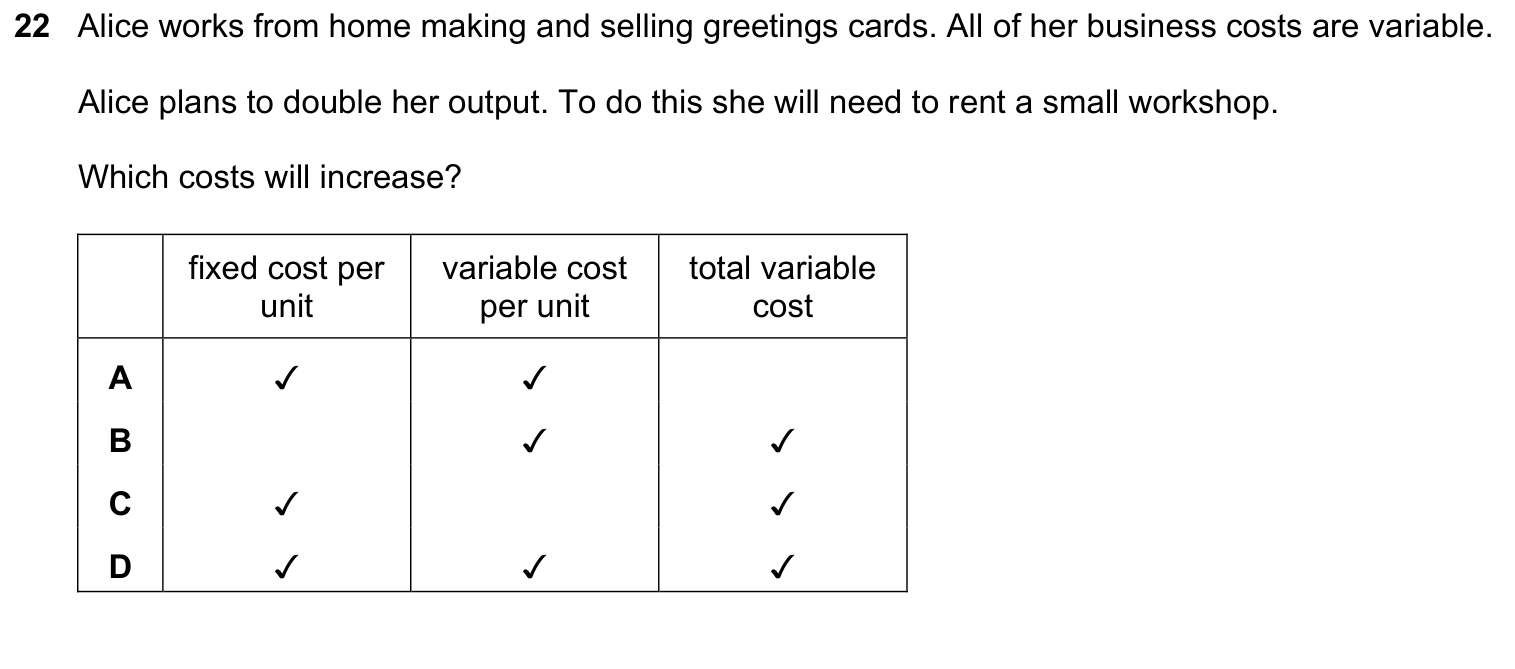
Answer: C.
Question 2
A company paid the following telephone costs.
number of total cost month customer enquiries $ 1 250 000 425 000
2 350 000 575 000
Telephone costs are a semi-variable cost.
What would be the total telephone costs incurred for 305 000 enquiries?
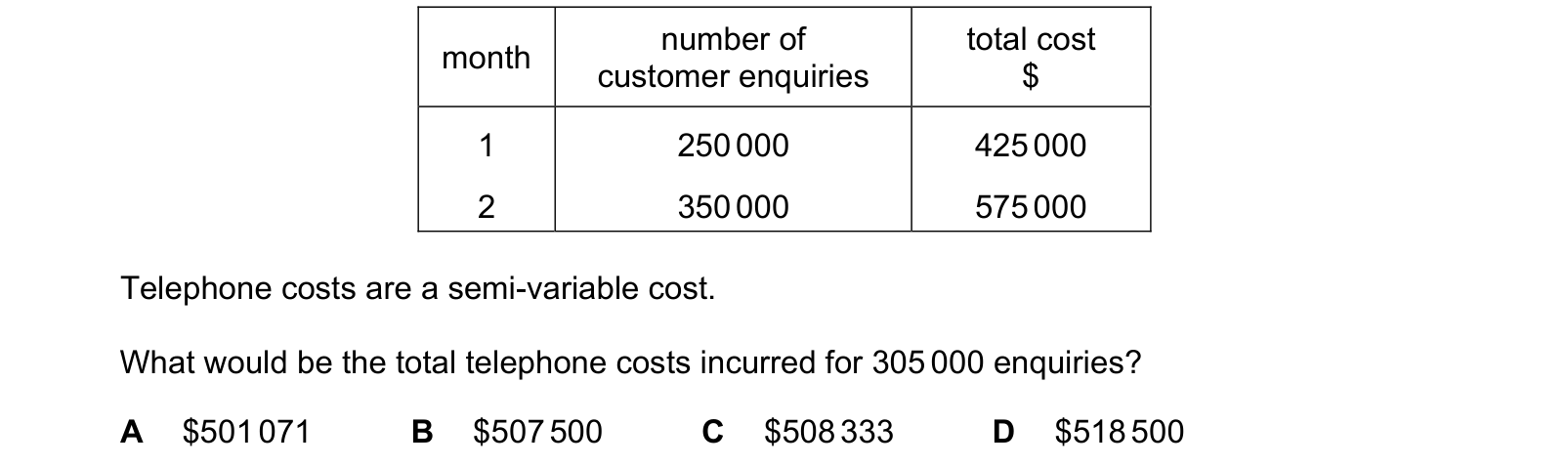
Answer: B.
Question 3
A business provided the following information about a product.
per unit $ selling price 15.00
variable cost 9.00
fixed cost 4.20
Budgeted production and sales were 1200 units.
What was the profit made for actual production and sales of 1500 units?
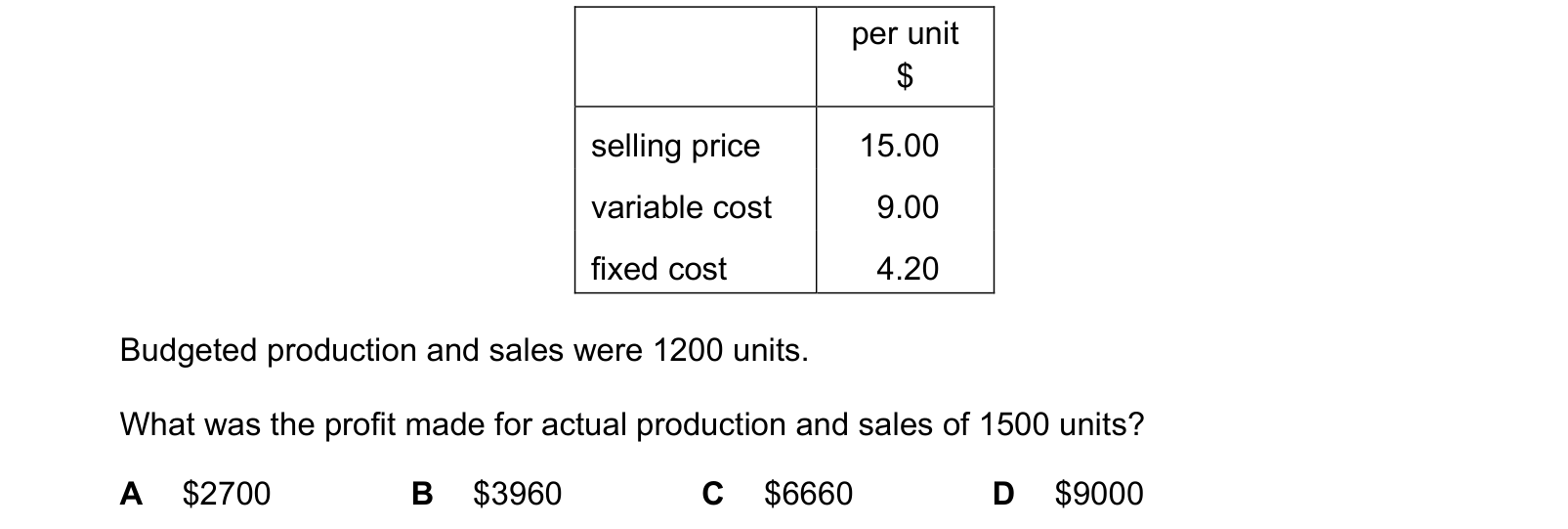
Answer: B.
What the syllabus asks for on this topicSyllabus points
Syllabus points
- Classify costs by element, by function and by behaviour.
- Distinguish direct from indirect costs, and fixed from variable costs.
- Explain and identify semi-variable costs and separate them using the high-low method.
- Explain how cost behaviour affects the cost per unit.
Related CIE 9706 Accounting topics
Not the topic you were looking for? Describe what you are stuck on in your own words and we will take you to the notes that answer it.