Bank reconciliation statements
Contents: 7 sections
Why the two figures differ
The business keeps a cash book; the bank keeps a statement. They record the same transactions from opposite sides and at different moments, so on any given date they disagree for two quite different reasons.
Reason one: the bank knows something the business has not recorded yet. These items appear on the statement only, and the business finds out about them when the statement arrives.
- Bank charges and interest charged.
- Interest received.
- Direct debits and standing orders.
- Credit transfers received directly into the account.
- Dishonoured cheques (a customer's cheque that bounced).
Reason two: the business knows something the bank has not processed yet. These are timing differences.
- Unpresented cheques: cheques written and entered in the cash book, but not yet paid out by the bank.
- Outstanding lodgements, also called uncredited deposits: money paid in and entered in the cash book, not yet credited by the bank.
The two reasons need opposite treatments, and keeping them apart is the whole skill in this topic.
The order of work
Step 1: update the cash book. Enter every item from reason one. Debit the receipts (interest received, credit transfers in); credit the payments (bank charges, standing orders, direct debits, dishonoured cheques). Also correct any errors the business itself made in the cash book. Then balance it. This new figure is the corrected cash book balance, and it is the figure that appears in the statement of financial position.
Step 2: prepare the reconciliation statement. This deals only with reason two, the timing differences, and it does not change any ledger figure. Its job is to prove the two balances agree once timing is allowed for.
Doing step 2 first, or putting bank charges in the reconciliation statement, is the classic way to lose most of the marks on the question.
The reconciliation statement
Starting from the bank statement balance:
| $ | |
|---|---|
| Balance per bank statement | 4 820 |
| Add outstanding lodgements | 1 350 |
| Less unpresented cheques | (2 070) |
| Balance per corrected cash book | 4 100 |
Check that arithmetic: 4 820 plus 1 350 is 6 170, less 2 070 is $4 100.
The directions make sense if you think about what the bank will do next. The bank has not yet added the lodgement, so add it. The bank has not yet taken out the unpresented cheques, so subtract them.
You may also start from the cash book and work to the statement, in which case every sign reverses: subtract lodgements and add unpresented cheques. Either presentation is acceptable, and the question sometimes specifies. Decide which end you are starting from before writing anything, because mixing the two directions halfway through is a common way to arrive at a plausible but wrong figure.
Overdrafts
An overdraft is a credit balance in the cash book and a debit balance on the bank statement, since the bank is owed money. In a reconciliation, treat an overdraft as a negative figure and apply the same rules. An overdraft of $1 200 on the statement, with lodgements of $900 and unpresented cheques of $500, gives negative 1 200 plus 900 minus 500, which is an overdraft of $800 per the cash book.
Why it matters
- It verifies the cash book against an independent record produced by someone else.
- It finds errors made by the business, and occasionally by the bank.
- It discovers items the business had no other way of knowing about, such as charges and dishonoured cheques.
- It deters fraud, because unrecorded payments show up.
- It supports prudence, since a dishonoured cheque means a receivable that is not actually settled.
Its limits are worth a sentence too. Reconciliation checks the bank balance only. It says nothing about whether a payment was authorised, whether the amount was correct, or whether the expense was genuine.
Common mistakes
- Putting bank charges or standing orders in the reconciliation statement instead of the cash book.
- Reversing the treatment of unpresented cheques and outstanding lodgements.
- Using the original cash book balance rather than the corrected one in the reconciliation.
- Forgetting that a dishonoured cheque must also be debited back to the customer's account.
- Mishandling an overdraft by ignoring the sign.
- Showing the bank statement balance in the statement of financial position. The corrected cash book balance goes there.
Check you have it
Question 1
Doug received his business bank statement. He updated the cash book and prepared the bank reconciliation statement. Which items appeared on the bank reconciliation statement? Each answer gives, in order: bank charges; customer payments by direct debit; uncredited deposits.
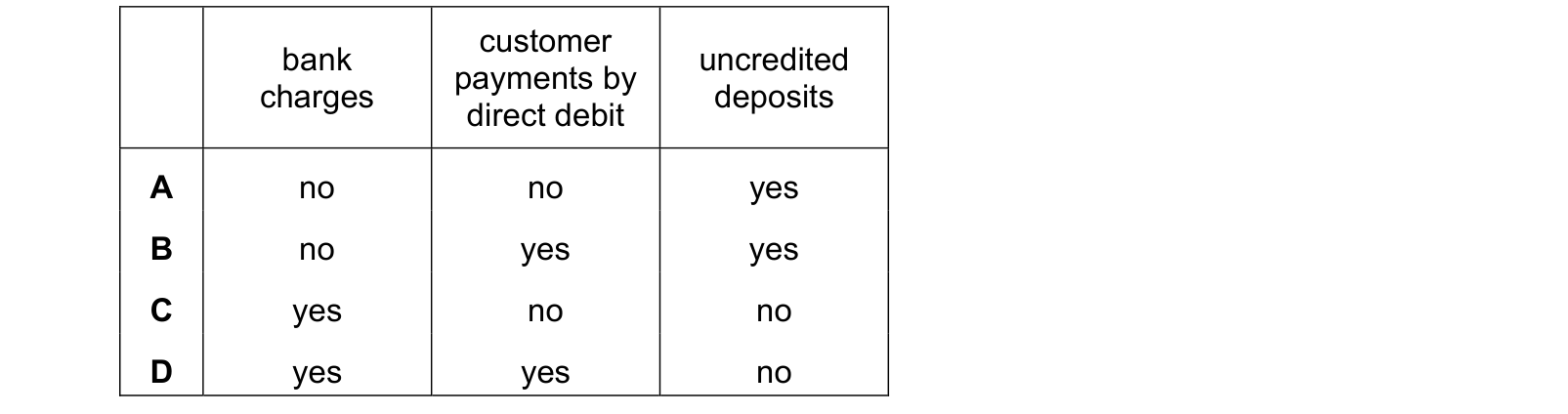
Answer: A.
Question 2
What are the advantages of preparing a bank reconciliation statement?

Answer: D.
Question 3
What is a benefit of preparing a bank reconciliation?
Answer: A.
What the syllabus asks for on this topicSyllabus points
Syllabus points
- Explain why the cash book balance and the bank statement balance differ.
- Update the cash book for items appearing only on the bank statement.
- Prepare a bank reconciliation statement.
- Explain the purpose and the limitations of bank reconciliation.
Related CIE 9706 Accounting topics
Not the topic you were looking for? Describe what you are stuck on in your own words and we will take you to the notes that answer it.