Bank reconciliation statements: five questions to try now
Real past-paper questions, the answer key from the mark scheme, and the explanation that goes with it. No account needed to answer them.
Question 1
How should the bank-statement differences be treated in the cash book and reconciliation? Use the complete source image for the figures and answer choices.
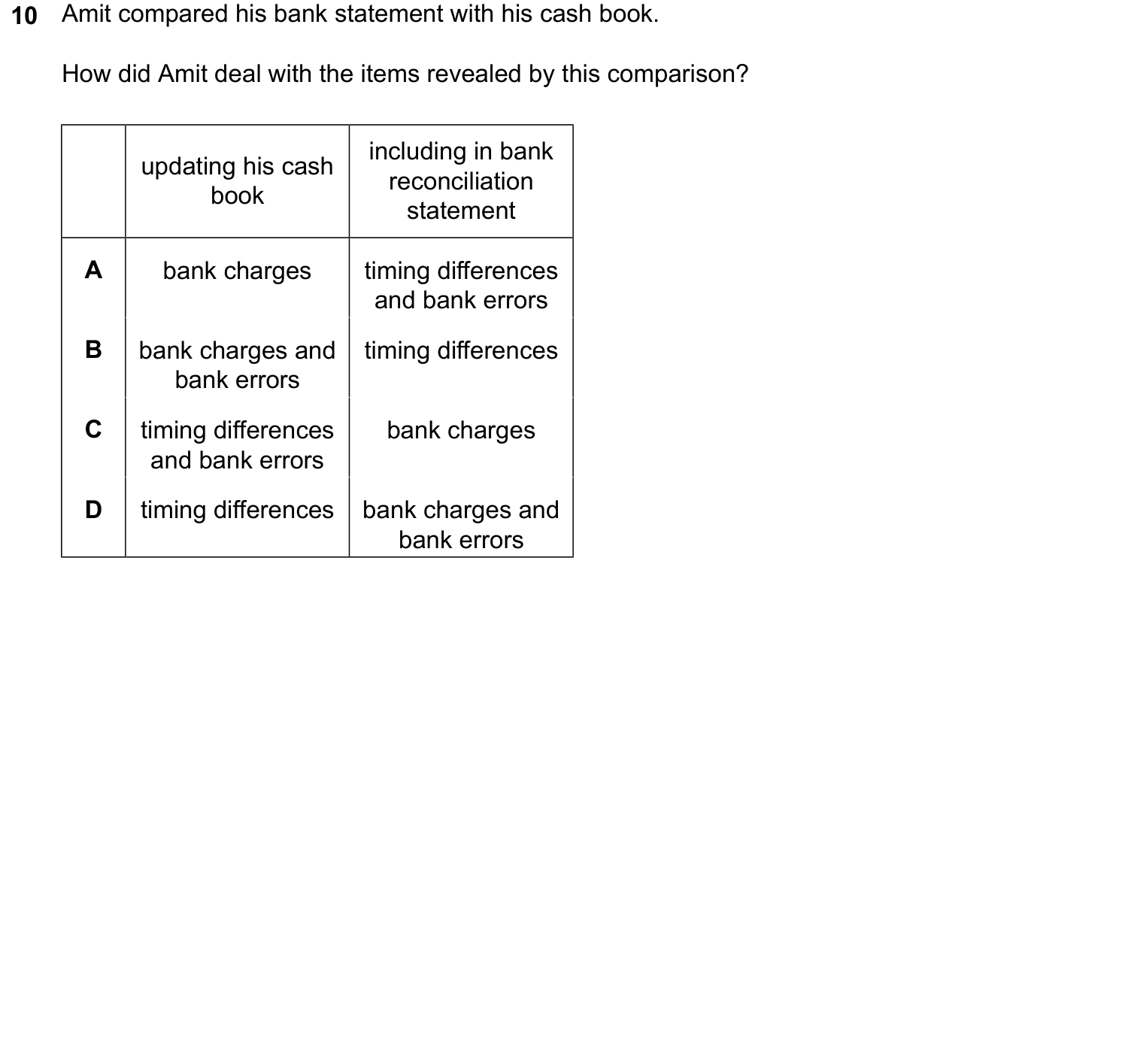
Answer: A.
Question 2
Which statements about a bank reconciliation are correct?
1 Cleared cheques are excluded.
2 It locates all errors.
3 It locates any fraud.
4 Uncredited deposits are included.
Answer: B.
Question 3
A business is preparing a bank reconciliation statement. The following information is available. $ uncleared lodgements 3450
unpresented cheques 2950
cash book balance 7650 credit
What is the debit balance on the bank statement?
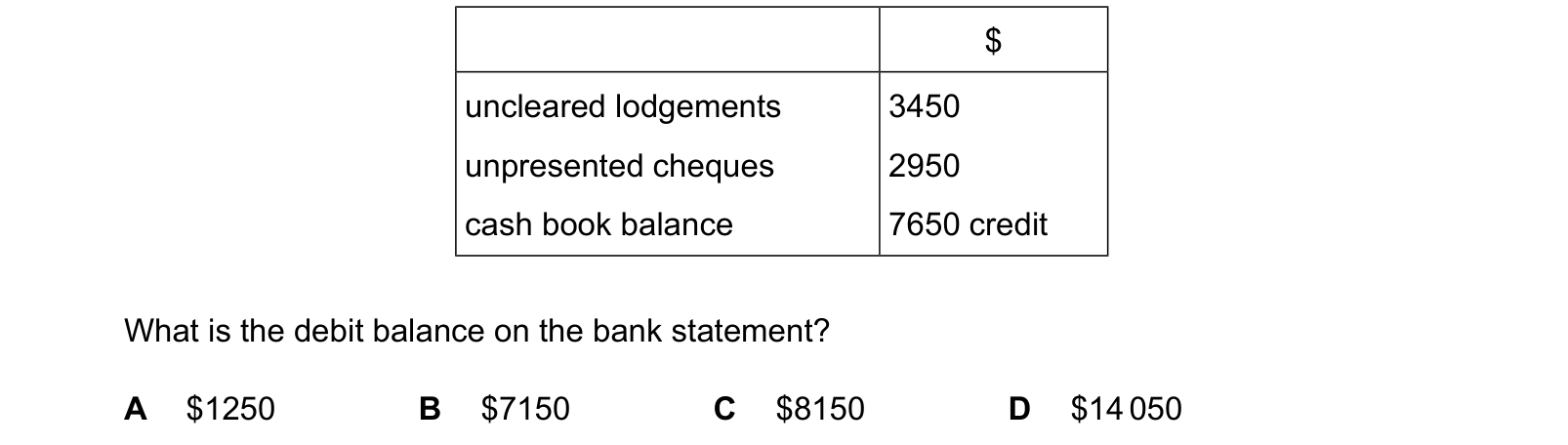
Answer: C.
Question 4
A book-keeper compared the business bank statement with the cash book. He then updated the cash book and finally prepared a bank reconciliation statement.
Why was the bank reconciliation statement prepared?
Answer: C.
Question 5
Which statements about an unpresented cheque are correct?
1 It arises as the result of an error of omission.
2 It arises from a timing difference.
3 It is used when preparing a bank reconciliation statement.
Answer: C.
What this practice covers
These questions are drawn from past CIE 9706 Accounting papers and filtered to bank reconciliation statements. You answer, you find out immediately whether you were right, and you get the reasoning for the correct option and for each distractor. Wrong answers go to a mistakes locker so you can come back to exactly those.
Practice is free. You need an account only so your progress and your mistakes are still there next time.
What examiners see students get wrong here
These are the errors that cost marks on bank reconciliation statements, taken from our own topic notes. Read them before you practise and you will recognise the traps in the questions.
- Putting bank charges or standing orders in the reconciliation statement instead of the cash book.
- Reversing the treatment of unpresented cheques and outstanding lodgements.
- Using the original cash book balance rather than the corrected one in the reconciliation.
- Forgetting that a dishonoured cheque must also be debited back to the customer's account.
- Mishandling an overdraft by ignoring the sign.
- Showing the bank statement balance in the statement of financial position. The corrected cash book balance goes there.
Revise it first
If any of the above is unfamiliar, work through the notes before practising: Bank reconciliation statements revision notes.