Control accounts
Contents: 10 sections
What a control account is
A control account is a summary account in the general ledger holding the totals of what the sales ledger or purchases ledger holds in detail.
If the postings have been made correctly, the balance on the sales ledger control account equals the sum of all the individual customer balances. Any difference means an error somewhere, and the control account tells you which ledger to search.
The control account is fed from the totals in the books of prime entry, while the personal accounts are fed from the individual entries. That independence is what makes the comparison meaningful: the same information reaches two places by two routes.
Sales ledger control account
The sales ledger control account is an asset, so its normal balance is a debit.
| Debit side (increases what customers owe) | Credit side (decreases it) |
|---|---|
| Opening balance of receivables | Cash and cheques received from customers |
| Credit sales | Discount allowed |
| Dishonoured cheques | Sales returns |
| Interest charged to customers | Irrecoverable debts written off |
| Refunds to customers | Contra with the purchases ledger |
Purchases ledger control account
A liability, so its normal balance is a credit.
| Debit side (decreases what is owed) | Credit side (increases it) |
|---|---|
| Payments to suppliers | Opening balance of payables |
| Discount received | Credit purchases |
| Purchases returns | Interest charged by suppliers |
| Contra with the sales ledger | Refunds received from suppliers |
What never appears
Several plausible-looking items belong nowhere near a control account, and questions include them deliberately.
- Cash sales and cash purchases. Control accounts cover credit transactions only.
- Provision or allowance for irrecoverable debts. The allowance is an estimate held in its own account. An irrecoverable debt actually written off does go in the control account; the allowance against the remaining balances does not.
- Bad debts recovered, when a debt previously written off is paid. This is reinstated separately and does not pass through the control account as a new sale.
Contra entries
A contra, sometimes called a set-off, arises when the same business is both a customer and a supplier. Rather than exchanging two payments, the smaller balance is offset against the larger.
- Debit purchases ledger control, credit sales ledger control.
So a contra appears on the credit side of the sales ledger control account and the debit side of the purchases ledger control account, reducing both. Only the lower of the two balances can be contra'd.
A worked control account
Opening receivables $32 400. During the month: credit sales $58 900, cash sales $6 200, receipts from customers $54 100, discount allowed $1 300, sales returns $2 700, irrecoverable debts written off $800, a contra of $1 500.
Debits are 32 400 plus 58 900, which is $91 300. The cash sales are excluded. Credits are 54 100 plus 1 300 plus 2 700 plus 800 plus 1 500, which is $60 400.
The closing balance is 91 300 minus 60 400, which is $30 900.
Reconciling with the ledger
When the control account balance and the total of the personal accounts disagree, work out which side the error is on before correcting anything.
- Errors in the totals posted from the books of prime entry affect the control account.
- Errors in an individual customer's or supplier's account affect the list of balances.
- An error in the sales journal itself, such as an invoice entered at the wrong amount, feeds both the total and the individual account, so it affects both and the two still agree with each other while both being wrong.
That last case is exactly why a control account is a check and not a proof.
Purposes and limitations
Control accounts give a quick total of receivables and payables without adding up every personal account, they localise errors to one ledger, they let the trial balance be prepared from the general ledger alone, and they act as a fraud deterrent when kept by someone other than the ledger clerk.
They do not catch everything. An error made in the book of prime entry, a compensating error, an entry posted to the wrong customer, or a transaction omitted entirely will all leave the control account agreeing perfectly with the ledger.
Common mistakes
- Including cash sales or cash purchases.
- Putting discount allowed on the debit side of the sales ledger control account.
- Including the allowance for irrecoverable debts.
- Putting the contra on the wrong side, or contra'ing more than the smaller balance.
- Treating the sales ledger control account as a credit balance.
- Saying an agreeing control account proves the ledger is correct.
- Forgetting that a dishonoured cheque is a debit in the sales ledger control account, restoring the amount the customer owes.
Check you have it
Question 1
On 31 December 2018, a business had the following balances. $ sales ledger 12 800
sales ledger control account 15 200
Which error explains the difference between the two figures?

Answer: A.
Question 2
Which items will be entered in the debit side of the purchases ledger control account?

Answer: A.
Question 3
What do the debit side closing balance carried down and the credit side opening balance brought down represent in a sales ledger control account? Each answer gives, in order: debit side closing balance carried down; credit side opening balance brought down.
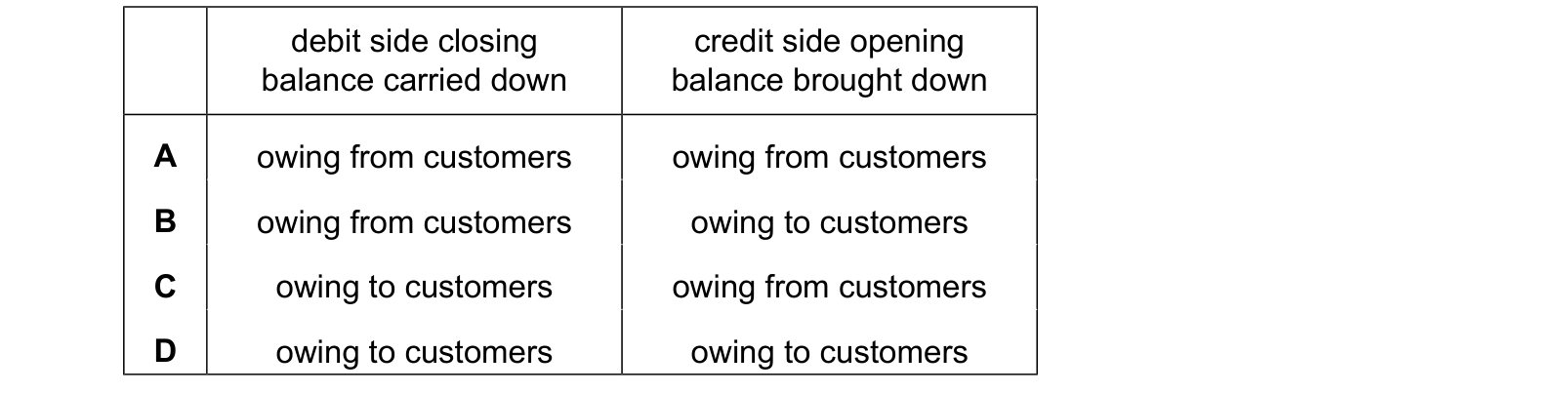
Answer: D.
What the syllabus asks for on this topicSyllabus points
Syllabus points
- Prepare sales ledger and purchases ledger control accounts.
- Reconcile a control account balance with the total of the personal ledger.
- Explain the purposes and the limitations of control accounts.
Related CIE 9706 Accounting topics
Not the topic you were looking for? Describe what you are stuck on in your own words and we will take you to the notes that answer it.