Liquidity ratios
Contents: 7 sections
The two ratios
Current ratio = current assets : current liabilities
Liquid ratio, also called the acid test or quick ratio = (current assets − inventory) : current liabilities
Both are expressed as a ratio to one, such as 1.8 : 1.
The only difference is inventory, and the reason for removing it is the whole idea behind the second ratio. Inventory is the least liquid current asset: it must be sold first, and then, if sold on credit, collected. If a business is under pressure it cannot rely on inventory to pay next week's bills.
Prepayments are sometimes excluded from the liquid ratio too, on the grounds that they will never become cash. Cambridge accepts the simple version above unless a question directs otherwise.
What the numbers mean
The often-quoted benchmarks are a current ratio near 2 : 1 and a liquid ratio near 1 : 1. Treat these as a starting point rather than a target, and say so, because the sensible level depends entirely on the trade.
A supermarket runs comfortably at a liquid ratio well below 1 : 1. It sells for cash, so it has almost no receivables, and it turns its inventory over in days while taking weeks of credit from suppliers. The same figure at a machinery manufacturer would be alarming.
Too low means the business may not be able to pay its debts as they fall due. It risks pressure from suppliers, loss of cash discounts, refusal of further credit, an overdraft called in, and ultimately insolvency even while trading profitably.
Too high is also a criticism, and this is the half of the answer most often missed. Excessive current assets mean resources sitting idle: too much cash earning nothing, too much inventory incurring storage costs and risking obsolescence, or receivables that are too generous and may not be collected. Money tied up in current assets is money not invested in something that earns a return, so a very high current ratio drags ROCE down.
Working capital
working capital = current assets − current liabilities
The ratios express working capital as a relationship; the subtraction expresses it as an amount. Both are needed, because a ratio hides scale: 2 : 1 could be $200 against $100 or $2m against $1m, and the operating consequences are not the same.
The working capital cycle is the time between paying for goods and collecting the cash from selling them. The longer it is, the more finance the business needs to bridge the gap. It lengthens when inventory is held longer, when customers take longer to pay, and when suppliers are paid sooner.
Profitable but out of cash
A business can be profitable and still fail for want of cash, and questions test whether you can explain why.
- Profit is not cash. A credit sale is profit today and cash in two months.
- Overtrading: expanding sales faster than the finance to support them, so inventory and receivables grow beyond what the business can fund.
- Buying non-current assets for cash, which drains liquidity without affecting profit at all in the year of purchase.
- Excessive drawings or dividends, taking cash out that the business needed.
- Repaying a loan, which reduces cash and never appears in the income statement.
- Slow collection from customers while suppliers must still be paid.
Improving liquidity
Each of these has a cost, and naming it is what separates a good answer.
- Chase receivables harder or offer a cash discount. The discount reduces profit; aggressive chasing can lose customers.
- Negotiate longer credit from suppliers. Costs nothing directly, but loses cash discounts and can strain the relationship.
- Reduce inventory levels. Frees cash, but risks stockouts and lost sales.
- Sell surplus non-current assets. Immediate cash; the asset is gone.
- Sale and leaseback. Cash now, rent for ever after.
- Arrange an overdraft or a loan. Fast, but interest is payable and an overdraft is repayable on demand.
- Introduce capital or issue shares. No repayment pressure, but it dilutes ownership.
- Reduce drawings or dividends. Direct and free, and often unwelcome.
Notice which of these do not work: cutting expenses helps profit more than liquidity in the short run, and selling inventory at a loss raises cash while damaging the very profitability being relied on.
Common mistakes
- Including inventory in the liquid ratio.
- Treating 2 : 1 as a rule that applies to every business.
- Saying a high current ratio is always good.
- Confusing liquidity with profitability, and using profit figures to explain a liquidity ratio.
- Quoting the ratio without saying what it means for paying debts.
- Suggesting improvements without noting the cost of each.
- Writing the ratio as a percentage. It is a ratio to one.
Check you have it
Question 1
Which actions will make the acid test ratio worse?
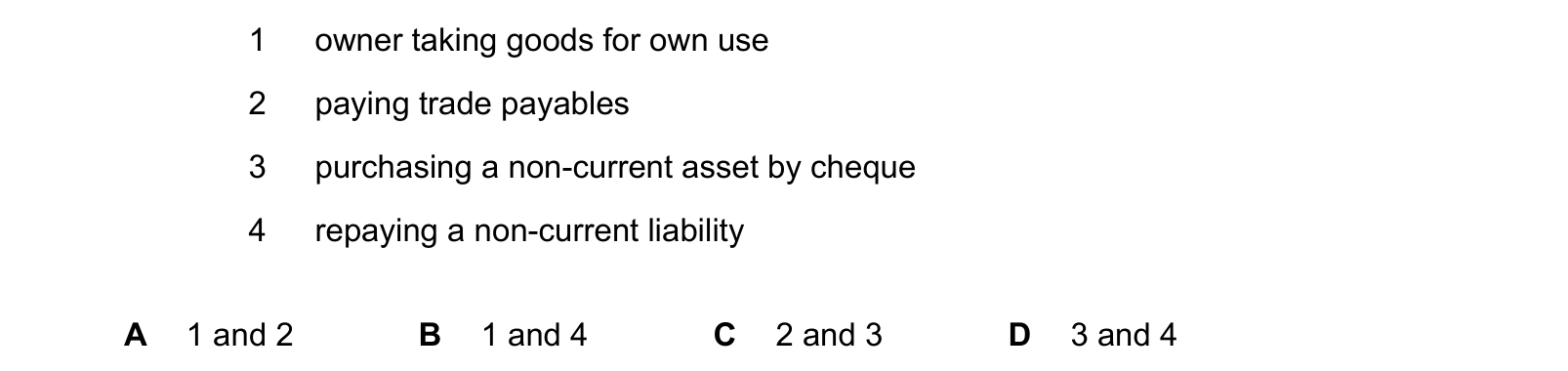
Answer: D.
Question 2
A business had current liabilities of $4000 at its year end.
The acid test ratio was 1.5 : 1.
The current ratio was 2.25 : 1.
What was the value of inventory held at the year end?
Answer: A.
Question 3
A business has the following current assets and current liabilities. $ trade receivables 6000
bank overdraft 1500
cash in hand 50
trade payables 5050
The only other item in the working capital is inventory.
The current ratio is 2 : 1.
What is the value of the inventory?
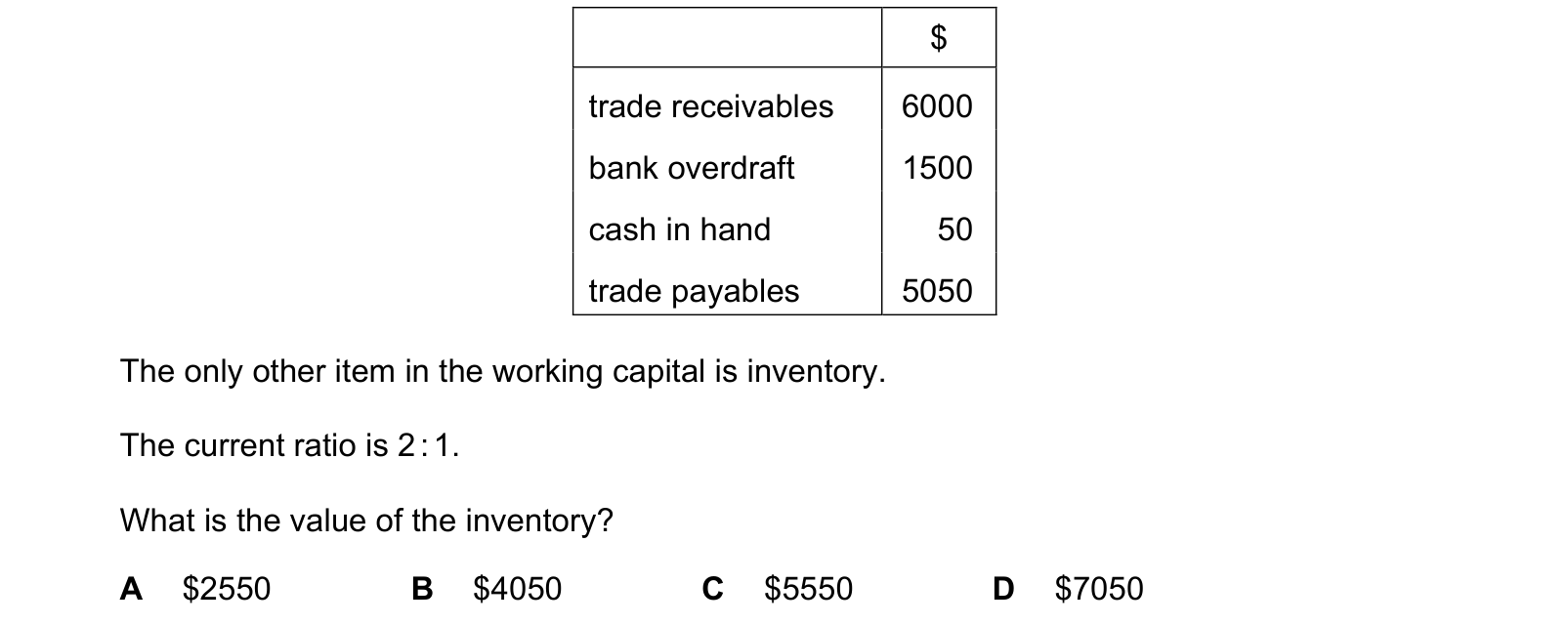
Answer: D.
What the syllabus asks for on this topicSyllabus points
Syllabus points
- Calculate the current ratio and the liquid (acid test) ratio.
- Interpret liquidity and comment on working capital.
- Explain the causes and the consequences of poor liquidity, and how to improve it.
Related CIE 9706 Accounting topics
Not the topic you were looking for? Describe what you are stuck on in your own words and we will take you to the notes that answer it.