Profitability ratios
Contents: 7 sections
The ratios
Gross margin = gross profit / revenue x 100
Profit margin = profit for the year / revenue x 100
Mark-up = gross profit / cost of sales x 100
Return on capital employed (ROCE) = profit from operations / capital employed x 100
Capital employed is the long-term finance of the business: for a sole trader, closing capital plus any long-term loan; for a company, equity plus non-current liabilities. Profit from operations means profit before interest and tax, because capital employed includes the money the lenders provided and the return must be measured on the same basis.
Using profit after interest against a capital employed that includes the loan is the single most common ROCE error, and it makes geared companies look artificially weak.
A worked set
Revenue $500 000, cost of sales $320 000, expenses $110 000, interest $10 000. Equity $220 000 and a long-term loan of $80 000.
Gross profit is 500 000 minus 320 000, which is $180 000, so the gross margin is 180 over 500, which is 36%.
Profit from operations is 180 000 minus 110 000, which is $70 000. Profit for the year is 70 000 minus 10 000, which is $60 000, so the profit margin is 60 over 500, which is 12%.
Capital employed is 220 000 plus 80 000, which is $300 000, so ROCE is 70 over 300, which is 23.3%.
Mark-up is 180 over 320, which is 56.25%.
Reading a change
The two margins together tell you where the problem is, and that is the whole point of calculating both.
- Gross margin down, profit margin down by the same amount. The trouble is in trading: selling prices, purchase costs, or the sales mix. Expenses are unchanged.
- Gross margin steady, profit margin down. Trading is fine; overheads have risen.
- Gross margin up, profit margin down. Both things happened. Trading improved and expenses rose by more.
Causes of a falling gross margin: selling prices cut to compete, supplier prices risen without a price rise passed on, a shift towards lower-margin products, theft of inventory or cash, higher carriage inwards, closing inventory undervalued.
Causes of a falling profit margin with gross margin held: higher rent, wages, advertising or energy; a large irrecoverable debt; a higher depreciation charge after buying assets.
ROCE
ROCE is the broadest measure, because it asks how well the business used all the finance it has, not just how well it sold goods.
It falls when profit falls, and it also falls when capital employed rises without profit following: an asset bought late in the year contributes a full amount to capital employed and only a few months of profit. That is worth saying in an answer, because it means a falling ROCE is not always bad news.
ROCE is usefully broken into two parts:
ROCE = profit margin x asset turnover
A business can reach the same ROCE by taking a high margin on few sales, as a jeweller does, or a thin margin on many, as a supermarket does. This is why ROCE should be compared with businesses in the same industry rather than across industries.
The obvious comparison is against what the money would earn elsewhere. A ROCE below the interest rate on a bank deposit means the owner would be better off closing and depositing the money, and that comparison is worth making explicitly when a question asks whether the return is adequate.
Improving profitability
Suggest actions, and then say what each one risks. An answer that only lists actions scores half.
- Raise selling prices. Improves margin per unit, but demand may fall, and total profit can drop.
- Find cheaper suppliers. Improves margin, but quality may suffer and damage the reputation.
- Reduce expenses. Cutting advertising lifts this year's profit and may cut next year's revenue.
- Change the sales mix towards higher-margin lines, if demand allows.
- Increase volume, spreading fixed costs over more units.
- Dispose of underused assets, which lifts ROCE by reducing capital employed.
Common mistakes
- Using profit after interest in ROCE while including the loan in capital employed.
- Confusing mark-up with margin. Mark-up is on cost, margin is on revenue.
- Saying gross margin fell "because costs rose" without saying which costs. Expenses do not affect gross margin at all.
- Quoting the ratio again as the explanation of the ratio.
- Comparing ROCE across different industries and drawing a conclusion.
- Recommending "cut costs" with no specific cost and no consequence.
- Forgetting that a percentage can rise while the money profit falls, if revenue fell further.
Check you have it
Question 1
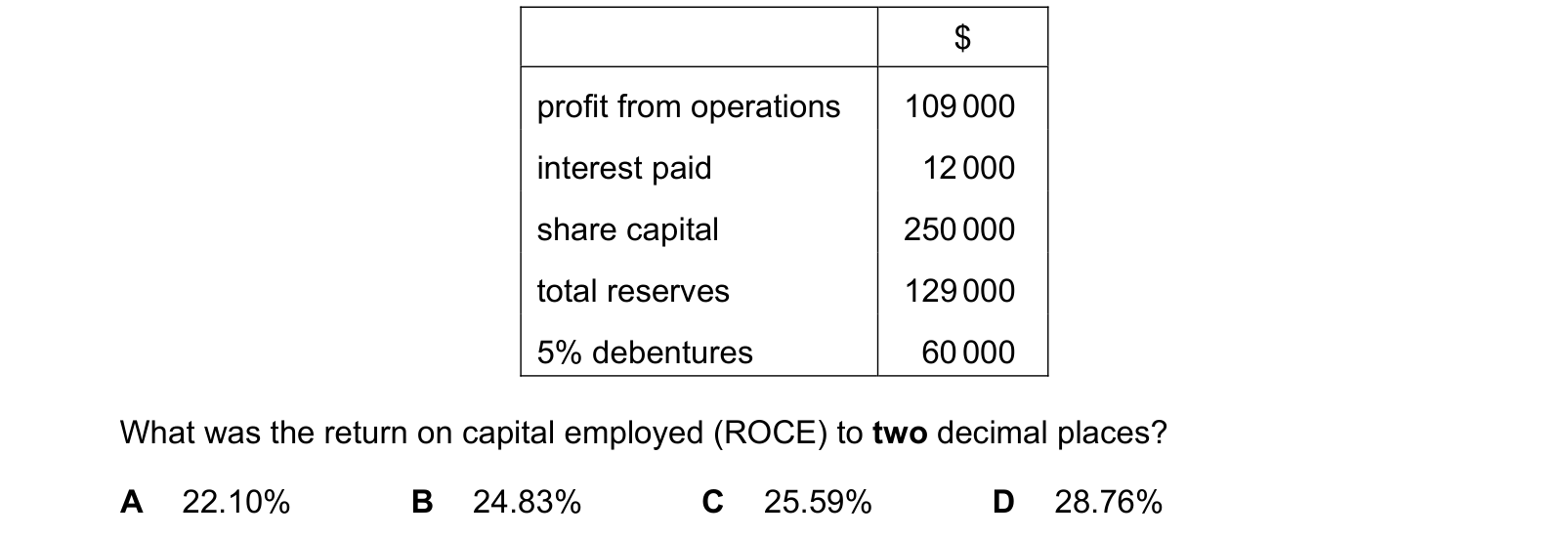
A company provided the following information. $ profit from operations 109 000
interest paid 12 000
share capital 250 000
total reserves 129 000
5% debentures 60 000
What was the return on capital employed (ROCE) to two decimal places?
Answer: B.
Question 2
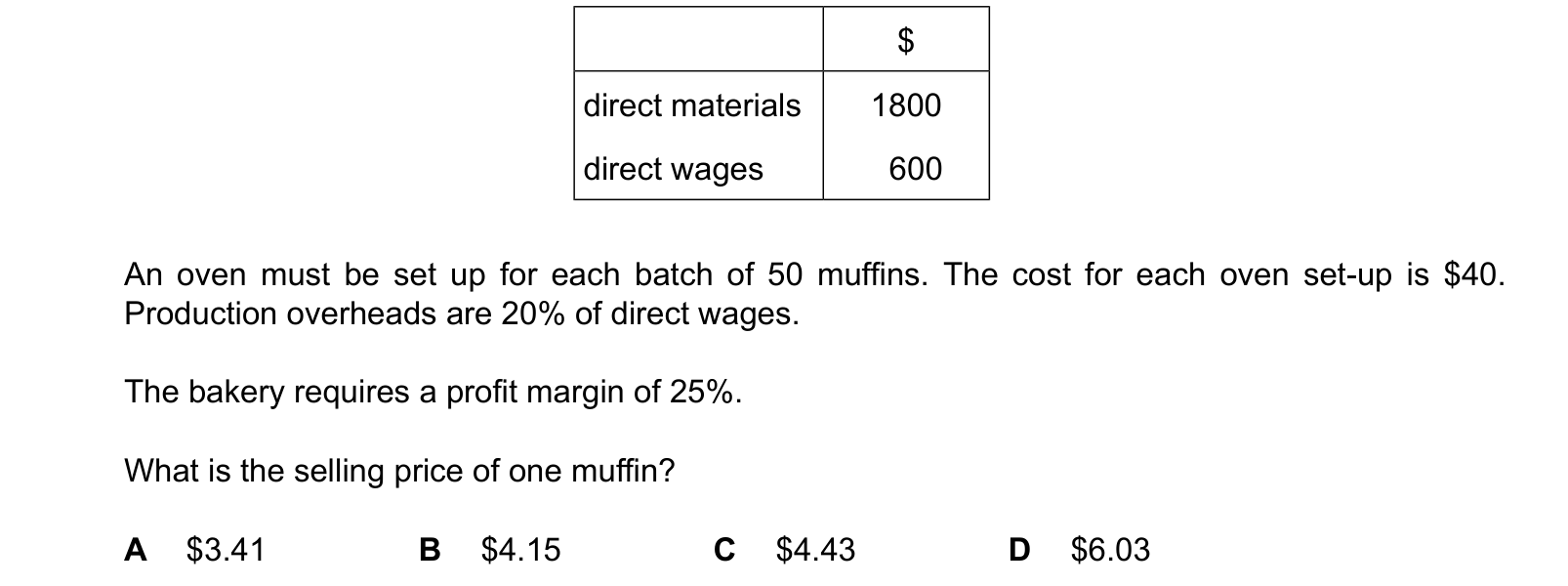
A bakery produces 1000 muffins a day. The total direct costs for these are shown. An oven must be set up for each batch of 50 muffins. The cost for each oven set-up is $40. Production overheads are 20% of direct wages.
The bakery requires a profit margin of 25%.
What is the selling price of one muffin?
Answer: C.
Question 3
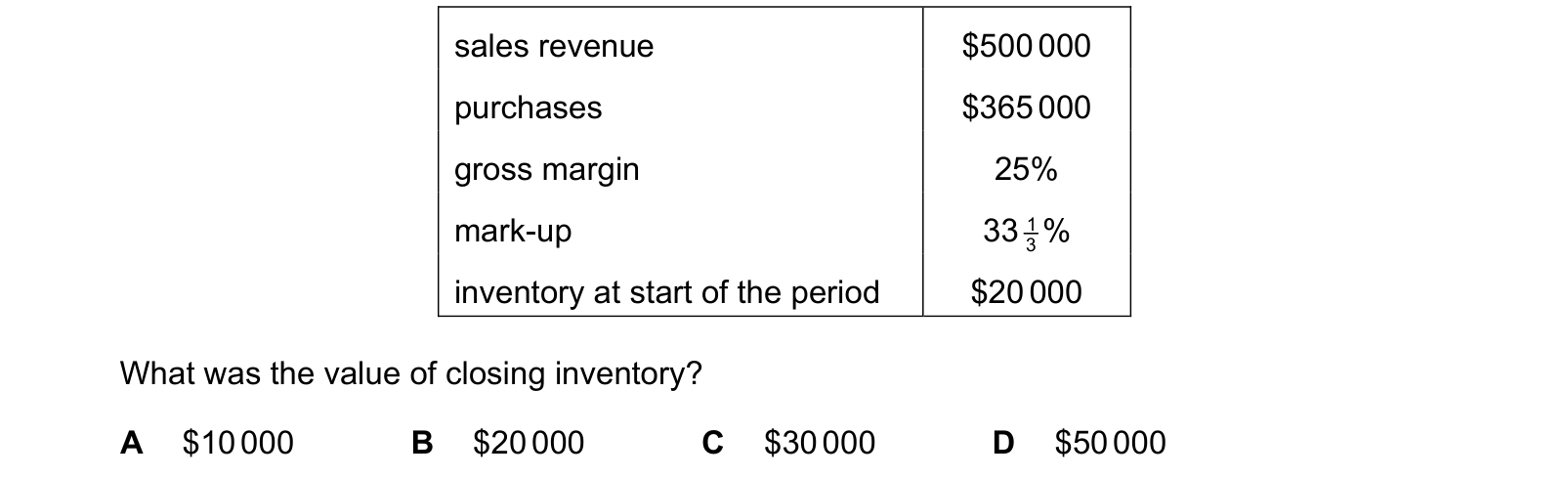
The following information is available for a business.
sales revenue $500 000
purchases $365 000
gross margin 25%
mark-up 33 1 % 3
inventory at start of the period $20 000
What was the value of closing inventory?
Answer: A.
What the syllabus asks for on this topicSyllabus points
Syllabus points
- Calculate gross margin, profit margin, mark-up and return on capital employed.
- Interpret a change in each ratio and suggest causes.
- Recommend action to improve profitability.
Related CIE 9706 Accounting topics
Not the topic you were looking for? Describe what you are stuck on in your own words and we will take you to the notes that answer it.