Partnerships
Contents: 7 sections
The agreement, and what happens without one
A partnership agreement sets out how the partners will run the business and, above all, how profits are divided. It usually covers the profit-sharing ratio, salaries, interest on capital, interest on drawings, and the rules on admitting or retiring a partner.
Where there is no agreement, the Partnership Act supplies default terms, and questions test these directly:
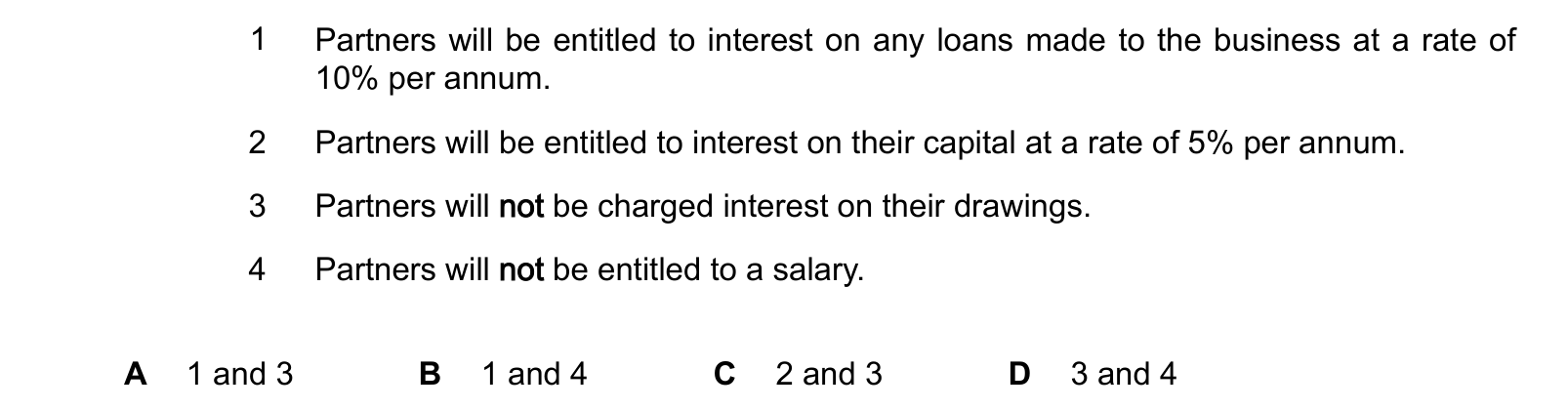
- Profits and losses are shared equally, regardless of how much capital each partner put in.
- No salaries are paid to partners.
- No interest is allowed on capital.
- No interest is charged on drawings.
- Interest of 5% per year is allowed on a loan from a partner.
The last one is different in kind from the others. A partner's loan is not capital: the interest on it is an expense in the income statement, paid whether or not there is a profit, and the loan is a liability of the partnership.
The appropriation account
Profit for the year is not shared out directly. It first passes through an appropriation account, which divides it according to the agreement.
Start with profit for the year. Then:
- Add interest charged on drawings, because it is a charge on the partners that increases the profit available to divide.
- Deduct partners' salaries.
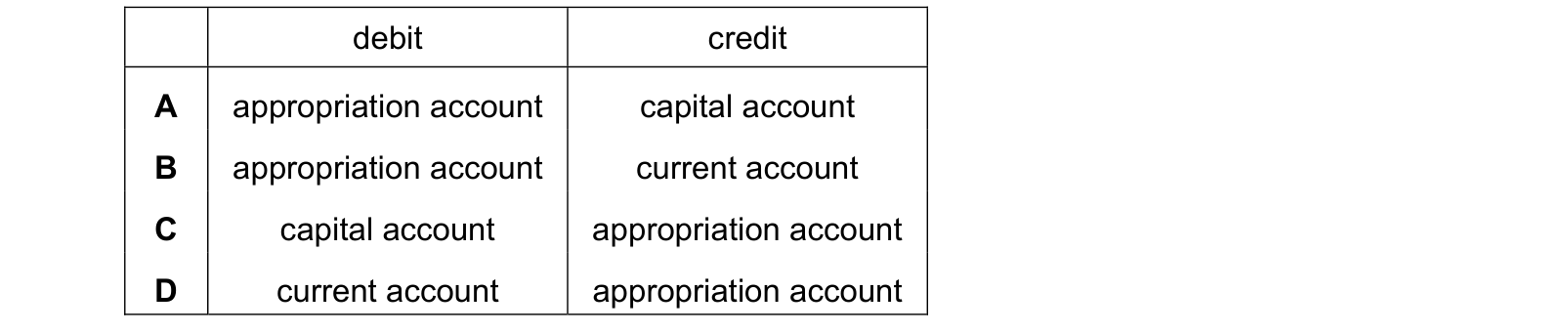
- Deduct interest allowed on capital.
- Divide the remainder in the profit-sharing ratio, which is the residual profit.
The whole of the profit ends up allocated to the partners; nothing is left over.
Nothing in this account is an expense. Partners' salaries and interest on capital are appropriations of profit, not costs of running the business, because partners are owners rather than employees. Putting a partner's salary in the income statement is the single most costly error in this topic, since it changes profit before the appropriation even starts.
A worked appropriation. A and B share profits 3:2. Profit for the year is $84 000. A has a salary of $12 000. Interest on capital is $4 000 for A and $3 000 for B. Interest on drawings is $500 for A and $700 for B.
The profit available is 84 000 plus interest on drawings of 1 200, which is $85 200. Deduct the salary of 12 000 and interest on capital of 7 000, leaving a residual of $66 200. A takes three fifths, which is $39 720, and B takes two fifths, which is $26 480.
Capital and current accounts
Most partnerships keep fixed capital accounts with a separate current account for each partner.
- The capital account holds the amount permanently invested. It changes only on the introduction or withdrawal of capital, or on a goodwill or revaluation adjustment.
- The current account holds the year-to-year movements: salaries, interest on capital and the share of profit are credited; drawings and interest on drawings are debited.
Both normally carry credit balances. A debit balance on a current account means the partner has drawn more than they have earned, and it is shown as a deduction in the capital section rather than as an asset.
Under the alternative, fluctuating capital accounts, there are no current accounts and everything goes through capital. The syllabus expects the fixed method unless told otherwise.
Goodwill
Goodwill is the value of the business above its identifiable net assets: reputation, customer loyalty, location, the trained workforce.
It matters at a change in the partnership, because goodwill was built up by the old partners and its value must be credited to them before the ratio changes.
The standard treatment where goodwill is not to remain in the books is a two-step adjustment:
- Create it: debit goodwill, credit the old partners' capital accounts in the old profit-sharing ratio.
- Write it off: credit goodwill, debit the new partners' capital accounts in the new ratio.
The net effect transfers value from the partners who gained a share to the partners who gave one up, without leaving goodwill on the statement of financial position. Leaving purchased goodwill in the books is permitted, but internally generated goodwill is not recognised, which is why it is usually written off.
Changes in the partnership
On the admission, retirement or death of a partner, or on a change in the profit-sharing ratio:
- Adjust for goodwill as above.
- Revalue the assets, and take the surplus or deficit to the old partners' capital accounts in the old ratio, since the change in value accrued during their time.
- If the change happens part way through the year, split the profit between the periods before and after, and appropriate each part on its own terms. State the basis of the split, usually time or turnover.
- A retiring partner's balance becomes a liability of the partnership until it is paid, or may be converted into a loan.
Common mistakes
- Treating a partner's salary or interest on capital as an expense in the income statement.
- Deducting interest on drawings from the profit available instead of adding it.
- Sharing profit in the ratio of capital balances when a profit-sharing ratio is given.
- Applying the Partnership Act defaults when an agreement exists, or forgetting them when it does not.
- Crediting goodwill to the new partners in the new ratio when creating it. It is created in the old ratio.
- Putting a debit balance on a current account among current assets.
- Charging interest on a partner's loan in the appropriation account. It is an expense.
Check you have it
Question 1
Which entries are made to record interest on capital in partnership accounts? Each answer gives, in order: debit; credit.
Answer: B.
Question 2
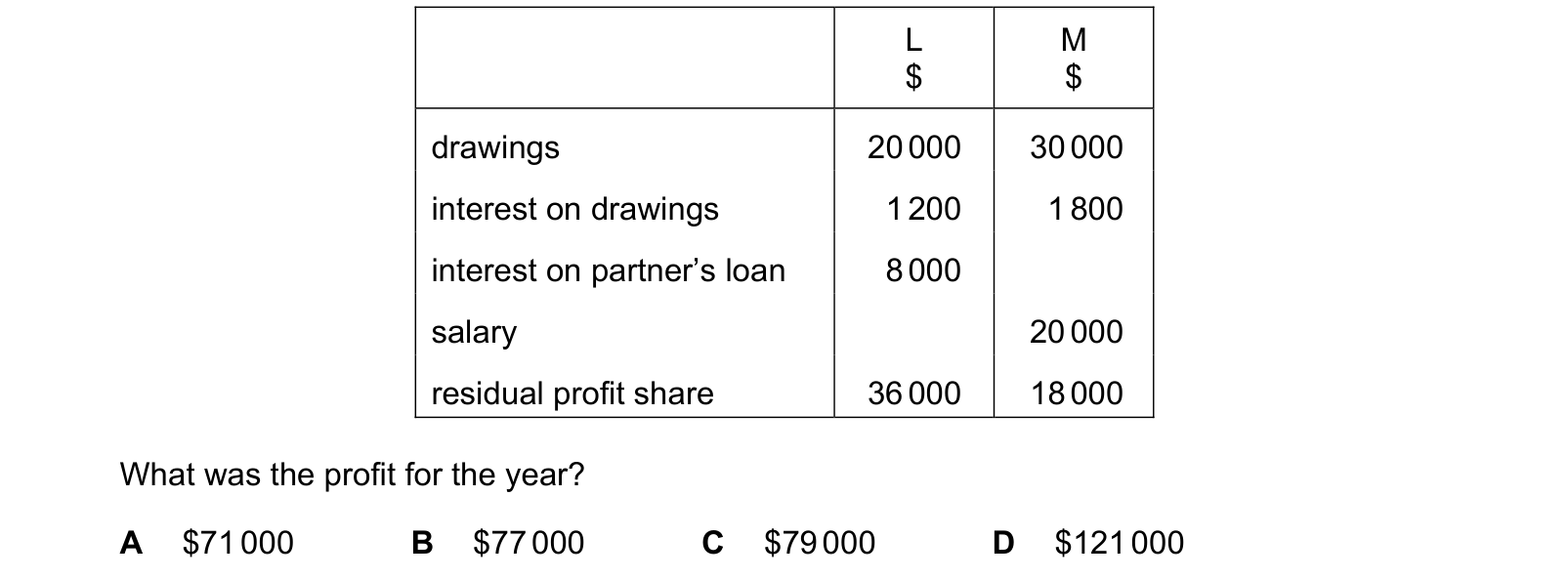
L and M are in partnership. The following information relates to the financial year.
L M $ $ drawings 20 000 30 000
interest on drawings 1 200 1 800
interest on partner’s loan 8 000
salary 20 000
residual profit share 36 000 18 000
What was the profit for the year?
Answer: A.
Question 3
A partnership operates without having a partnership agreement.
Which rules will apply to the partnership?
Answer: D.
What the syllabus asks for on this topicSyllabus points
Syllabus points
- Explain the purpose and the contents of a partnership agreement.
- Prepare an appropriation account and the partners' capital and current accounts.
- Apply the Partnership Act where there is no agreement.
- Account for goodwill and for a change in the partnership.
Related CIE 9706 Accounting topics
Not the topic you were looking for? Describe what you are stuck on in your own words and we will take you to the notes that answer it.