Absorption costing
Contents: 8 sections
The three stages
Absorption costing charges every production cost, fixed and variable, to the units made. Getting an overhead from the factory as a whole onto one unit takes three steps, and the vocabulary matters because questions use the exact words.
- Allocation. An overhead that belongs entirely to one department is charged straight to it. The salary of the machining department supervisor is allocated to machining.
- Apportionment. An overhead shared across departments is split on a fair basis. Factory rent is apportioned on floor area.
- Absorption. The total overhead of each production department is charged to the units passing through it, using an absorption rate.
Allocation and apportionment both move costs between departments. Absorption moves cost from a department onto a product. Using the words interchangeably loses marks in a written answer.
Bases of apportionment
The basis must have a causal link with the cost.
| Overhead | Apportioned on |
|---|---|
| Rent, rates, heating, lighting, building insurance | Floor area |
| Depreciation and insurance of machinery | Value of machinery |
| Power | Machine hours or kilowatt hours |
| Supervision, canteen, personnel, welfare | Number of employees |
| Stores costs | Number of requisitions or value of materials |
Reapportioning service departments
Service departments such as stores, maintenance and the canteen do not make anything, so their costs must be passed on to the production departments before absorption.
Where services work only for production departments, split the cost on a stated basis and the job is done.
Where services also serve each other, two methods appear.
- The repeated distribution method passes the costs back and forth until the amounts remaining are negligible.
- The algebraic method solves simultaneous equations for the total cost of each service department.
An absorption rate
overhead absorption rate = budgeted overhead for the department / budgeted level of activity
The rate is set from budgeted figures, before the year begins, because a price has to be quoted to a customer long before the actual costs are known. This is the whole reason under- and over-absorption exists.
The common bases are direct labour hours, machine hours, units of output, and a percentage of direct labour cost or of prime cost.
Choose the basis that reflects how the department works. A machine-intensive department should absorb on machine hours; a hand-assembly department on labour hours. Absorbing a highly automated department's overheads on labour hours puts a large cost onto a small number of hours and distorts the cost of every job.
A department budgets overheads of $180 000 and 12 000 machine hours. The rate is 180 000 divided by 12 000, which is $15 per machine hour. A job using 40 machine hours absorbs 40 times 15, which is $600.
Under- and over-absorption
Overhead absorbed = actual activity x the predetermined rate.
Compare that with the overhead actually incurred:
- Absorbed more than incurred: over-absorption, credited to the income statement, increasing profit.
- Absorbed less than incurred: under-absorption, debited to the income statement, reducing profit.
Continuing the example: actual overheads turn out to be $186 000 and actual machine hours are 11 500.
Overhead absorbed is 11 500 times 15, which is $172 500. Overhead incurred is $186 000. The shortfall is 186 000 minus 172 500, which is $13 500 under-absorbed, charged as an expense.
Two mistakes hide in that calculation. The rate stays at $15, the budgeted rate, all year: it is never recalculated using actual figures. And the absorbed figure uses actual hours, not budgeted ones. Mixing the two gives a plausible wrong answer.
The cause splits neatly in two: activity differed from budget, or spending differed from budget, or both. Here both moved against the business, fewer hours and higher costs.
Absorption against marginal costing
Absorption costing includes fixed production overheads in the cost of a unit, so those costs sit in closing inventory and are carried into the next period. Marginal costing charges fixed overheads in full as a period cost.
This is why the two methods report different profits whenever inventory changes, covered in 8.3.
Absorption costing is required for financial statements, because closing inventory must include a share of production overheads. Marginal costing is used for decisions. Neither is wrong; they answer different questions.
Common mistakes
- Using the words allocation and apportionment as though they meant the same thing.
- Recalculating the absorption rate using actual figures at the year end.
- Using budgeted activity instead of actual activity to calculate overhead absorbed.
- Getting the direction wrong: under-absorption reduces profit.
- Absorbing service department costs directly onto products without reapportioning first.
- Apportioning on a basis with no link to the cost, such as splitting rent by number of machines.
- Including selling and administration overheads in the absorption rate. Only production overheads are absorbed.
Check you have it
Question 1
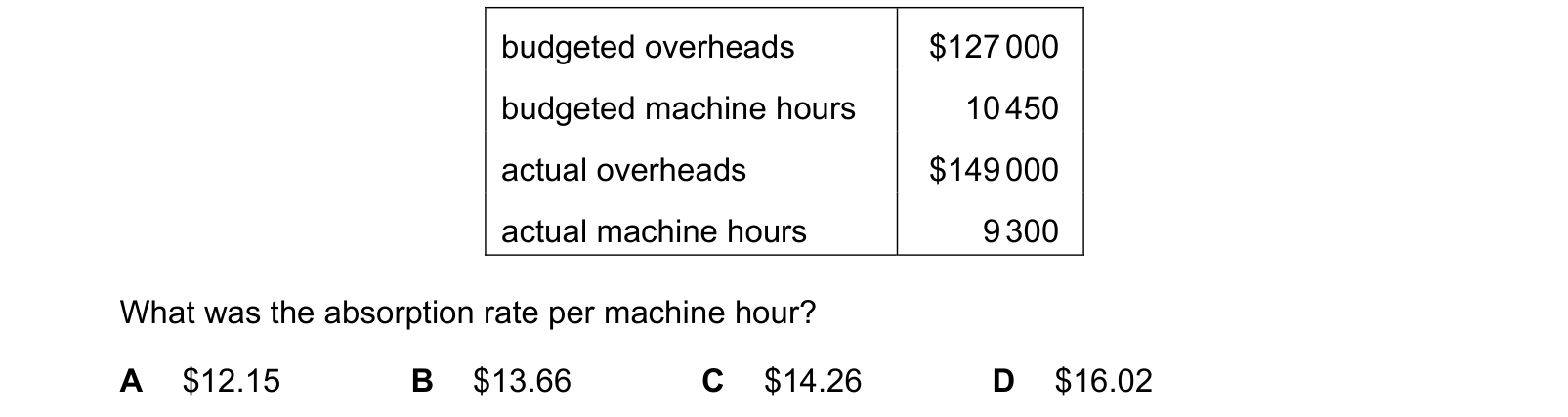
A business provided the following information.
budgeted overheads $127 000
budgeted machine hours 10 450
actual overheads $149 000
actual machine hours 9 300
What was the absorption rate per machine hour?
Answer: A.
Question 2
A business absorbs its fixed overheads using direct labour hours.
The following information is provided.
actual budgeted
overheads $600 000 $508 000
labour hours 14 300 12 700
Which statement is correct?

Answer: B.
Question 3
In March, a company’s overhead absorption rate was $2 per machine hour. In April this rate increased.
What had increased in April causing the change in the overhead absorption rate?
Answer: A.
What the syllabus asks for on this topicSyllabus points
Syllabus points
- Allocate and apportion overheads to production and service departments.
- Reapportion service department costs to production departments.
- Calculate and apply overhead absorption rates.
- Calculate and explain under- and over-absorption of overheads.
Related CIE 9706 Accounting topics
Not the topic you were looking for? Describe what you are stuck on in your own words and we will take you to the notes that answer it.