Correction of errors and suspense accounts
Contents: 6 sections
Two families of error
Everything in this topic depends on one question: did the error leave the trial balance in agreement?
Errors that do not affect the trial balance put equal debits and credits into the books, so nothing looks wrong. There are six, covered in 2.3: omission, commission, principle, original entry, reversal of entries and compensating errors. Correcting these needs no suspense account, because the books balanced before and must balance after.
Errors that do affect the trial balance are one-sided: a single entry, a double posting to one side, a balance carried down wrongly, an addition error, or a figure entered in the wrong column. Correcting these must involve the suspense account, because the correcting entry has to put right an amount that is currently sitting in it.
That gives a reliable rule when writing a journal. If the error had two sides, the correction has two sides and neither is suspense. If the error had one side, the correction uses suspense as its other side.
The suspense account
When the trial balance does not agree, the difference is entered in a suspense account so that draft financial statements can still be produced.
- If the debit column is short, the suspense account carries a debit balance.
- If the credit column is short, the suspense account carries a credit balance.
As each one-sided error is corrected, part of the balance clears. When every such error has been found, the suspense account is zero. A suspense balance that will not clear means an error is still undiscovered, and the account must never appear in the final statement of financial position.
Writing the correcting journal
Work in three steps and the entry falls out:
- Write down what the books actually show now.
- Write down what they should show.
- The journal is whatever moves you from the first to the second.
Example, a two-sided error. Repairs of $700 were debited to the machinery account. The books show machinery too high by $700 and repairs missing. Correction: debit repairs $700, credit machinery $700. No suspense, because the error was an error of principle and the credit side was right all along.
Example, a one-sided error. Discount received of $180 was credited to the discount received account but not entered anywhere else. Only a credit was made, so the credit column is $180 too big, and suspense carries a debit of $180. Correction: debit suspense $180, credit trade payables $180.
Example, a reversal. Cash of $450 received from a customer was debited to the customer and credited to bank. Both accounts are wrong by twice the amount, so the correction is for $900: debit bank $900, credit the customer $900. Reversal errors always need double the original figure, which is the point most often missed.
Statement of corrected profit
Start from the draft profit and adjust for every error that touched the income statement. Errors between two statement of financial position accounts do not change profit at all.
| Error | Effect on profit |
|---|---|
| An expense omitted | Deduct |
| An expense overstated | Add |
| Income omitted | Add |
| Income overstated | Deduct |
| Capital expenditure charged as an expense | Add |
| Revenue expenditure capitalised | Deduct |
| Error between two customers' accounts | No effect |
| Error between bank and a payable | No effect |
| Discount allowed omitted | Deduct |
| Closing inventory undervalued | Add |
Show the working, not just the final figure. Each adjustment usually carries its own mark, and a correct total reached without them scores less than a clear list.
Common mistakes
- Using the suspense account to correct a two-sided error.
- Correcting a reversal with the original amount instead of double it.
- Adjusting profit for an error that only moved figures between two statement of financial position accounts.
- Getting the direction wrong: an overstated expense increases corrected profit.
- Leaving a suspense balance in the final accounts.
- Writing "correct the error" as the journal narrative instead of describing what was done.
- Forgetting that a corrected profit changes the capital figure in the statement of financial position too.
Check you have it
Question 1
Which errors would be identified by preparing a trial balance?
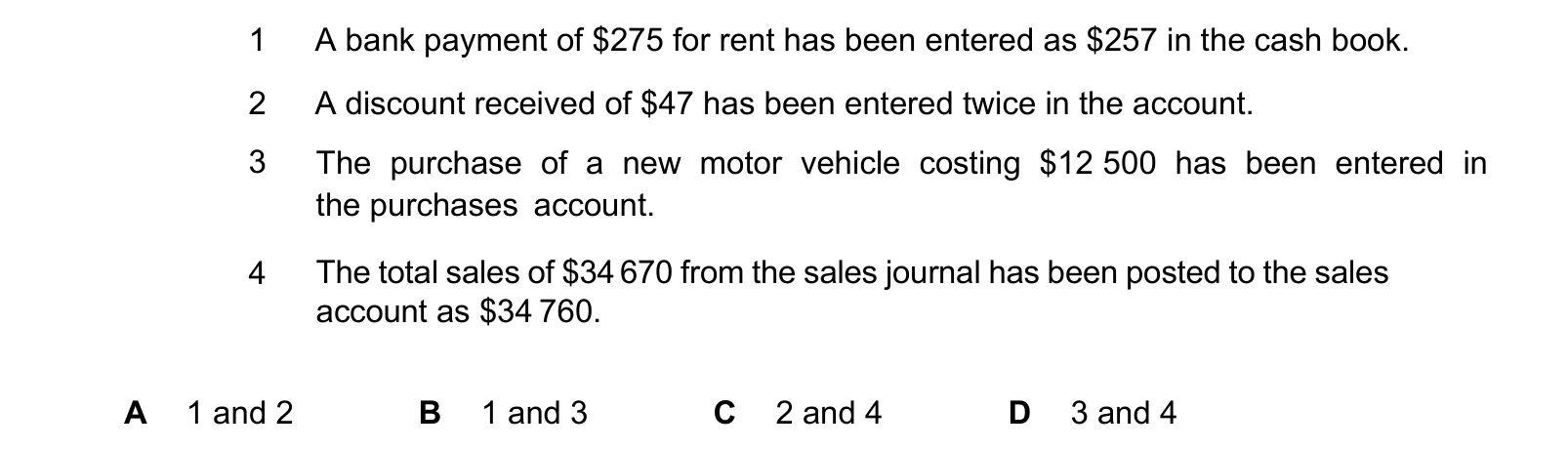
Answer: C.
Question 2
There were two errors in Bernie’s books of account. What was the opening balance in the suspense account?

Answer: A.
Question 3
Which are reasons for preparing a trial balance?
1 to assist in the preparation of draft financial statements
2 to detect all errors in the books of account
3 to find out the balance of the suspense account
Answer: B.
What the syllabus asks for on this topicSyllabus points
Syllabus points
- Identify and correct errors that do not affect the trial balance.
- Identify and correct errors that do affect the trial balance, using a suspense account.
- Prepare journal entries to correct errors.
- Prepare a statement of corrected profit.
Related CIE 9706 Accounting topics
Not the topic you were looking for? Describe what you are stuck on in your own words and we will take you to the notes that answer it.