Disposal and revaluation
Contents: 7 sections
Profit or loss on disposal
The calculation is short:
profit or loss on disposal = proceeds − carrying amount at the date of disposal
where the carrying amount is cost less accumulated depreciation to that date.
Proceeds above carrying amount give a profit on disposal, which is credited to the income statement as an item of other income. Proceeds below give a loss on disposal, which is debited as an expense.
What that profit really means is worth saying, because a written question often asks. A profit on disposal is not trading profit. It says the depreciation charged over the asset's life was too much: the business wrote the asset down faster than it actually lost value, so past profits were understated and this year's figure corrects it. A loss on disposal says the opposite.
The three entries
Everything about the asset is cleared out of the ledger through a disposal account:
- Transfer the cost: debit disposal, credit the asset account with the original cost.
- Transfer the accumulated depreciation: debit provision for depreciation, credit disposal.
- Record the proceeds: debit bank (or the receivable), credit disposal.
The balance left on the disposal account is the profit or loss, transferred to the income statement. A credit balance is a profit; a debit balance is a loss.
Step 2 is the one most often left out, and omitting it turns a small profit into a large loss.
A worked disposal
A vehicle costing $18 000 has accumulated depreciation of $11 400 when it is sold for $7 000.
The carrying amount is 18 000 minus 11 400, which is $6 600. The proceeds of $7 000 exceed that by $400, so there is a profit on disposal of $400.
In the disposal account: debit $18 000 cost and credit $11 400 depreciation and $7 000 proceeds, so credits of $18 400 exceed debits of $18 000 by $400, a credit balance, which confirms a profit.
Part exchange
A part exchange is a disposal where the proceeds arrive as a reduction in the price of the new asset rather than as cash.
Handle it in two steps and it stays simple:
- The part-exchange allowance is the proceeds of the old asset. Debit the new asset account, credit disposal.
- The cost of the new asset is the full price, not the cash paid. The full price is the allowance plus whatever cash or finance made up the balance.
A machine with a carrying amount of $4 300 is part exchanged for a new one priced at $26 000, with an allowance of $5 000 and the balance of $21 000 paid by cheque.
The old machine shows a profit on disposal of 5 000 minus 4 300, which is $700. The new machine is capitalised at $26 000, not $21 000.
Capitalising only the cash paid is the standard error here, and it understates the asset and every future depreciation charge.
Revaluation
An asset, most often land and buildings, may be restated at a higher current value.
- Debit the asset account with the increase, credit the revaluation reserve.
- If a provision for depreciation on that asset exists, it is cleared to the revaluation account as part of the exercise, so the asset is then carried at the new valuation with no accumulated depreciation against it.
The revaluation surplus is a capital reserve. Three things follow, and all three are examined:
- It is not a profit and never goes through the income statement. Nothing has been sold and no cash has been received.
- It cannot be distributed as a dividend, because it is unrealised.
- It increases equity and therefore reduces the gearing ratio, which is one reason a company might choose to revalue.
Depreciation in later years is charged on the new, higher valuation over the remaining useful life, so the annual charge rises and profit falls.
Revaluing supports the concept of relevance, by showing a value users can act on, but it works against historic cost and prudence, because the figure is an estimate rather than a verifiable transaction. A balanced answer says both.
Common mistakes
- Forgetting to transfer the accumulated depreciation to the disposal account.
- Comparing proceeds with cost instead of with carrying amount.
- Capitalising only the cash paid in a part exchange.
- Taking a revaluation surplus to the income statement.
- Paying a dividend out of the revaluation reserve.
- Continuing to depreciate on the old cost after a revaluation.
- Saying a profit on disposal means the asset was sold well, without explaining that it means depreciation was overcharged.
Check you have it
Question 1
A company revalued its premises upwards.
Which statement about the increase in value is correct?
Answer: A.
Question 2
A business purchased a vehicle which had cost $27 000 and had an estimated residual value of $1000. Depreciation of $18 200 has been charged on this vehicle.
The vehicle was sold in part exchange for a new vehicle which cost $29 500. A cheque for $19 000 was paid in settlement of the transaction.
Which profit or loss was made on the sale of the vehicle?
Answer: C.
Question 3
The following information is available. $ freehold premises at cost 125 000 provision for depreciation of freehold premises 50 000 The premises were revalued at $180 000. Which entries are required to record the revaluation? Each answer gives, in order: income statement; freehold premises at cost account; provision for depreciation; revaluation reserve.
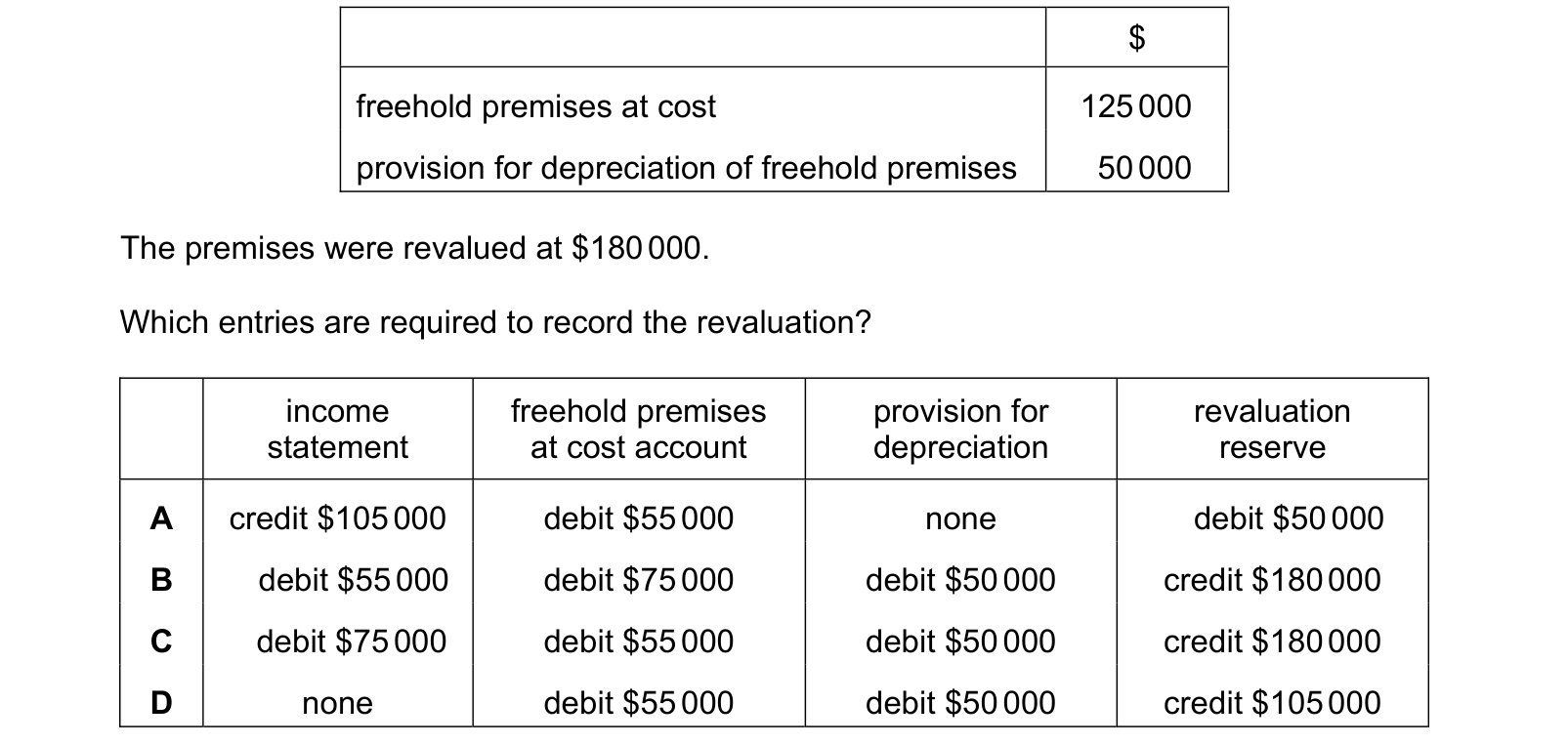
Answer: D.
What the syllabus asks for on this topicSyllabus points
Syllabus points
- Record the disposal of a non-current asset and calculate the profit or loss on disposal.
- Record a part exchange of a non-current asset.
- Record the revaluation of a non-current asset and explain the treatment of the surplus.
Related CIE 9706 Accounting topics
Not the topic you were looking for? Describe what you are stuck on in your own words and we will take you to the notes that answer it.