Capital and revenue expenditure
Contents: 8 sections
The distinction
Capital expenditure is money spent acquiring a non-current asset, or improving one so that it does more than it did before. It appears in the statement of financial position and is written off gradually through depreciation.
Revenue expenditure is the running cost of the period: keeping the asset working, and everything else the business spends to trade. It is charged in full to the income statement of the period.
The test is whether the spending gives a benefit beyond the current period and whether it improves the asset rather than maintaining it.
Cost includes getting the asset ready
Capital expenditure is not just the purchase price. Everything spent bringing the asset to its location and into working condition is capitalised:
- Purchase price, after any trade discount.
- Delivery and carriage inwards.
- Installation, testing and commissioning.
- Legal fees on the purchase of a property.
- Site preparation.
- Initial modifications required to make the asset usable.
What is not capitalised, even though it arrives on the same invoice:
- The annual insurance and the road licence on a new vehicle.
- Fuel and consumables.
- Staff training on the new machine.
- Maintenance contracts.
- Repairs after the asset is in use.
The dividing line is the moment the asset becomes ready for use. Costs before it go into the asset; costs after it are expenses.
A worked comparison
A machine is bought for a list price of $40 000 with a 10% trade discount. Delivery costs $1 200, installation $2 500, a first-year maintenance contract $900 and operator training $600.
The capitalised cost is the discounted price of $36 000, plus delivery $1 200, plus installation $2 500, which comes to $39 700. The maintenance contract and the training, $1 500 together, are revenue expenditure and go straight to the income statement.
Receipts
The same split applies to money coming in.
- Capital receipts come from selling a non-current asset, issuing shares, or taking out a loan. They are not income of the period.
- Revenue receipts are the trading income of the period: sales, rent received, commission received, discount received.
Selling a delivery van for $3 000 does not add $3 000 to revenue. Only the profit or loss on disposal, the difference between the proceeds and the carrying amount, touches the income statement.
What goes wrong when they are mixed up
This is where the marks are, because a single misclassification hits both statements at once.
| Error | Profit | Non-current assets | Capital |
|---|---|---|---|
| Capital expenditure treated as revenue | Understated | Understated | Understated |
| Revenue expenditure treated as capital | Overstated | Overstated | Overstated |
Take the second row concretely. A repair of $5 000 debited to the machinery account instead of repairs: the income statement is missing a $5 000 expense, so profit is $5 000 too high, and machinery is $5 000 too high in the statement of financial position. It gets worse in later years, because the $5 000 is now being depreciated, so a further error runs through every subsequent income statement.
Both errors are errors of principle, so the trial balance still balances and nothing prompts an investigation.
The borderline cases
- Repainting an existing building: revenue, it maintains.
- Painting a newly built building for the first time: capital, it completes the asset.
- Replacing a broken window: revenue.
- Adding an extension: capital, the building does more.
- Replacing an engine with an identical one: revenue, it restores.
- Fitting a larger engine that increases capacity: capital, it improves.
- Legal fees defending a boundary dispute: revenue.
- Legal fees on purchasing the property: capital.
Say why in an answer. "Capital, because it increases the earning capacity of the asset rather than maintaining it" scores; "capital" on its own often does not.
Common mistakes
- Capitalising the whole invoice, including insurance, licence, fuel or training.
- Treating proceeds from selling an asset as sales revenue.
- Saying the trial balance would reveal the misclassification. It will not.
- Stating the effect on profit but not on the statement of financial position, when the question asks for the effect on the financial statements.
- Forgetting that overstating an asset also overstates the following year's depreciation charge.
- Treating a loan received as income.
Check you have it
Question 1
An item of capital expenditure has been incorrectly treated as revenue expenditure in the financial statements of a business. What is the effect of this error on the financial statements? Each answer gives, in order: assets; profit for the year.
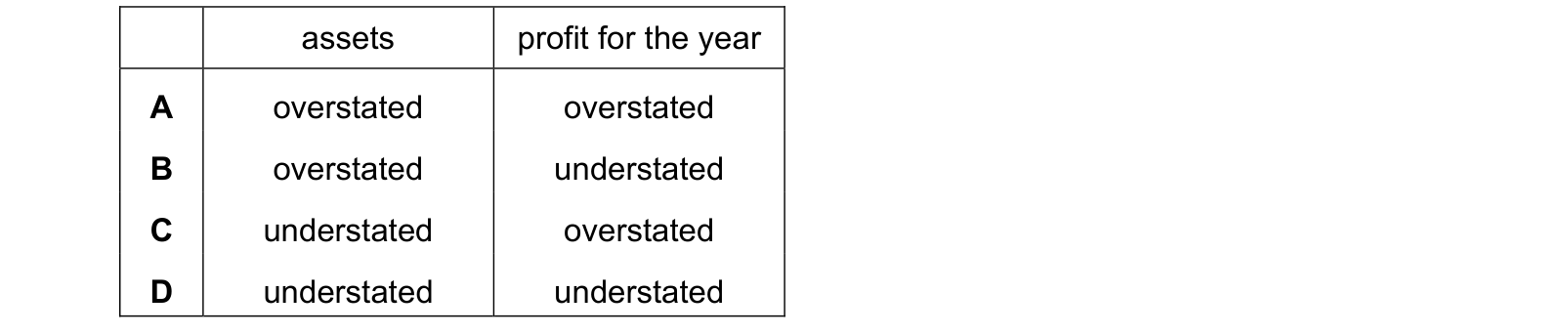
Answer: D.
Question 2
Which items are capital expenditure?
1 payment of wages to staff to install new equipment
2 purchase of a new computer for office
3 purchase of spare parts for factory equipment
4 use of factory machinery to repair owner’s car
Answer: A.
Question 3
A business recorded expenditure on improving a non-current asset as revenue expenditure. What is the effect of this error on the carrying value of non-current assets and profit for the year? Each answer gives, in order: carrying value of non-current assets; profit for the year.
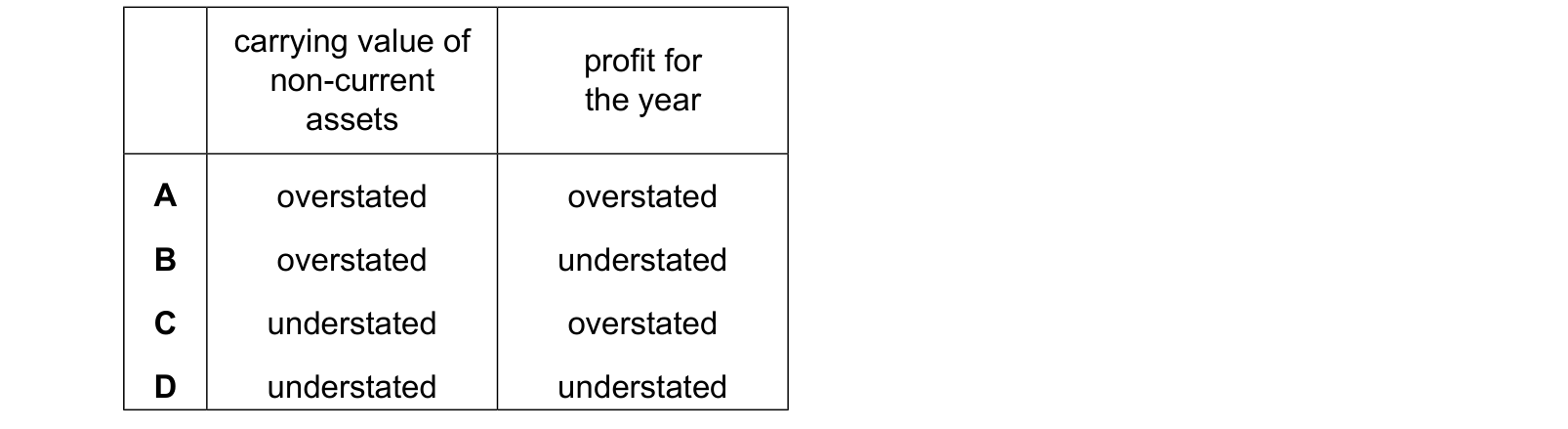
Answer: D.
What the syllabus asks for on this topicSyllabus points
Syllabus points
- Distinguish capital expenditure from revenue expenditure.
- Distinguish capital receipts from revenue receipts.
- Explain the effect on profit and on the statement of financial position of treating one as the other.
Related CIE 9706 Accounting topics
Not the topic you were looking for? Describe what you are stuck on in your own words and we will take you to the notes that answer it.