25 past-paper questions on this unit. Five of them are below. Answer on the page: each one is marked the moment you pick, the correct option is shown whether or not you found it, and the full explanation opens either way.
CIE 9706 AccountingPaper 1 MCQsFree account
Capital and revenue expenditure: five questions to try now
Real past-paper questions, the answer key from the mark scheme, and the explanation that goes with it. No account needed to answer them.
Question 1
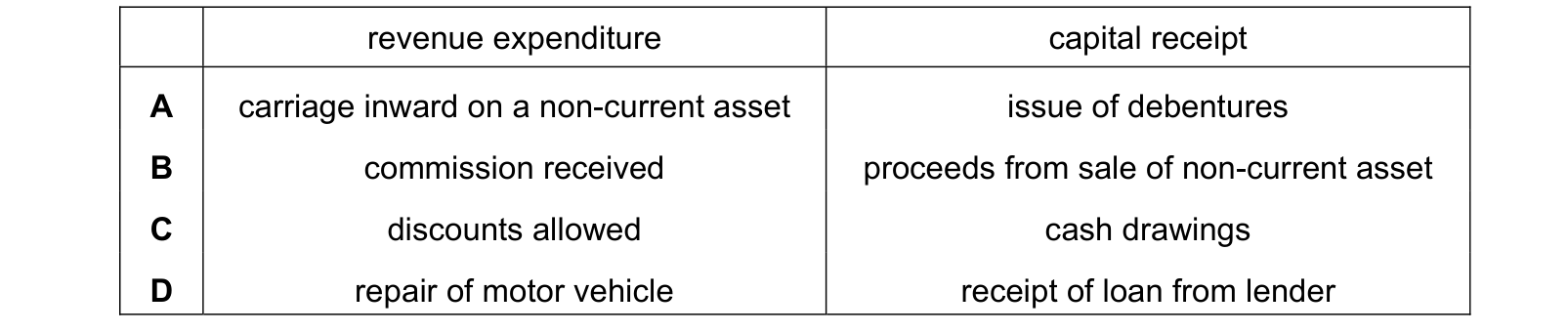
Which items identify revenue expenditure and a capital receipt? Each answer gives, in order: revenue expenditure; capital receipt.
Answer: D.
Repairing a motor vehicle keeps an existing asset working, so it is revenue expenditure, and a loan received is new long-term finance rather than income, so it is a capital receipt. Both halves of D hold. A names a capital receipt correctly, since a debenture issue is one, but carriage inward on a non-current asset is part of that asset's cost and so is capital expenditure. B also names a capital receipt correctly, but commission received is income, not expenditure of any kind. C has discounts allowed right as revenue expenditure, but cash drawings are money taken out by the owner, not a receipt.
Question 2
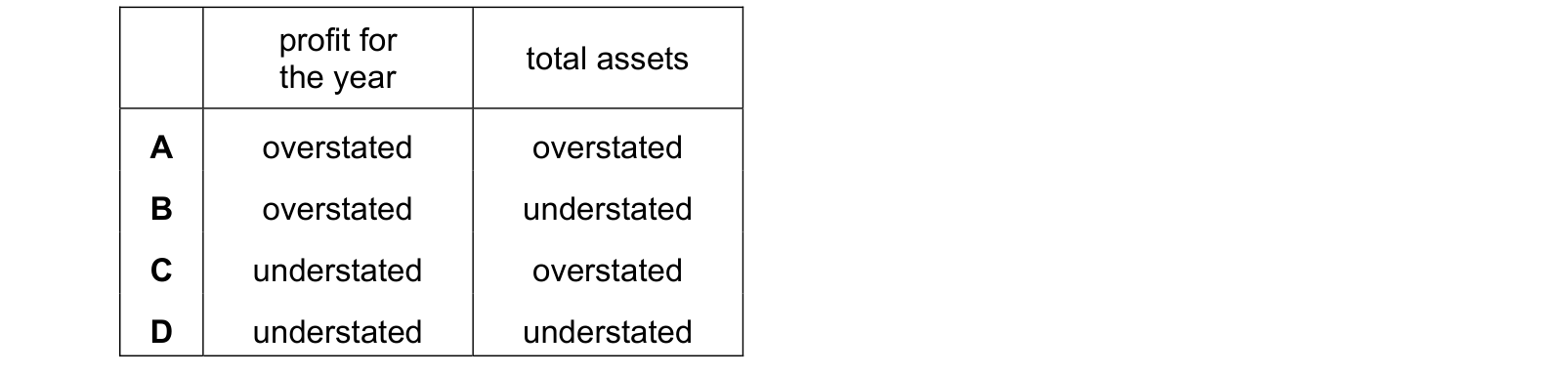
The delivery cost of a machine purchased for business use has been included in carriage inwards. What is the effect on the profit for the year and on total assets? Each answer gives, in order: profit for the year; total assets.
Answer: D.
Carriage inwards is added to purchases, so putting the machine's delivery cost there inflates cost of sales, cuts gross profit and leaves profit understated. That same money should have been capitalised as part of the machine, so non-current assets, and total assets with them, are understated too. Both effects run the same way, which rules out B and C at a glance. A is the mirror image of the truth: charging capital expenditure as an expense can only depress reported profit. The rule being tested is that any cost of bringing an asset to its working location and condition is capital expenditure.
Question 3
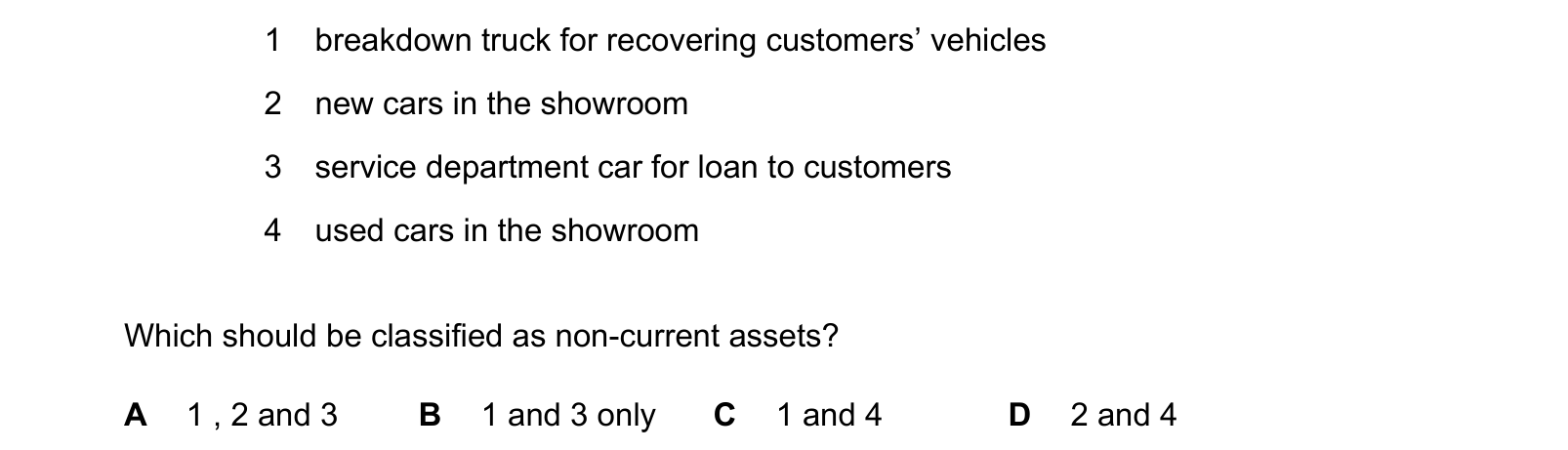
A car dealer and garage owner has the following vehicles at her premises. Which should be classified as non-current assets?
Answer: B.
The test is what the vehicle is used for, not what kind of vehicle it is. The breakdown truck recovers customers' vehicles and the service department car is lent to customers, so both are used to run the business and are non-current assets. New and used cars in the showroom are held for resale, so they are inventory, a current asset, which rules out A, C and D. This is the classic trap in a motor dealer's accounts, where identical vehicles land in different parts of the statement of financial position depending on what the business intends to do with them.
Question 4
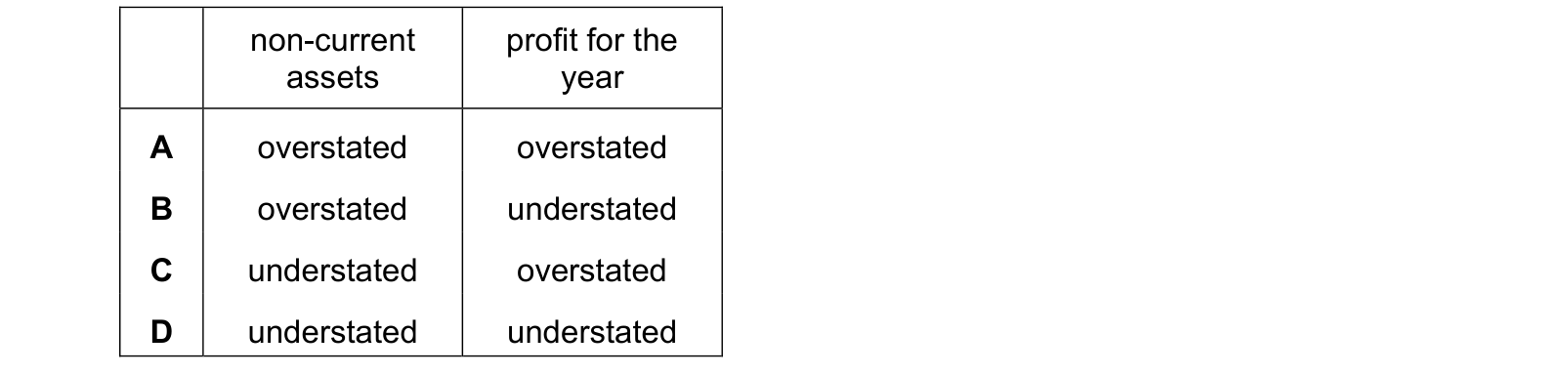
An item of revenue expenditure is wrongly treated as capital expenditure. What is the effect of this error? Each answer gives, in order: non-current assets; profit for the year.
Answer: A.
Treating revenue expenditure as capital puts a running cost into the asset account. The income statement is therefore missing an expense, so profit is OVERSTATED, and the asset account holds something that is not an asset, so non-current assets are OVERSTATED too. Both move the same way, which is what makes this error so damaging: it flatters the profit and the balance sheet at once, and it goes on doing so because the amount is then depreciated in later years.
Question 5
Why is it important for a trader to distinguish between capital expenditure and revenue expenditure? 1 to apply the realisation concept 2 to know which method of depreciation to use 3 to obtain a more accurate profit figure
Answer: D.
Capital expenditure is carried forward as an asset with only its depreciation charged this year, while revenue expenditure is charged in full, so misclassifying it distorts the profit. That makes 3 the only correct reason. 1 is wrong because the realisation concept governs when revenue is recognised, not how spending is classified. 2 is wrong because the choice of depreciation method depends on how an asset gives up its benefits, not on the capital or revenue split. A, B and C each rest on one of those two loose associations.
These questions are drawn from past CIE 9706 Accounting papers and filtered to capital and revenue expenditure. You answer, you find out immediately whether you were right, and you get the reasoning for the correct option and for each distractor. Wrong answers go to a mistakes locker so you can come back to exactly those.
Practice is free. You need an account only so your progress and your mistakes are still there next time.
These are the errors that cost marks on capital and revenue expenditure, taken from our own topic notes. Read them before you practise and you will recognise the traps in the questions.
Capitalising the whole invoice, including insurance, licence, fuel or training.
Treating proceeds from selling an asset as sales revenue.
Saying the trial balance would reveal the misclassification. It will not.
Stating the effect on profit but not on the statement of financial position, when the question asks for the effect on the financial statements.
Forgetting that overstating an asset also overstates the following year's depreciation charge.