Depreciation and changing asset values
Contents: 9 sections
What depreciation is
Depreciation is the allocation of the cost of a non-current asset over its useful life. It is not a valuation, and it is not a fund of cash set aside for a replacement.
Two consequences follow from that definition, and both are examined:
- Depreciation is charged because of the accruals concept. The asset earns revenue over several years, so its cost must be spread over those years to match.
- Depreciation does not involve any movement of cash. The cash left when the asset was bought. This is why depreciation is added back in a cash flow statement.
The causes are wear and tear, obsolescence (a newer model makes this one uneconomic), the passage of time (a lease of a fixed number of years), and depletion (a quarry runs out).
Straight line
An equal charge every year.
annual depreciation = (cost − residual value) / useful life
Alternatively a fixed percentage of cost is given, in which case residual value is usually zero.
A machine costs $50 000, has a residual value of $5 000 and a useful life of 5 years. The annual charge is 45 000 divided by 5, which is $9 000 every year. After 3 years the accumulated depreciation is $27 000 and the carrying amount is $23 000.
Straight line suits assets that give an even benefit over their life, and assets whose life is defined by time: fixtures, buildings, a lease.
Reducing balance
A fixed percentage of the carrying amount, so the charge falls each year.
annual depreciation = carrying amount at the start of the year x rate
The same $50 000 machine at 20% reducing balance:
| Year | Opening carrying amount | Charge at 20% | Closing carrying amount |
|---|---|---|---|
| 1 | 50 000 | 10 000 | 40 000 |
| 2 | 40 000 | 8 000 | 32 000 |
| 3 | 32 000 | 6 400 | 25 600 |
Note that the charge is calculated on the carrying amount, not the cost, from year 2 onward. Applying 20% to $50 000 every year is the single most common error in this topic.
Reducing balance suits assets that give more benefit early, and assets with rising repair costs: vehicles and machinery. Charging more depreciation in the early years, when repairs are low, gives a more even total cost across the life.
Revaluation
Used for many small items that are hard to track individually, such as loose tools, small equipment or crockery.
depreciation = opening valuation + purchases during the year − closing valuation
Loose tools valued at $4 200 at the start of the year, with $900 bought during the year and a closing valuation of $3 600, give a charge of 4 200 plus 900 minus 3 600, which is $1 500.
The ledger entries
Depreciation is recorded so that the asset account keeps showing cost, and the accumulated depreciation is held separately.
- Debit depreciation expense, credit provision for depreciation.
- The depreciation expense goes to the income statement.
- The provision for depreciation is a credit balance, deducted from cost in the statement of financial position to give the carrying amount.
So a machine at cost $50 000 with a provision of $27 000 is shown at a carrying amount of $23 000. The cost figure never changes because of depreciation.
Choosing a method, and the policies around it
Consistency requires the same method year after year. A change is allowed if it gives a fairer presentation, but it must be justified and disclosed.
Businesses also adopt a policy for the year of purchase. The two common ones are a full year's charge in the year of purchase and none in the year of sale, or a proportionate charge for the months owned. The question will tell you which applies. Read that sentence before calculating anything.
Effect if depreciation is wrong
| Error | Profit | Carrying amount |
|---|---|---|
| Depreciation overcharged | Understated | Understated |
| Depreciation undercharged | Overstated | Overstated |
| No depreciation charged at all | Overstated | Overstated |
Failing to depreciate breaks the accruals concept, because the cost is not matched to the periods that benefit, and prudence, because both profit and assets end up overstated.
Common mistakes
- Applying the reducing-balance rate to cost instead of to carrying amount.
- Deducting residual value when calculating reducing-balance depreciation. Residual value is used in the straight-line formula only.
- Saying depreciation sets money aside to replace the asset.
- Crediting the asset account instead of the provision account.
- Ignoring the stated policy on part years.
- Saying depreciation is a valuation of the asset. Carrying amount is very rarely market value.
- Treating the provision for depreciation as a debit balance in the trial balance.
Check you have it
Question 1
Which items would appear on the debit side of the dissolution account for a partnership?
1 costs of dissolution
2 net book value of the assets
3 proceeds of sales of assets
4 profit on dissolution
Answer: B.
Question 2
Jake sold a non-current asset which was not fully depreciated. He mistakenly recorded this by debiting the bank account and crediting the sales account with the proceeds.
What was the effect of this error?
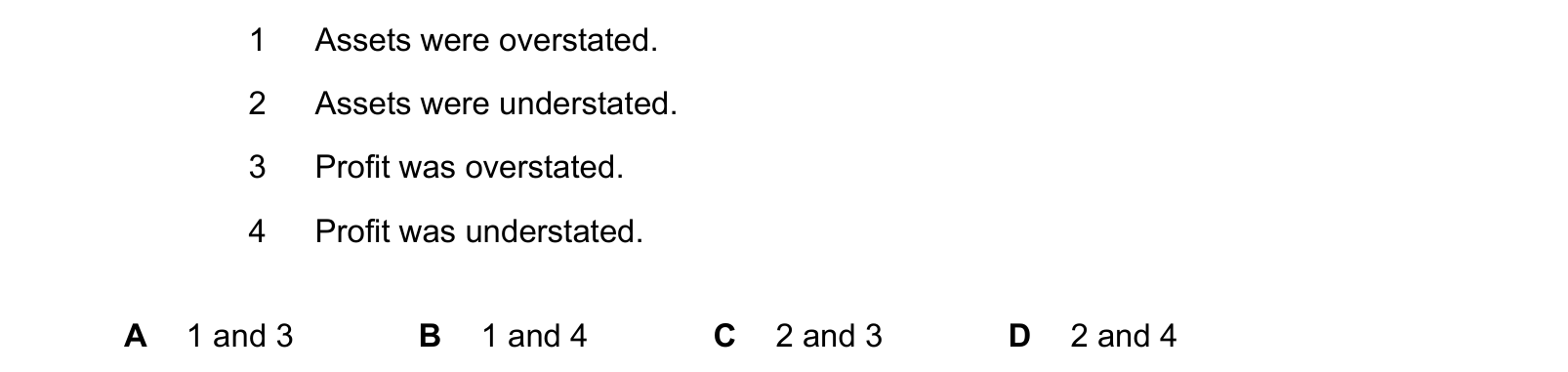
Answer: A.
Question 3
The following information relates to the motor vehicles of a business. During the year 2021 the following occurred. What was the depreciation charge for 2021?
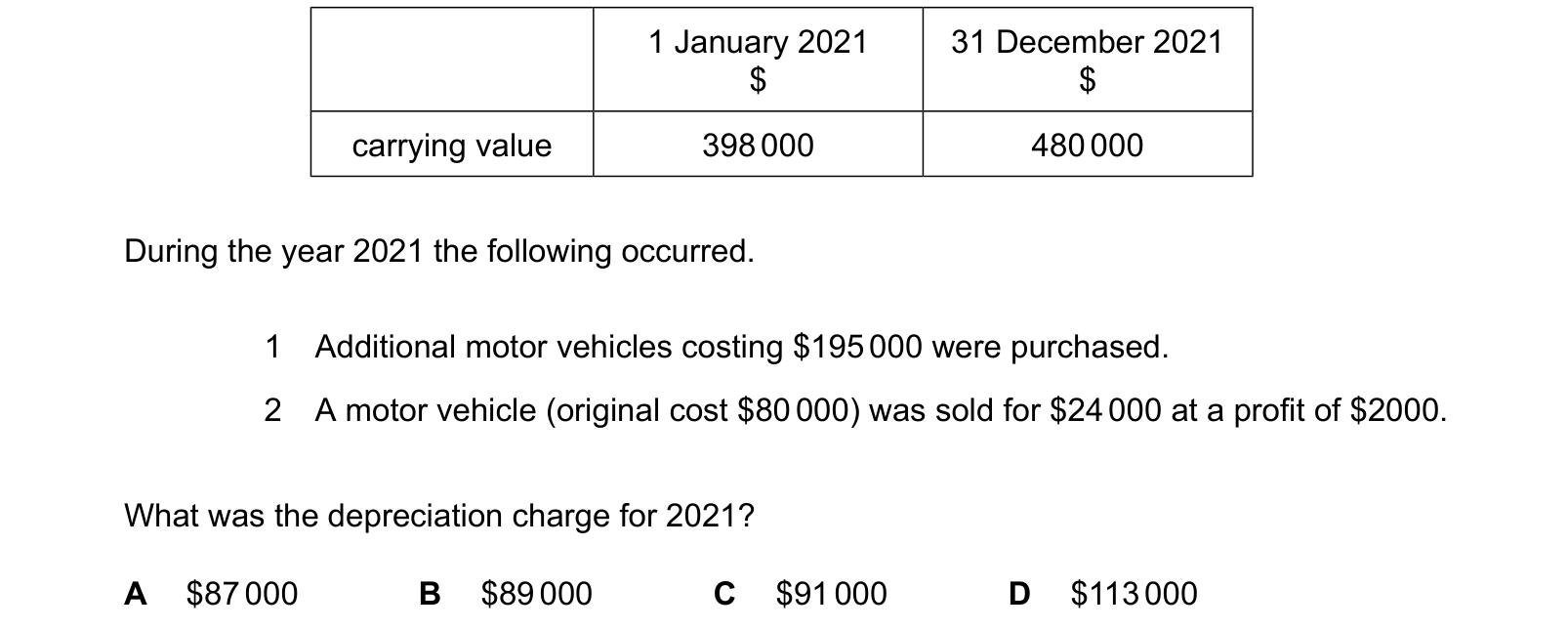
Answer: C.
What the syllabus asks for on this topicSyllabus points
Syllabus points
- Explain the causes of depreciation and why it is charged.
- Calculate depreciation using the straight-line, reducing-balance and revaluation methods.
- Record depreciation in the ledger and present it in the financial statements.
- Compare the methods and justify a choice for a given asset.
Related CIE 9706 Accounting topics
Not the topic you were looking for? Describe what you are stuck on in your own words and we will take you to the notes that answer it.