Depreciation and changing asset values Exam Questions
110 past-paper questions on this unit. Five of them are below. Answer on the page: each one is marked the moment you pick, the correct option is shown whether or not you found it, and the full explanation opens either way.
CIE 9706 AccountingPaper 1 MCQsFree account
Depreciation and changing asset values: five questions to try now
Real past-paper questions, the answer key from the mark scheme, and the explanation that goes with it. No account needed to answer them.
Question 1
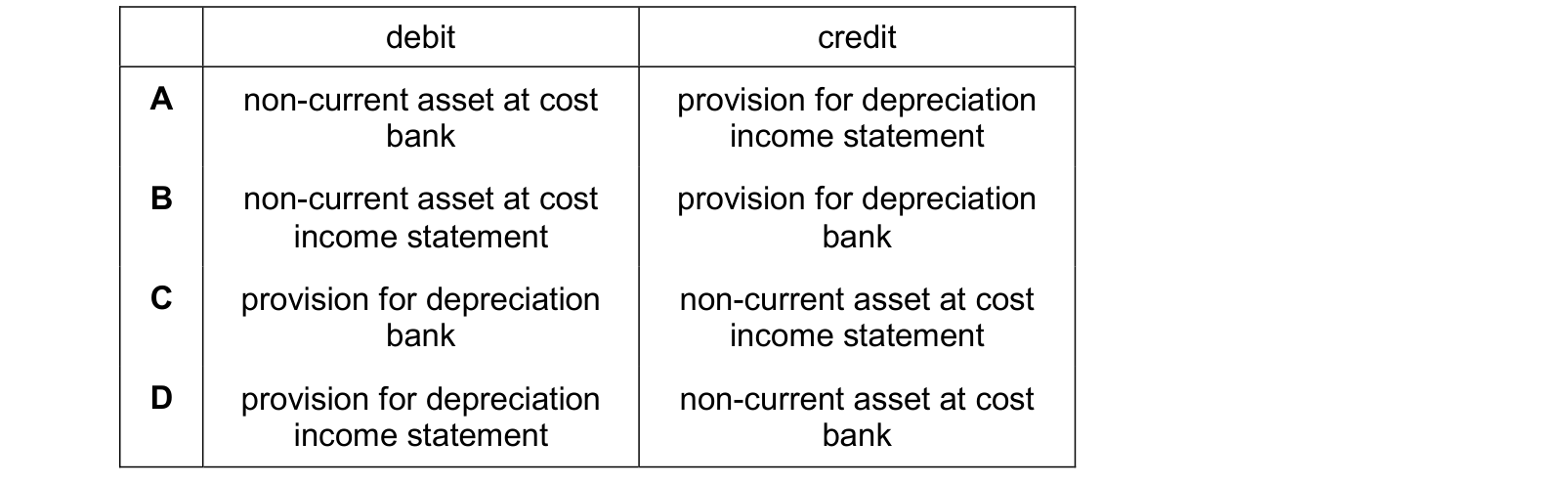
A business sold a non-current asset at a profit. What are the entries to be made in a disposal account? Each answer gives, in order: debit; credit.
Answer: B.
Build the disposal account in order: the cost of the asset is transferred in on the debit side, and the accumulated depreciation and the proceeds from the bank are both credited. Where the asset sold at a profit the credits exceed the debits, so the balancing entry is a debit in the disposal account and a credit in the income statement, which is why the income statement sits on the debit side here. A puts the proceeds on the debit side and the income statement on the credit side, which is the pattern a loss on disposal would give. C and D swap cost and accumulated depreciation, starting the account from the wrong side entirely.
Question 2
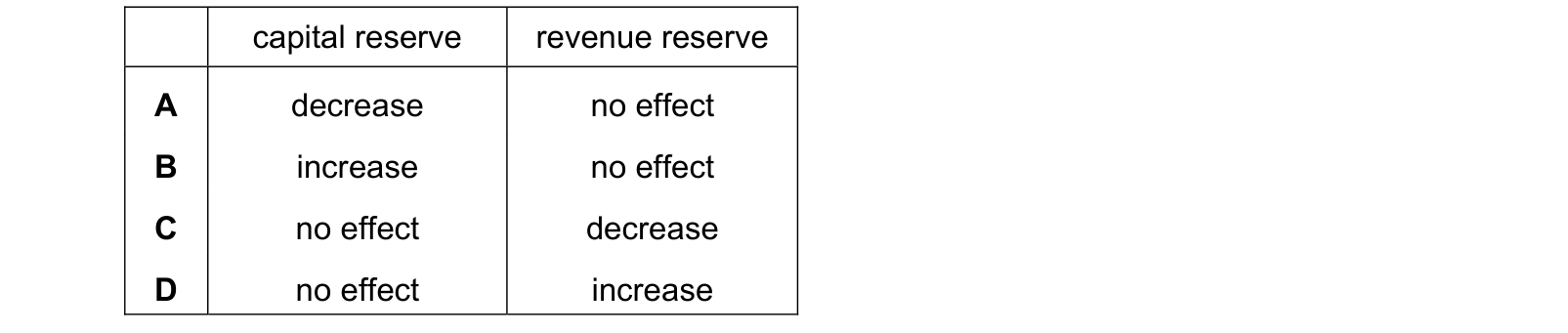
A depreciated non-current asset is revalued upwards. What is the effect of this? Each answer gives, in order: capital reserve; revenue reserve.
Answer: B.
An upward revaluation is credited to a revaluation reserve, and that is a capital reserve because the gain is unrealised and cannot be paid out as a dividend. Retained earnings, the revenue reserve, are untouched, because the surplus never passes through the statement of profit or loss. So the capital reserve increases and the revenue reserve is unaffected. A has the capital reserve falling, which is what a downward revaluation would do. C and D route the gain into retained earnings, which would make an unrealised gain distributable, and the realisation concept does not allow that.
Question 3
The non-current asset turnover of a business improved between 2020 and 2021, even though the net revenue was the same for both years. What caused the improvement in the ratio?
Answer: C.
Non-current asset turnover is revenue divided by non-current assets, and revenue was the same in both years, so the ratio can only have improved because the non-current asset figure fell. That happens when the depreciation charged for the year is larger than the cost of the new assets bought, which is C. B pushes the carrying amount of the premises up, so the ratio would get worse rather than better, and D increases the asset base for the same reason. A changes irrecoverable debts, which sit in expenses and in trade receivables, so it affects profit and current assets but leaves revenue and non-current assets untouched.
Question 4
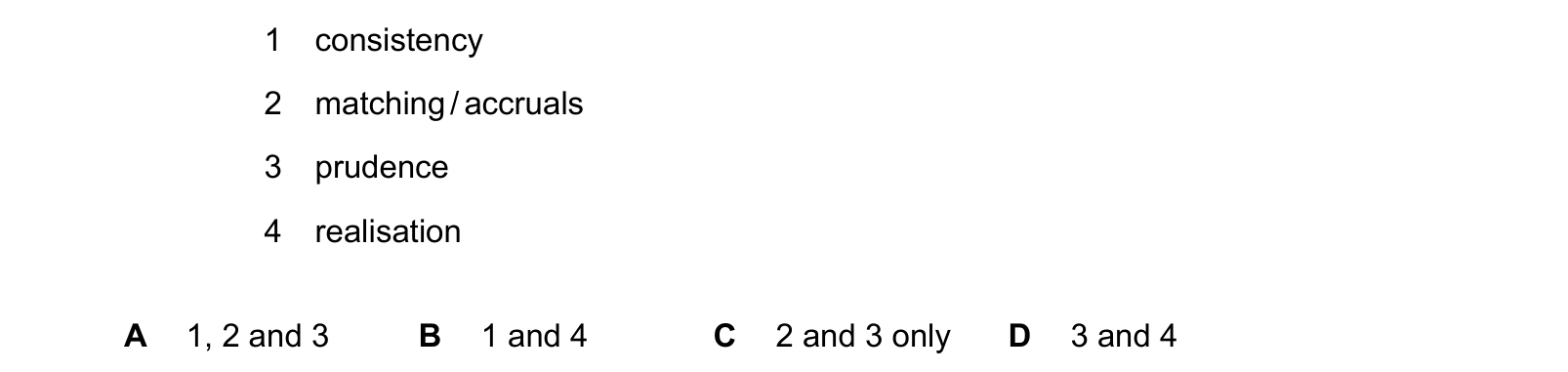
Which accounting concepts are applied when a business makes an annual charge for depreciation of non-current assets?
Answer: A.
Depreciation spreads the cost of an asset over the periods that benefit from it, which is matching, or accruals. Charging it the same way each year is consistency, and writing the asset down rather than carrying it at cost keeps assets and profit from being overstated, which is prudence. So 1, 2 and 3 all apply. Realisation governs when revenue is recognised, as the goods or service pass to the customer, and has nothing to do with the annual charge, so B and D fail on that. C drops consistency, which matters because a business that changed method every year could report almost any profit it liked.
Question 5
A trader depreciates loose tools using the revaluation method. Which account is credited at the end of the year to record depreciation on loose tools?
Answer: C.
Under the revaluation method there is no provision for depreciation account at all. The tools are valued at the year end and the fall in value is the charge for the year, so the entry is to debit depreciation of loose tools and credit the loose tools account itself, writing the asset down directly. The account credited is therefore C. A is the account debited, not credited. B is used only when an asset is actually sold, which is not what is happening here, and D does not exist under this method, since revaluation reduces the asset account rather than building up a separate provision.
These questions are drawn from past CIE 9706 Accounting papers and filtered to depreciation and changing asset values. You answer, you find out immediately whether you were right, and you get the reasoning for the correct option and for each distractor. Wrong answers go to a mistakes locker so you can come back to exactly those.
Practice is free. You need an account only so your progress and your mistakes are still there next time.
These are the errors that cost marks on depreciation and changing asset values, taken from our own topic notes. Read them before you practise and you will recognise the traps in the questions.
Applying the reducing-balance rate to cost instead of to carrying amount.
Deducting residual value when calculating reducing-balance depreciation. Residual value is used in the straight-line formula only.
Saying depreciation sets money aside to replace the asset.
Crediting the asset account instead of the provision account.
Ignoring the stated policy on part years.
Saying depreciation is a valuation of the asset. Carrying amount is very rarely market value.
Treating the provision for depreciation as a debit balance in the trial balance.