Limited companies
Contents: 8 sections
What is different about a company
The trading and expenses sections look much like a sole trader's. Four things change.
- Directors' remuneration is an expense. Directors are employees of the company.
- Debenture and loan interest is an expense, charged whether or not the company is profitable.
- Taxation is charged after profit before tax, giving profit for the year.
- Dividends are an appropriation of profit, never an expense, and they appear in the statement of changes in equity rather than in the income statement.
So the income statement ends at profit for the year, and everything the owners receive is dealt with below it.
Share capital
Ordinary shares carry the votes and a variable dividend. Preference shares carry a fixed percentage dividend paid first, and usually no vote.
Called-up share capital is shown at nominal value, whatever the shares were actually issued for. A share with a nominal value of $1 issued at $1.50 adds $1 to share capital and $0.50 to share premium.
Reserves
Reserves split into two kinds, and the distinction decides what can be paid out.
Capital reserves cannot be distributed as a dividend:
- Share premium, the excess of issue price over nominal value.
- Revaluation reserve, the unrealised surplus on revaluing an asset.
Revenue reserves can be distributed:
- Retained earnings, the accumulated profit not yet paid out.
- General reserve, profit deliberately set aside.
A transfer to a general reserve moves one revenue reserve into another. It does not reduce profit, it does not involve any cash, and it does not stop the money being distributed later. It is a signal of intent, nothing more.
Share premium has three permitted uses worth knowing: issuing bonus shares, writing off the expenses of a share issue, and writing off a premium on the redemption of shares.
Bonus issue and rights issue
These are examined together because they look similar and behave in opposite ways.
| Bonus issue | Rights issue | |
|---|---|---|
| Offered to | Existing shareholders | Existing shareholders |
| Price | Free | Below market price |
| Cash raised | None | Cash is raised |
| Funded from | Reserves, share premium first | The shareholders |
| Effect on share capital | Increases | Increases |
| Effect on total equity | Unchanged | Increases |
A bonus issue capitalises reserves: it converts something the shareholders already owned into shares, so total equity is exactly as it was. Debit share premium (and then other reserves if the premium is insufficient), credit share capital. A bonus issue is always made at nominal value, so it never creates a share premium.
A company with 400 000 ordinary shares of $0.50 makes a one for four bonus issue. That is 100 000 new shares at a nominal value of $0.50, which is $50 000 transferred from reserves to share capital.
A rights issue raises cash and may be made above nominal value, creating a share premium. Debit bank with the full amount received, credit share capital with the nominal value and share premium with the rest.
Dividends
- Interim dividends are paid during the year.
- Final dividends are proposed after the year end and approved by the shareholders.
A proposed final dividend is not recognised as a liability at the year end, because it has not been approved and the company has no obligation. It is disclosed as a note. Only dividends paid during the year appear in the statement of changes in equity.
Preference dividends are paid before ordinary dividends. Ordinary dividends are usually stated in cents per share, so multiply by the number of shares, not by the nominal capital.
Statement of changes in equity
This statement shows how each component of equity moved during the year.
| Share capital | Share premium | General reserve | Retained earnings | Total | |
|---|---|---|---|---|---|
| Balance at start | 400 | 90 | 50 | 220 | 760 |
| Profit for the year | 140 | 140 | |||
| Dividends paid | (60) | (60) | |||
| Transfer to general reserve | 30 | (30) | 0 | ||
| Bonus issue | 100 | (90) | (10) | 0 | |
| Balance at end | 500 | 0 | 70 | 270 | 840 |
Figures in $000. Two rows have a total of zero, and that is the point of the statement: the transfer and the bonus issue move value between columns without changing the total. The overall movement, from 760 to 840, is the profit of 140 less the dividends of 60.
Common mistakes
- Treating dividends as an expense in the income statement.
- Treating debenture interest or directors' fees as an appropriation. Both are expenses.
- Showing share capital at issue price rather than nominal value.
- Saying a bonus issue raises cash, or that it increases total equity.
- Paying a dividend out of share premium or the revaluation reserve.
- Recognising a proposed final dividend as a current liability.
- Saying a transfer to general reserve reduces the profit for the year.
Check you have it
Question 1
‘Shareholders are entitled to a fixed annual dividend with any unpaid dividends being paid out of future profits.’
What does this statement describe?
Answer: A.
Question 2
The value of inventory for a limited company at 31 May 2020 was overstated by $20 000. What was the effect of this error on retained earnings? Each answer gives, in order: retained earnings at 31 May 2020; retained earnings at 31 May 2021.
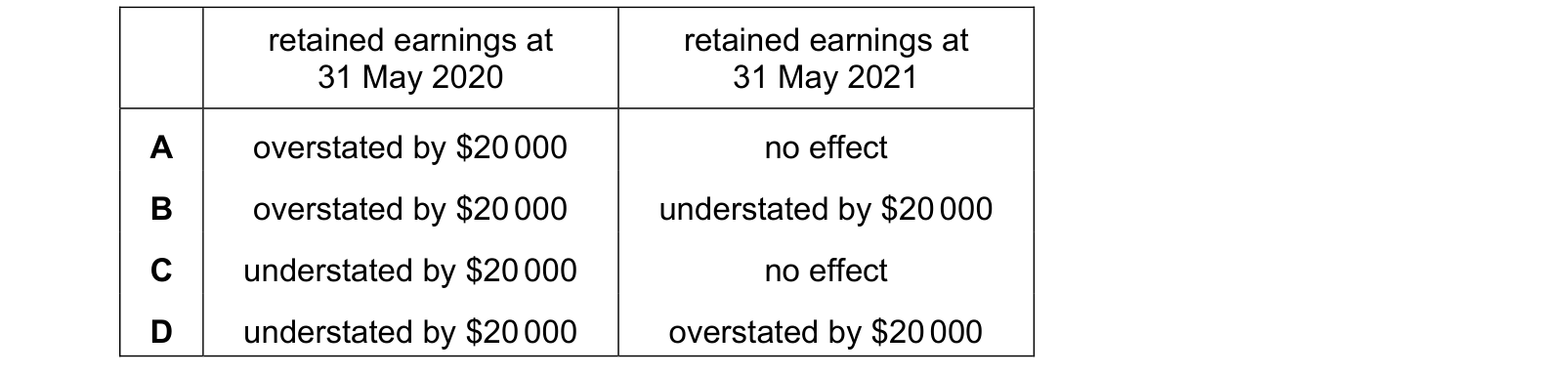
Answer: A.
Question 3
A company issues 500 000 $1 ordinary shares for $3 each and $250 000 debentures of 6%.
By which amount will the net assets of the company increase?
Answer: C.
What the syllabus asks for on this topicSyllabus points
Syllabus points
- Prepare the income statement and statement of financial position of a limited company.
- Distinguish share capital, share premium, reserves and retained earnings.
- Account for rights issues and bonus issues.
- Prepare a statement of changes in equity.
Related CIE 9706 Accounting topics
Not the topic you were looking for? Describe what you are stuck on in your own words and we will take you to the notes that answer it.