112 past-paper questions on this unit. Five of them are below. Answer on the page: each one is marked the moment you pick, the correct option is shown whether or not you found it, and the full explanation opens either way.
CIE 9706 AccountingPaper 1 MCQsFree account
Limited companies: five questions to try now
Real past-paper questions, the answer key from the mark scheme, and the explanation that goes with it. No account needed to answer them.
Question 1
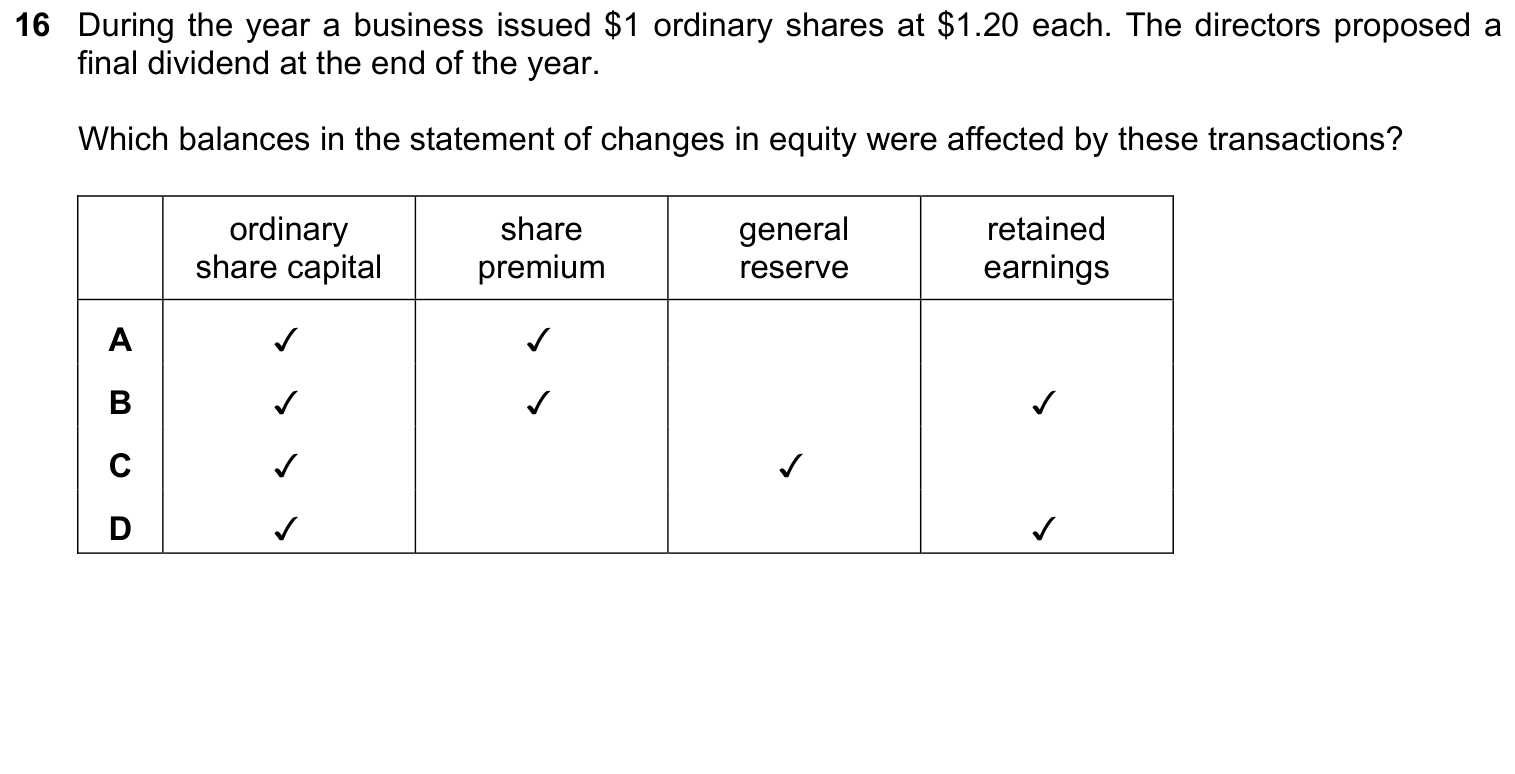
Which balances in the statement of changes in equity are affected by a share issue and proposed dividend? Use the complete source image for the figures and answer choices.
Answer: A.
Ordinary share capital and share premium only. Issuing $1 shares at $1.20 splits the proceeds: the nominal $1 goes to ordinary share capital and the $0.20 excess to share premium, which is why both move. The PROPOSED final dividend changes nothing. A dividend proposed after the reporting date is not an obligation at the year end, so it is neither a liability nor a deduction from retained earnings; it is disclosed as a note and appears in the statement of changes in equity only in the year it is actually paid. The general reserve moves only on a deliberate transfer, which nothing here does.
Question 2
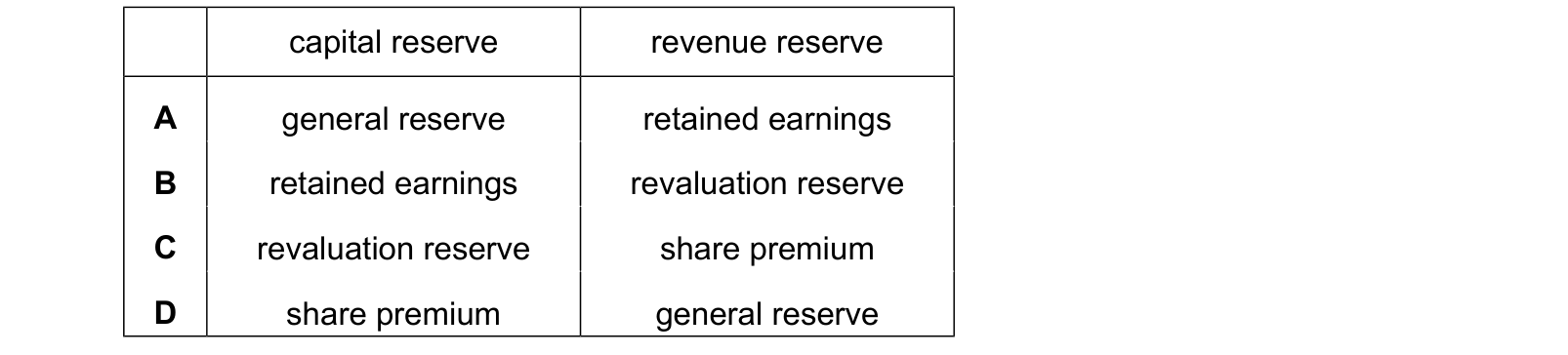
Which row correctly shows an example of a capital reserve and an example of a revenue reserve? Each answer gives, in order: capital reserve; revenue reserve.
Answer: D.
Share premium is a capital reserve and the general reserve is a revenue reserve. The distinction is where the amount came from: a capital reserve arises from something OUTSIDE normal trading, such as issuing shares above nominal value or revaluing property, and cannot be paid out as a cash dividend. A revenue reserve is accumulated trading profit and remains distributable. Retained earnings and the general reserve are both revenue; share premium and the revaluation reserve are both capital.
Question 3
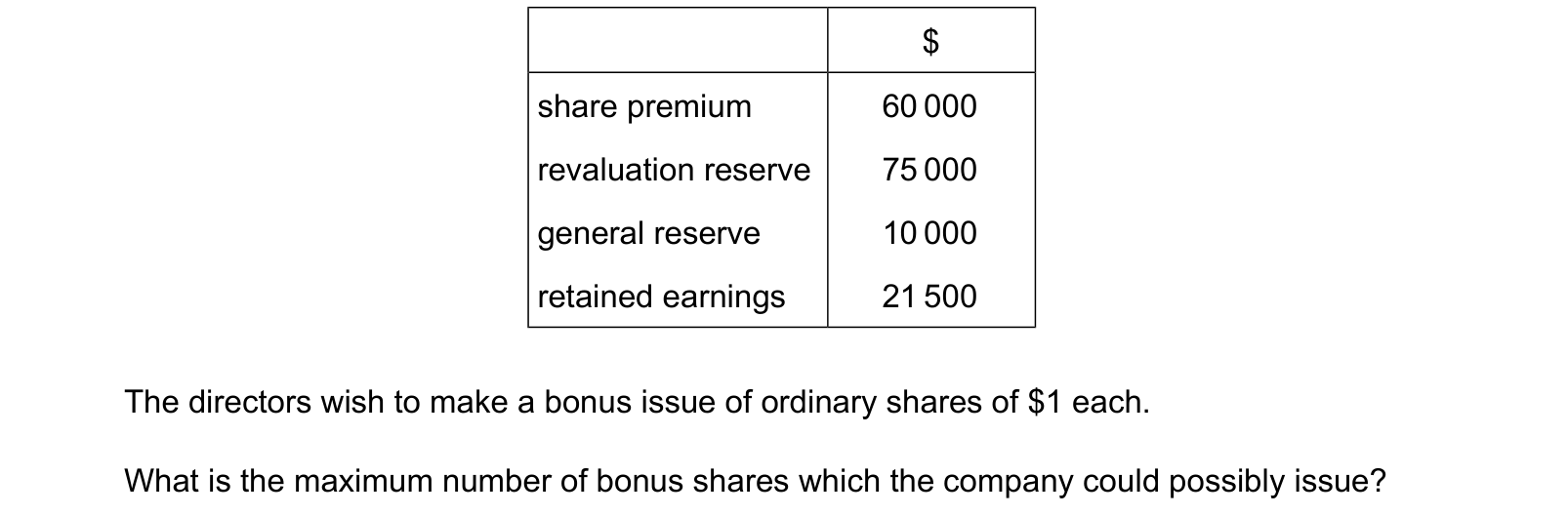
A company has the following reserves. The directors wish to make a bonus issue of ordinary shares of $1 each. What is the maximum number of bonus shares which the company could possibly issue?
Answer: B.
A bonus issue may be funded from the share premium, the general reserve and retained earnings, but NOT from the revaluation reserve, because that reserve holds an UNREALISED gain and unrealised profit cannot be capitalised. The maximum is therefore 60 000 plus 10 000 plus 21 500, which is $91 500, so 91 500 shares of $1. Including the revaluation reserve gives $166 500, which is the trap, and using only the distributable reserves gives $31 500.
Question 4
A company made a bonus issue of ordinary shares. Where would this appear in the financial statements?
Answer: A.
A bonus issue converts reserves into share capital, so total equity is unchanged but its composition shifts, with share capital rising and a reserve falling by the same amount. That movement is shown in the statement of changes in equity, and the new share capital figure appears in the statement of financial position, which is A. B is incomplete, because it gives the closing position without the transfer that produced it. C and D route the bonus issue through the statement of profit or loss, but it is a transaction with the owners in which no income or expense arises, so profit is never touched.
Question 5
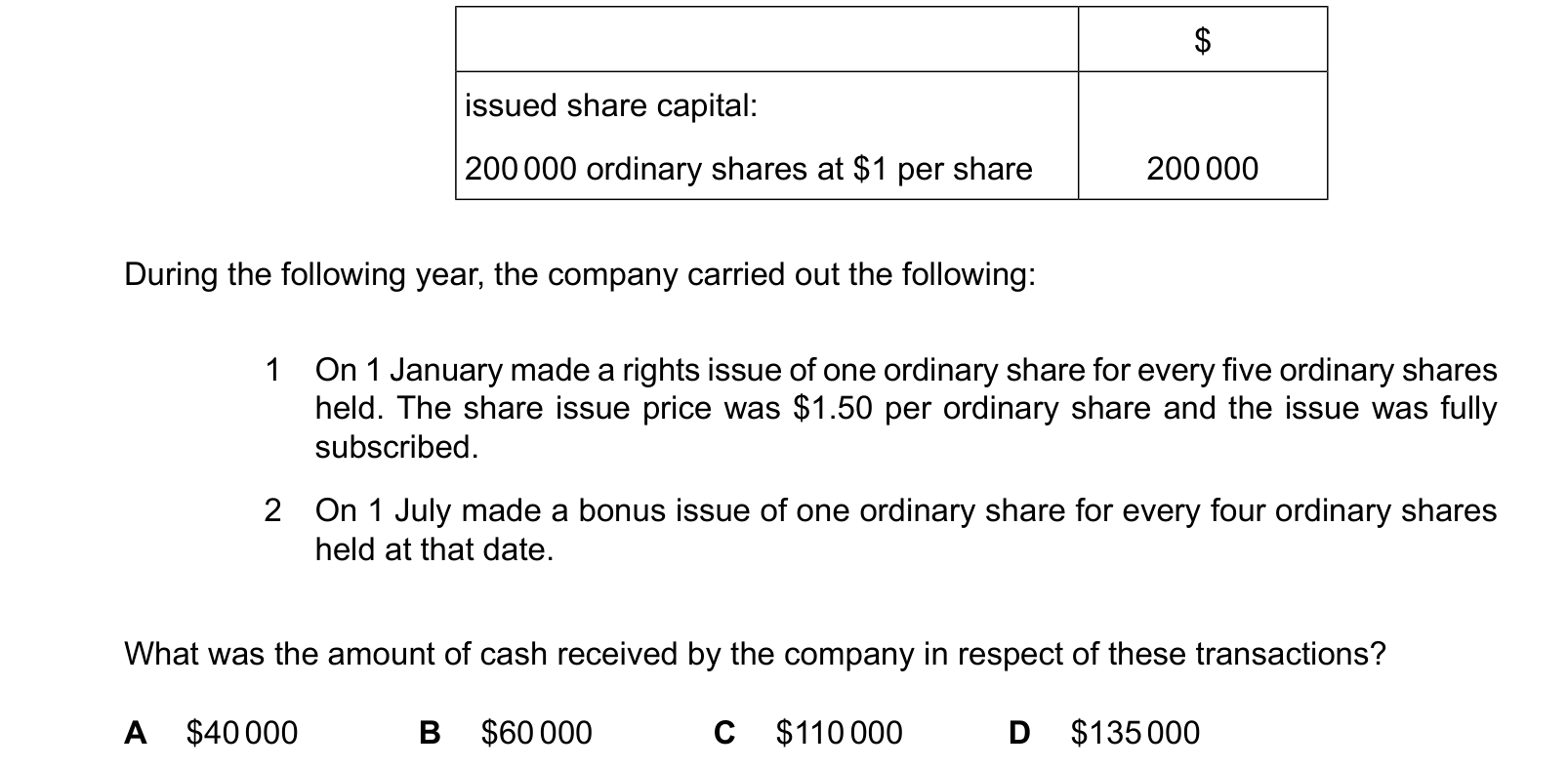
The statement of financial position of a company at 31 December showed the following: During the following year, the company carried out the following: What was the amount of cash received by the company in respect of these transactions?
Answer: B.
Only the rights issue brings cash in. One share for every five of the 200 000 held is 40 000 shares at 1.50, so 60 000 is received, 40 000 of it share capital and 20 000 share premium. A bonus issue turns reserves into shares and no money changes hands, so any answer that adds something for it is wrong: C of 110 000 and D of 135 000 both treat the bonus shares as though they had been paid for. A of 40 000 counts the rights shares at their 1 par value and drops the 0.50 of premium on each one.
These questions are drawn from past CIE 9706 Accounting papers and filtered to limited companies. You answer, you find out immediately whether you were right, and you get the reasoning for the correct option and for each distractor. Wrong answers go to a mistakes locker so you can come back to exactly those.
Practice is free. You need an account only so your progress and your mistakes are still there next time.
These are the errors that cost marks on limited companies, taken from our own topic notes. Read them before you practise and you will recognise the traps in the questions.
Treating dividends as an expense in the income statement.
Treating debenture interest or directors' fees as an appropriation. Both are expenses.
Showing share capital at issue price rather than nominal value.
Saying a bonus issue raises cash, or that it increases total equity.
Paying a dividend out of share premium or the revaluation reserve.
Recognising a proposed final dividend as a current liability.
Saying a transfer to general reserve reduces the profit for the year.