Sole traders and incomplete records
Contents: 6 sections
The sole trader's statements
The income statement runs in two stages.
Trading section, giving gross profit: revenue, less sales returns, less cost of sales. Cost of sales is opening inventory plus purchases (less purchases returns, plus carriage inwards) less closing inventory.
Profit and loss section, giving profit for the year: gross profit, plus other income, less expenses.
Two details decide several marks. Carriage inwards is part of cost of sales, because it is a cost of getting goods in. Carriage outwards is a distribution expense in the second section. And goods taken by the owner for personal use are deducted from purchases and added to drawings, never treated as a sale.
The capital section of the statement of financial position is short: opening capital, plus any capital introduced, plus profit for the year, less drawings, gives closing capital.
Profit from the change in capital
Where almost nothing was recorded, profit can still be found from the accounting equation:
profit = closing capital − opening capital + drawings − capital introduced
The logic is that capital only moves for three reasons. It rises with profit and with new capital introduced, and it falls with drawings. Strip out the last two and what remains is profit.
Each capital figure is found by listing the assets and liabilities at that date and taking the difference. This is called a statement of affairs, and it is not a statement of financial position, because it is compiled from estimates and physical checks rather than from ledger balances.
Capital at the start of the year is $46 000 and at the end $61 000. Drawings for the year were $18 000 and the owner paid in a further $5 000.
Profit is 61 000 minus 46 000, which is 15 000, plus drawings of 18 000, less capital introduced of 5 000, giving $28 000.
Deriving the missing figures
Where more is known, a full income statement can be built by reconstructing the accounts that were never kept.
Credit sales come from the sales ledger control account. Open with receivables at the start, close with receivables at the end, put in the receipts, discounts, returns and write-offs, and the balancing figure is credit sales.
Credit purchases come from the purchases ledger control account the same way.
Cash and bank figures come from a reconstructed cash book, where the balancing figure might be drawings, cash sales, or cash stolen.
Expenses come from the expense account: payments, adjusted for the opening and closing accruals and prepayments.
The habit that makes all of these work is the same. Draw a T-account, enter every figure you know, and the one missing number is the balancing figure. Trying to do it by formula invites sign errors.
Mark-up and margin
Both express profit on a sale; they differ in what they are a percentage of.
- Mark-up is gross profit as a percentage of cost of sales.
- Margin is gross profit as a percentage of revenue.
Take cost of sales of $80 000 and gross profit of $20 000, giving revenue of $100 000. The mark-up is 20 000 over 80 000, which is 25%. The margin is 20 000 over 100 000, which is 20%.
Converting between them is often faster than working from first principles. A mark-up of 25% is a margin of 25/125, and 25 divided by 125 is 20%. A margin of 20% is a mark-up of 20/80, and 20 divided by 80 is 25%.
The typical use is to find a missing figure. If revenue is $150 000 and the margin is 30%, gross profit is $45 000 and cost of sales is $105 000. With opening inventory, purchases and the derived cost of sales known, closing inventory is the balancing figure, which is how a stock loss from fire or theft is calculated.
Common mistakes
- Using mark-up where the question gives margin, or the reverse. Read which one it is before touching the numbers.
- Treating goods taken by the owner as a sale.
- Putting carriage inwards among the expenses.
- Forgetting to add back drawings when calculating profit from the change in capital.
- Adding capital introduced instead of deducting it in the same calculation.
- Calling a statement of affairs a statement of financial position.
- Using the closing capital figure in the statement of financial position without showing the profit and drawings that produced it.
Check you have it
Question 1
At the end of a financial year, the following took place in a business: What was the effect of the two transactions on the net assets of the business?

Answer: A.
Question 2
How are closing inventory and loss for the year treated in the financial statements of a sole trader? Each answer gives, in order: closing inventory; loss for the year.
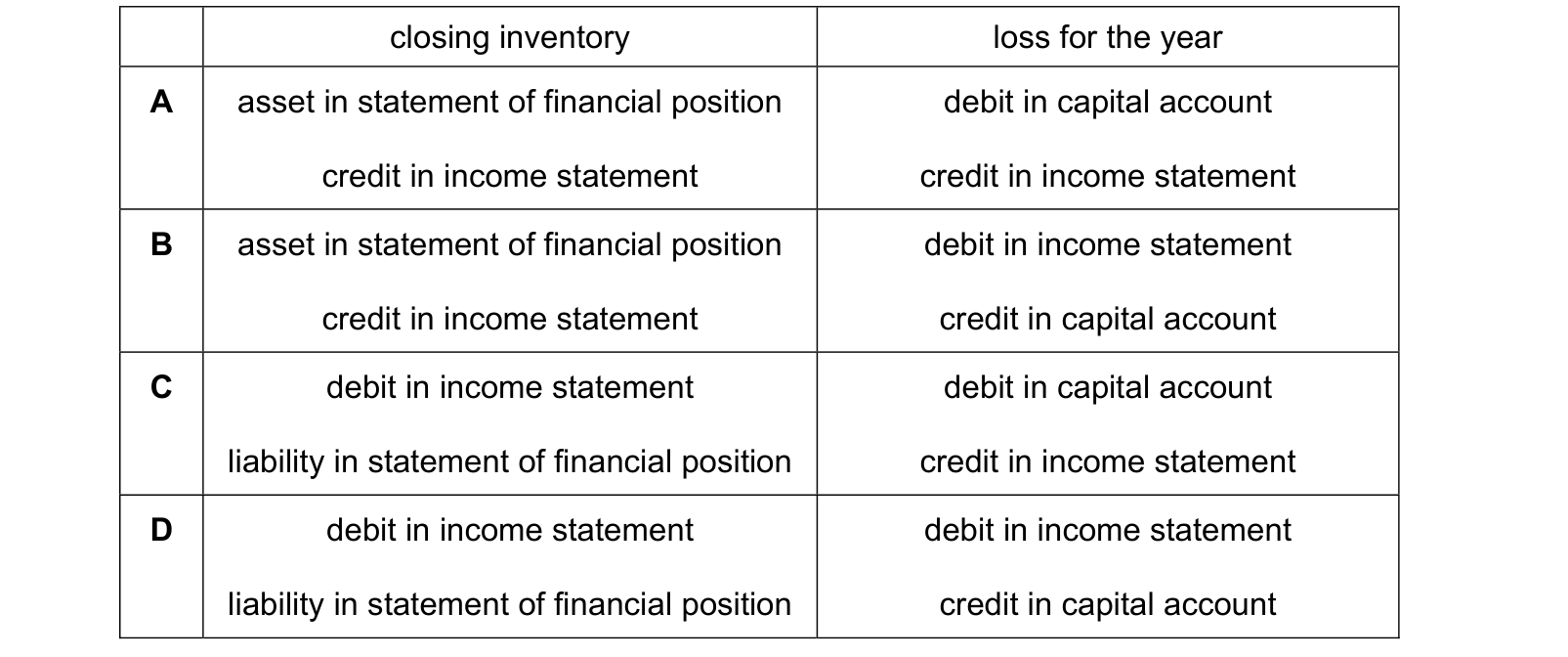
Answer: A.
Question 3
A sole trader had the following transactions. $ returns outwards 2750
carriage inwards 4820
goods for own use 1460
What was the total effect of these transactions on the cost of sales?

Answer: A.
What the syllabus asks for on this topicSyllabus points
Syllabus points
- Prepare an income statement and a statement of financial position for a sole trader.
- Calculate profit from a change in capital where no records exist.
- Derive sales, purchases and missing figures from control accounts and cash records.
- Use mark-up and margin to derive missing figures.
Related CIE 9706 Accounting topics
Not the topic you were looking for? Describe what you are stuck on in your own words and we will take you to the notes that answer it.