Sole traders and incomplete records Exam Questions
79 past-paper questions on this unit. Five of them are below. Answer on the page: each one is marked the moment you pick, the correct option is shown whether or not you found it, and the full explanation opens either way.
CIE 9706 AccountingPaper 1 MCQsFree account
Sole traders and incomplete records: five questions to try now
Real past-paper questions, the answer key from the mark scheme, and the explanation that goes with it. No account needed to answer them.
Question 1
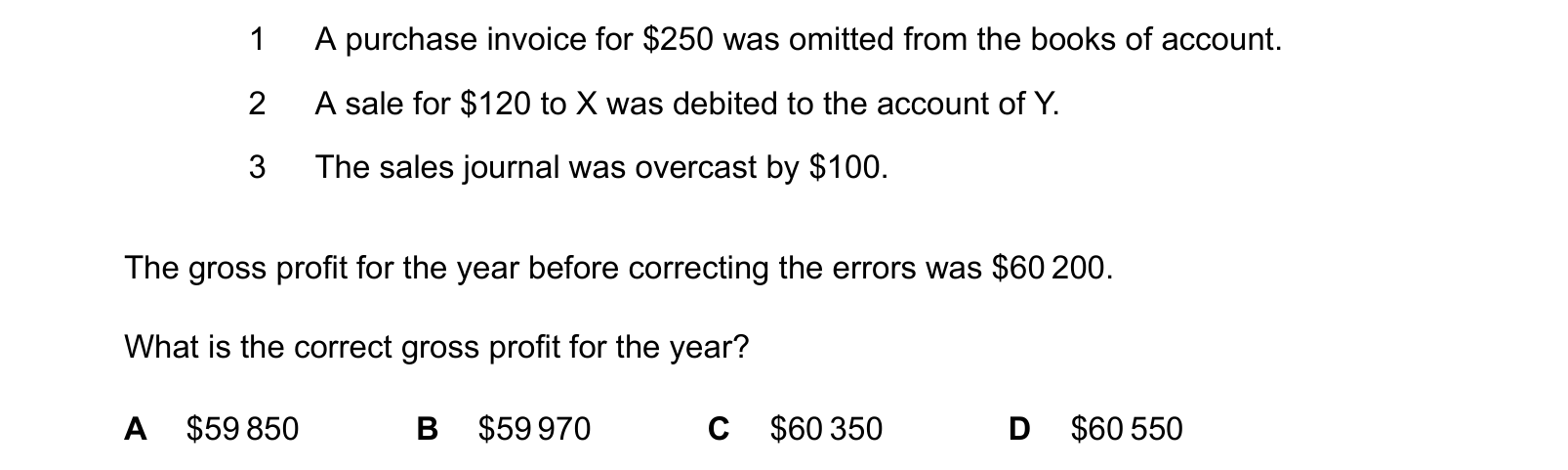
The following errors in the accounting records have been found and corrected. The gross profit for the year before correcting the errors was $60 200. What is the correct gross profit for the year?
Answer: A.
Only errors touching sales or purchases change gross profit. The omitted purchase invoice of 250 raises purchases, so gross profit falls by 250, and a sales journal overcast by 100 means sales were 100 too high, so gross profit falls by another 100: 60 200 - 350 = 59 850. Error 2 is an error of commission between two customers' accounts, so total sales are unchanged and it never enters the calculation. B of 59 970 brings that 120 in anyway, C of 60 350 adds the purchase invoice instead of deducting it, and D of 60 550 pushes both real adjustments the wrong way.
Question 2
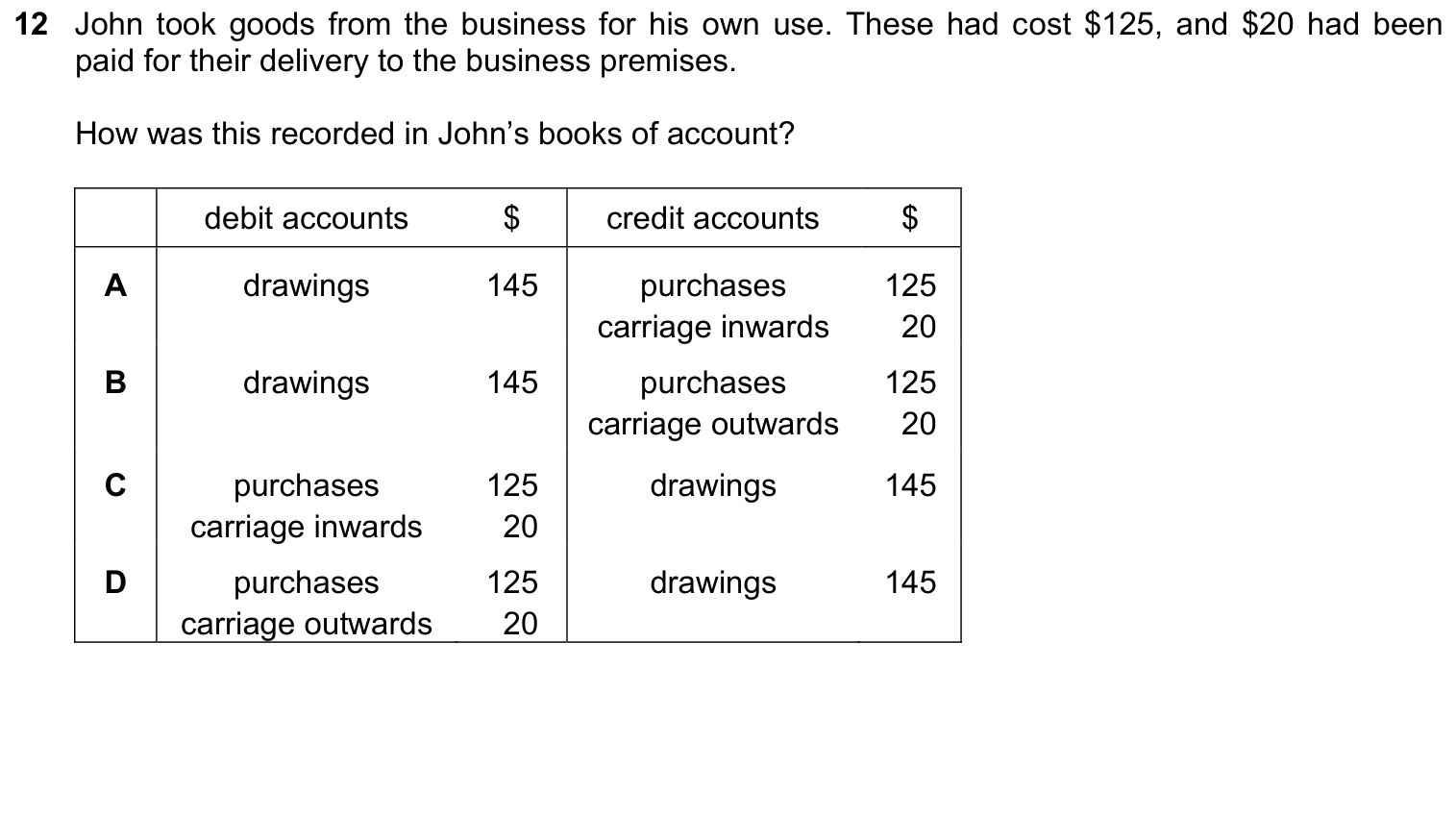
How were goods taken by the owner for personal use recorded? Use the complete source image for the figures and answer choices.
Answer: A.
Goods taken by the owner are removed at what they cost the BUSINESS to get them onto the premises, which is the $125 of purchases plus the $20 of carriage inwards, so drawings are debited with $145 and both of those accounts are credited. Carriage INWARDS is the cost of bringing goods in and forms part of the cost of goods; carriage OUTWARDS is the cost of delivering to customers and is a separate expense that has nothing to do with these goods. Options C and D reverse the entry entirely, crediting drawings when drawings reduce capital and must be debited.
Question 3
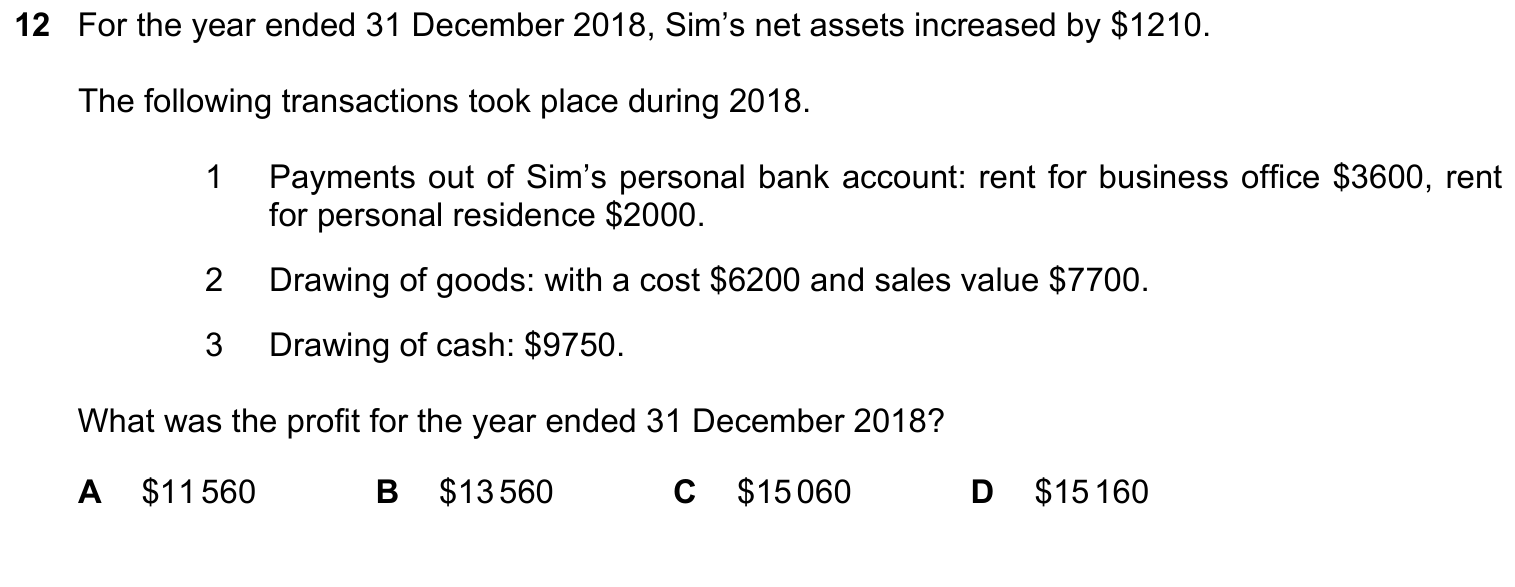
Calculate profit from the change in net assets and the owner transactions shown. Use the complete source image for the figures and answer choices.
Answer: B.
Profit is the increase in net assets, add back drawings, less capital introduced. Net assets rose $1210. Drawings are the goods at COST of $6200, not their $7700 selling price, plus the $9750 of cash, which is $15 950. Paying the business office rent of $3600 from a personal account is capital INTRODUCED, so it is deducted. The rent on Sim's own residence is a private matter that never enters the books at all. Profit is 1210 plus 15 950 less 3600, which is $13 560. Using the goods at selling price gives $15 060.
Question 4
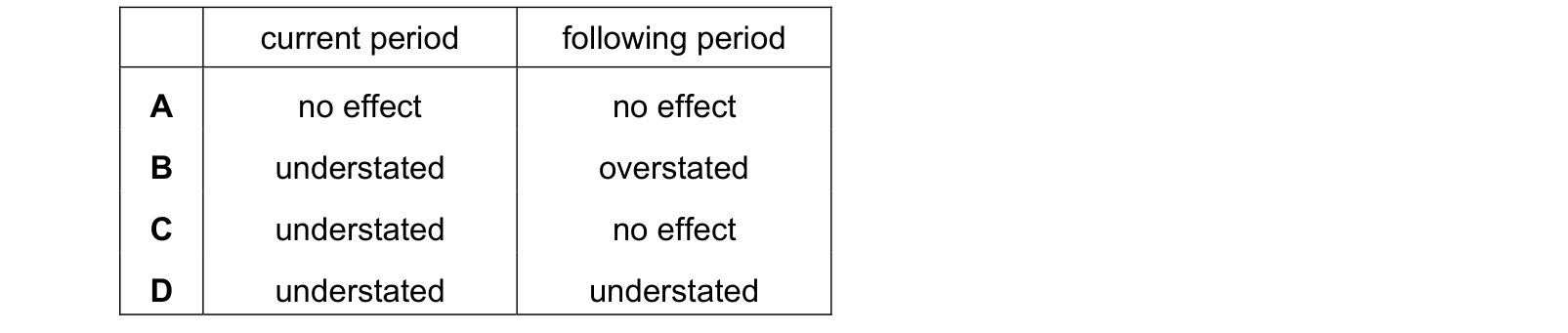
A company undervalued the closing inventory for its current accounting period. How did this affect gross profit? Each answer gives, in order: current period; following period.
Answer: B.
Understated this period, overstated the next. Closing inventory is deducted in arriving at cost of sales, so understating it inflates cost of sales and depresses gross profit now. That same figure becomes OPENING inventory next period, where it is added to cost of sales, so understating it lowers cost of sales and inflates gross profit then. The error reverses itself, which is why the two periods move in opposite directions and the total over both is unaffected.
Question 5
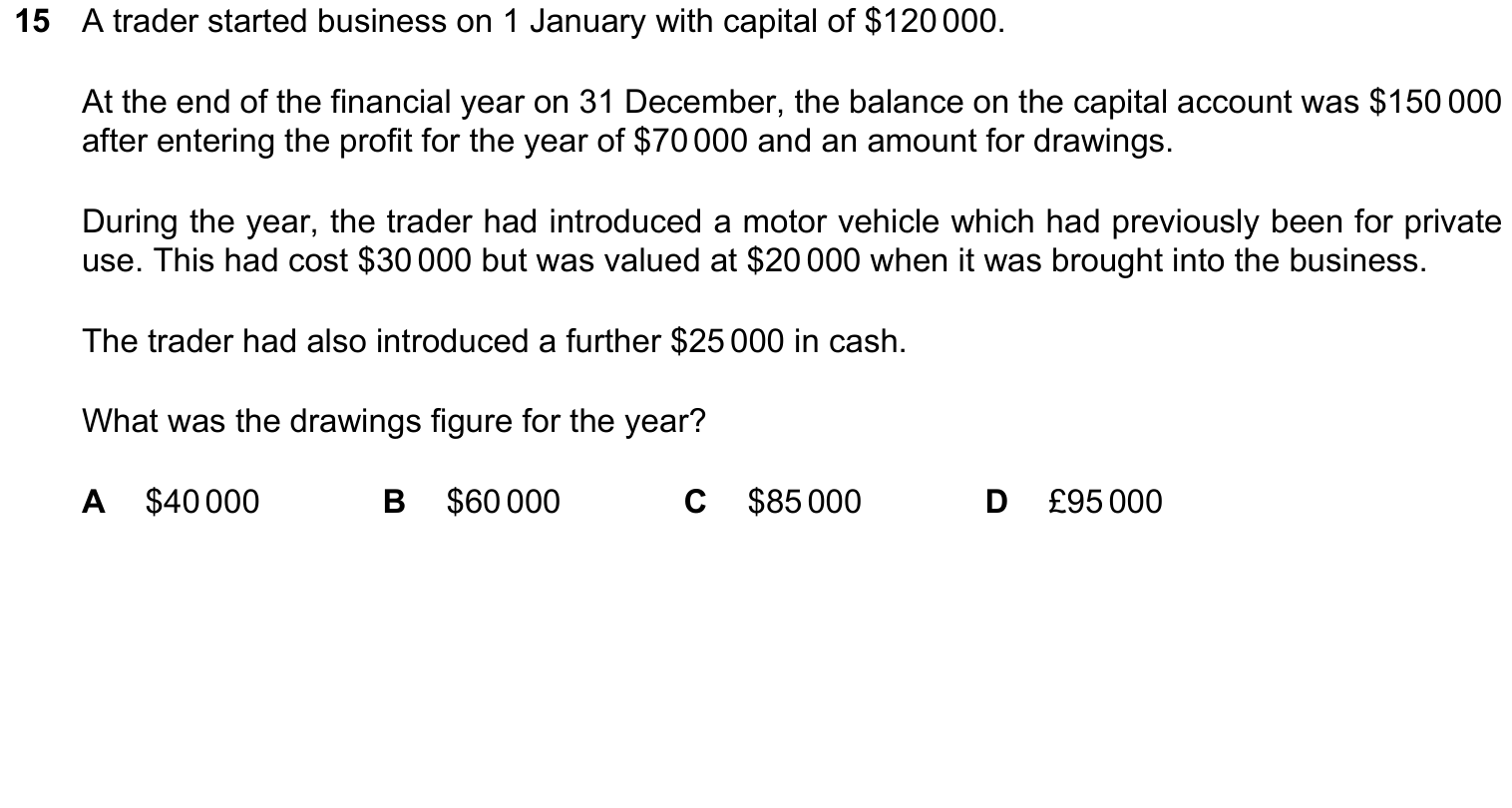
Calculate the drawings figure from the capital-account information shown. Use the complete source image for the figures and answer choices.
Answer: C.
Reconstruct the capital account. It opens at $120 000, is increased by the $70 000 profit and by the capital introduced during the year, and is reduced by drawings to leave $150 000. The vehicle is brought in at its VALUE of $20 000, not the $30 000 it originally cost, because that is what the business is receiving. With the $25 000 cash, capital introduced is $45 000. So drawings are 120 000 plus 70 000 plus 45 000 less 150 000, which is $85 000. Using the $30 000 cost gives $95 000, which is the trap.
These questions are drawn from past CIE 9706 Accounting papers and filtered to sole traders and incomplete records. You answer, you find out immediately whether you were right, and you get the reasoning for the correct option and for each distractor. Wrong answers go to a mistakes locker so you can come back to exactly those.
Practice is free. You need an account only so your progress and your mistakes are still there next time.
These are the errors that cost marks on sole traders and incomplete records, taken from our own topic notes. Read them before you practise and you will recognise the traps in the questions.
Using mark-up where the question gives margin, or the reverse. Read which one it is before touching the numbers.
Treating goods taken by the owner as a sale.
Putting carriage inwards among the expenses.
Forgetting to add back drawings when calculating profit from the change in capital.
Adding capital introduced instead of deducting it in the same calculation.
Calling a statement of affairs a statement of financial position.
Using the closing capital figure in the statement of financial position without showing the profit and drawings that produced it.