Adjustments to financial statements
Contents: 7 sections
Why the adjustments exist
Every adjustment in this topic comes from the accruals concept: the income statement must show the income earned and the expenses incurred in the period, whatever was actually paid. Prudence then supplies the second half, on inventory and on doubtful debts.
Each adjustment does two things at once, and answers must show both: it changes a figure in the income statement, and it creates or removes something in the statement of financial position.
Accruals and prepayments
| Item | Meaning | In the income statement | In the statement of financial position |
|---|---|---|---|
| Accrued expense | Incurred, not yet paid | Add to the expense | Current liability |
| Prepaid expense | Paid, relates to next period | Deduct from the expense | Current asset |
| Accrued income | Earned, not yet received | Add to the income | Current asset |
| Prepaid income | Received, not yet earned | Deduct from the income | Current liability |
The pattern is worth stating once: anything the business owes or has not yet earned is a liability; anything it is owed or has paid ahead is an asset.
A worked case. Rent of $24 000 was paid during the year. At the start of the year $2 000 was owing; at the end $3 000 has been paid in advance.
The charge for the year is 24 000 less the 2 000 that belonged to last year, less the 3 000 that belongs to next year, which is $19 000. The $3 000 prepayment appears as a current asset.
Work it through the expense account rather than by memorising the signs. An opening accrual is a credit brought down; an opening prepayment is a debit brought down.
Irrecoverable debts
An irrecoverable debt is a specific customer who will not pay. It is a certainty, not an estimate.
- Debit irrecoverable debts (an expense), credit trade receivables.
If the customer later pays, the debt is recovered: reinstate the receivable and record the receipt, and credit the recovery to the income statement as other income.
Allowance for irrecoverable debts
An allowance is an estimate against the receivables that remain, made because experience says some proportion will not pay. It comes from prudence: do not overstate receivables or profit.
The crucial mechanic is that only the change in the allowance goes to the income statement.
- An increase in the allowance is an expense.
- A decrease is an income, shown as a reduction in the expense or as other income.
Trade receivables are $80 000 and an allowance of 4% is required. Last year's allowance was $2 600.
The required allowance is 4% of 80 000, which is $3 200. The existing allowance is $2 600, so the increase is $600, and $600 is charged to the income statement. The statement of financial position shows receivables of $80 000 less the allowance of $3 200, a net figure of $76 800.
Charging the whole $3 200 rather than the $600 movement is the standard error and it costs several marks.
Note the order: write off irrecoverable debts first, then calculate the allowance on what is left. Calculating the allowance on receivables that include a debt you are about to write off double-counts.
Inventory
Inventory is valued at the lower of cost and net realisable value, applied to each line of inventory separately rather than to the total.
Net realisable value is the expected selling price less any costs still to be incurred in getting the goods sold: rectification, repackaging, selling costs.
| Line | Cost | NRV | Value used |
|---|---|---|---|
| A | 4 000 | 5 200 | 4 000 |
| B | 3 500 | 2 900 | 2 900 |
| C | 1 800 | 1 800 | 1 800 |
The total is 4 000 plus 2 900 plus 1 800, which is $8 700. Comparing the totals instead, $9 300 against $9 900, would have given $9 300 and overstated inventory by $600.
Closing inventory affects both statements: it is deducted in cost of sales, raising gross profit, and it appears as a current asset. Overvaluing closing inventory overstates profit and assets together, and it also understates next year's profit, because this year's closing inventory is next year's opening inventory.
Common mistakes
- Charging the full allowance to the income statement instead of the movement in it.
- Calculating the allowance before writing off irrecoverable debts.
- Reversing accruals and prepayments, or putting a prepaid expense in liabilities.
- Applying the lower of cost and net realisable value to the total rather than line by line.
- Valuing inventory at selling price.
- Adjusting only the income statement and leaving the statement of financial position untouched.
- Treating a recovered debt as a reduction in the irrecoverable debts of a customer who still owes money.
Check you have it
Question 1
What are advantages of absorption costing?
1 conforms to the matching concept
2 is a recognised method of inventory valuation
3 is suitable for determining selling price
Answer: A.
Question 2
Which items are treated as expenses in the income statement? Use the complete source image for the figures and answer choices.
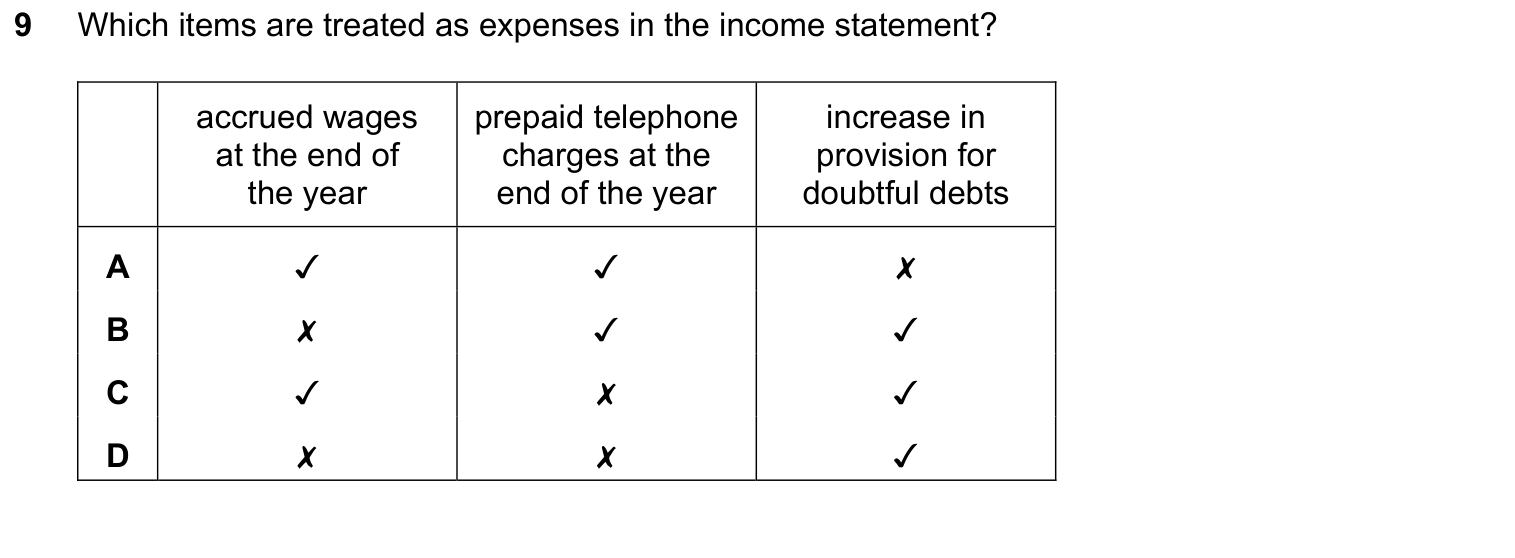
Answer: C.
Question 3
In a draft statement of profit or loss, two errors were discovered. What was the effect of these errors on the draft profit for the year?

Answer: A.
The net movement is
18 000 - 12 000 = 6000
down, so the draft profit was overstated by 6000. B of 12 000 treats the disposal error as a single 6000 rather than a double swing, which is the commonest slip here. C and D have the direction reversed.
What the syllabus asks for on this topicSyllabus points
Syllabus points
- Account for accrued and prepaid expenses and income.
- Account for irrecoverable debts and the allowance for irrecoverable debts.
- Value inventory at the lower of cost and net realisable value.
- Show the effect of each adjustment on the income statement and the statement of financial position.
Related CIE 9706 Accounting topics
Not the topic you were looking for? Describe what you are stuck on in your own words and we will take you to the notes that answer it.