Marginal costing
Contents: 8 sections
Marginal cost and contribution
Marginal cost is the cost of producing one more unit: the variable cost. Fixed costs do not change when one more unit is made, so they are not part of it.
Contribution = selling price − variable cost.
Contribution is what each unit contributes towards covering the fixed costs, and once those are covered, towards profit. It is the single most useful number in this half of the syllabus, because it separates the part of the cost that a decision can change from the part it cannot.
total contribution − fixed costs = profit
A marginal costing statement
| $ | |
|---|---|
| Revenue, 5 000 units at $40 | 200 000 |
| Less variable costs, 5 000 at $24 | (120 000) |
| Contribution | 80 000 |
| Less fixed costs | (52 000) |
| Profit | 28 000 |
Contribution per unit is 40 minus 24, which is $16, and 5 000 times 16 is $80 000, which agrees.
Why the two methods give different profits
Under absorption costing, fixed production overheads are absorbed into each unit, so unsold units carry some of those fixed costs forward in closing inventory. Under marginal costing, the whole of the fixed overhead is charged in the period it arises.
The consequence is a rule worth memorising:
| Inventory | Which profit is higher |
|---|---|
| Closing more than opening (production exceeded sales) | Absorption is higher |
| Closing less than opening (sales exceeded production) | Marginal is higher |
| Closing equals opening | The two are equal |
The reasoning behind the first row is that absorption costing has carried some fixed cost out of this period's income statement and into inventory, so this period is charged with less.
The reconciliation is short:
difference in profit = change in inventory units x fixed overhead absorbed per unit
Production was 5 000 units and sales 4 600, with fixed production overhead absorbed at $8 a unit. Inventory rose by 400 units, so absorption profit exceeds marginal profit by 400 times 8, which is $3 200.
Break-even and margin of safety
These follow directly from contribution.
break-even point in units = fixed costs / contribution per unit
break-even point in revenue = fixed costs / contribution to sales ratio
margin of safety = budgeted sales − break-even sales, often expressed as a percentage of budgeted sales
Using the statement above, the break-even point is 52 000 divided by 16, which is 3 250 units. Budgeted sales are 5 000, so the margin of safety is 1 750 units, which is 1 750 over 5 000, or 35% of budgeted sales.
To find the output for a target profit, add the target to the fixed costs before dividing. A target profit of $40 000 needs (52 000 plus 40 000) divided by 16, which is 5 750 units.
Using it for decisions
The principle is always the same: ignore fixed costs that will not change, and choose the option with the greatest contribution.
Accepting a special order below normal price. Accept if the price exceeds the variable cost, so the order makes a positive contribution, provided there is spare capacity and no better use for it. Then consider what the numbers do not show: whether existing customers will demand the same price, and whether the capacity would be better used elsewhere.
Make or buy. Compare the variable cost of making with the price of buying, plus any fixed cost that would actually be avoided. Fixed costs that continue either way are irrelevant. Then weigh quality, reliability of supply, and the effect on the workforce.
Discontinuing a product. Keep it if it makes a positive contribution, even when absorption costing shows it making a loss. Dropping it removes the contribution but not the apportioned fixed costs, which simply move onto the remaining products. This is the most examined decision in the topic and the most often answered wrongly.
A limiting factor. When one resource is scarce, rank products by contribution per unit of the limiting factor, not by contribution per unit and not by profit per unit.
Product X earns $30 contribution and uses 5 kg of scarce material; product Y earns $22 and uses 2 kg. Per kilogram, X earns 30 over 5, which is $6, and Y earns 22 over 2, which is $11. Y is made first, even though X looks better on contribution per unit.
Limitations
- The split between fixed and variable is rarely clean, and semi-variable costs must be estimated.
- Costs and prices are assumed to be linear, ignoring bulk discounts and price cuts needed to sell more.
- It works within the relevant range only.
- Consistently pricing at marginal cost never recovers the fixed costs.
- It is short term. Over the long run every cost is variable and must be covered.
- It cannot be used to value inventory in published financial statements.
Common mistakes
- Including fixed costs in the marginal cost of a unit.
- Deducting fixed overhead before calculating contribution.
- Ranking products by contribution per unit when a limiting factor applies.
- Discontinuing a product that makes a positive contribution because absorption costing shows a loss.
- Getting the reconciliation the wrong way round when inventory rises.
- Forgetting the non-financial factors when a question asks for advice.
- Using marginal cost to value closing inventory in the financial statements.
Check you have it
Question 1
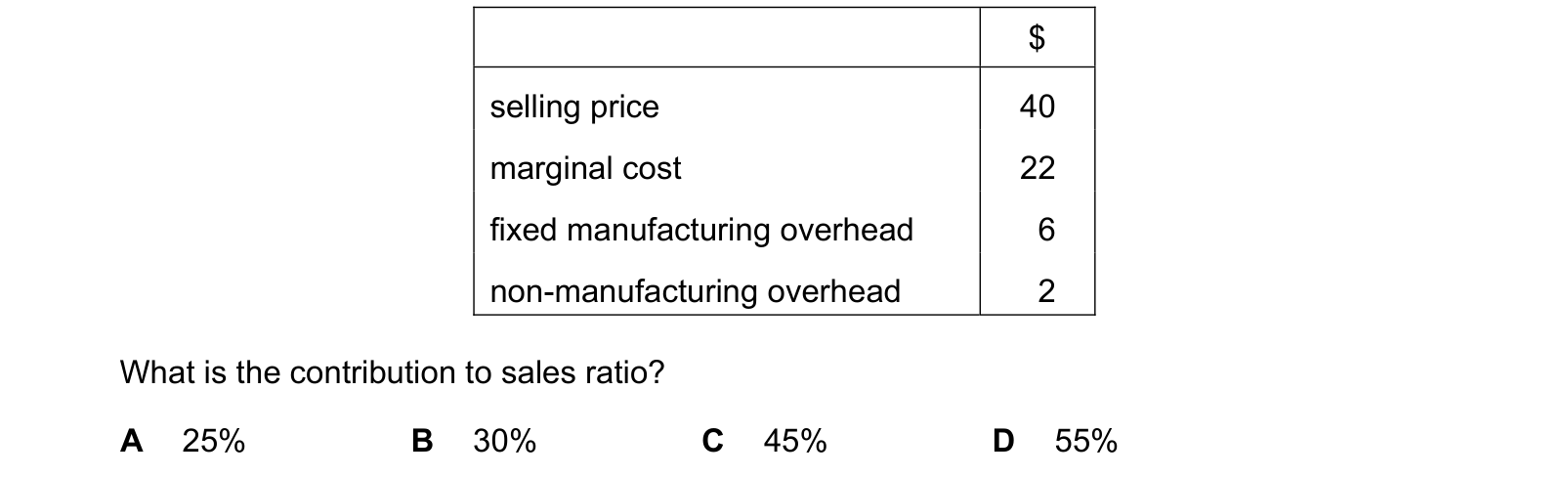
A product has the following revenue and costs per unit. $ selling price 40
marginal cost 22
fixed manufacturing overhead 6
non-manufacturing overhead 2
What is the contribution to sales ratio?
Answer: C.
Question 2
A business prepares its income statement using marginal costing. The profit is reduced by changing from marginal costing to absorption costing.
Which statement is correct?
Answer: B.
Question 3
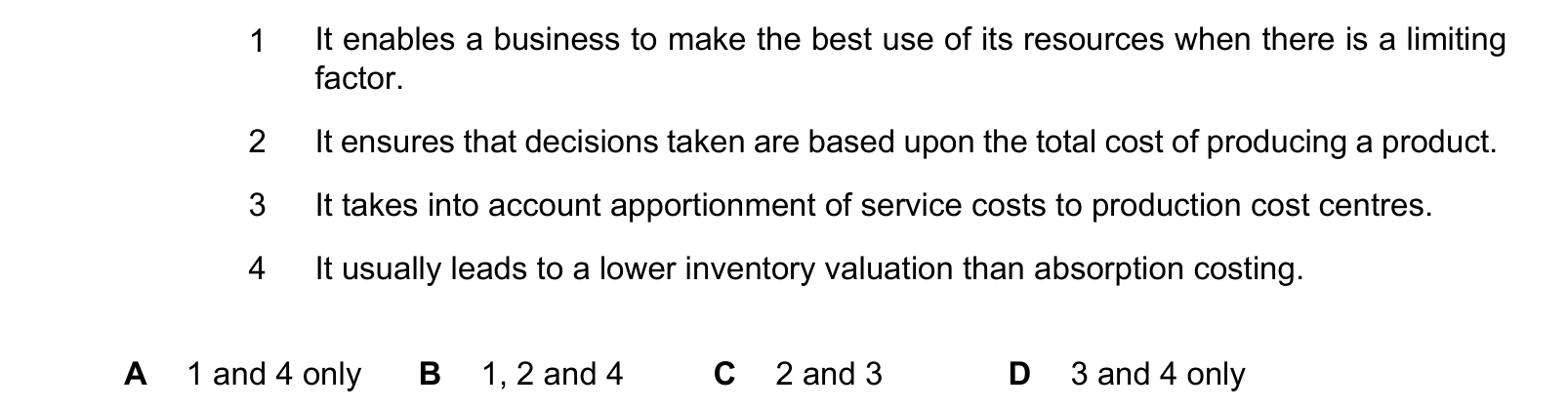
Which statements about marginal costing are correct?
Answer: A.
What the syllabus asks for on this topicSyllabus points
Syllabus points
- Explain marginal cost and contribution.
- Prepare a marginal costing statement.
- Reconcile the profit under marginal and absorption costing.
- Apply marginal costing to short-term decisions, including limiting factors.
Related CIE 9706 Accounting topics
Not the topic you were looking for? Describe what you are stuck on in your own words and we will take you to the notes that answer it.