Users of accounting information
Contents: 5 sections
The users and what each one wants
The mark is never for naming the user. It is for saying which decision they are making and which figure answers it.
| User | The decision | What they look at |
|---|---|---|
| Owners and shareholders | Hold, buy or sell; is management doing well? | Profit, return on capital employed, dividends |
| Managers | How to run the business day to day | Everything, including internal information nobody else sees |
| Lenders and banks | Lend or not; will the interest be paid? | Liquidity, gearing, security available, cash flow |
| Trade payables | Give credit, and how much? | Liquidity ratios, payment history, current ratio |
| Trade receivables | Will this supplier still exist to honour warranties? | Going concern, profitability |
| Employees and unions | Job security, wage claims | Profitability, expansion plans |
| Government and tax authorities | Tax assessment, statistics, regulation | Profit, revenue |
| The local community | Employment, environmental effects | Expansion, closures |
| Competitors | Benchmarking | Margins, revenue, ratios |
Two contrasts are worth holding on to, because comparison questions use them.
A long-term lender and a trade payable both care about being paid, but over different horizons: the lender wants gearing and long-run profitability, the supplier wants the current and liquid ratios. And a shareholder and a manager look at the same business with different access: managers see internal, forward-looking information, shareholders see only what is published, and only after the year has ended.
Qualitative characteristics
Information is useful when it has these features.
- Relevance. It has the capacity to change a decision. Out-of-date information is not relevant however accurate.
- Reliability, sometimes called faithful representation. It is free from material error and bias, and it reflects the substance of what happened.
- Comparability. Results can be compared with other years and with other businesses, which is why consistency of method matters.
- Understandability. It is presented so that a user with reasonable knowledge can follow it.
- Timeliness. It arrives soon enough to be acted on.
- Materiality. Nothing that would change a decision is left out or misstated.
Relevance and reliability pull against each other, and saying so earns marks. A current valuation of property is more relevant than a cost from thirty years ago, but it is an estimate and therefore less reliable. Faster reporting is more timely, but a figure produced quickly has been checked less. Preparers choose a balance rather than getting both.
What published statements cannot tell you
- They are historic. They report a year that has finished, and users are making decisions about the future.
- They omit anything without a money measurement: staff skill, customer loyalty, brand strength, management quality.
- They use historic cost, so asset values can be badly out of date.
- They involve estimates: depreciation rates, useful lives, the allowance for irrecoverable debts, inventory valuation. Different judgements give different profits from identical trading.
- A statement of financial position is a snapshot at one date, and a seasonal business can look very different a month either side.
- They are summarised and aggregated, so a division making losses can be hidden inside a profitable total.
- Window dressing is possible: settling payables just before the year end, or delaying a purchase, improves the ratios on the day without changing the business.
Common mistakes
- Listing users without saying what each one needs.
- Giving the same reason for every user, usually "to see if the business is profitable".
- Saying published accounts show the value of the business.
- Naming a qualitative characteristic without applying it to the scenario in the question.
- Saying financial statements are always accurate. They contain unavoidable estimates.
- Forgetting that managers have access to information no external user sees.
Check you have it
Question 1
An accounting student made the following statements about the requirements of different users of the accounting information of a company. Which statements are correct?
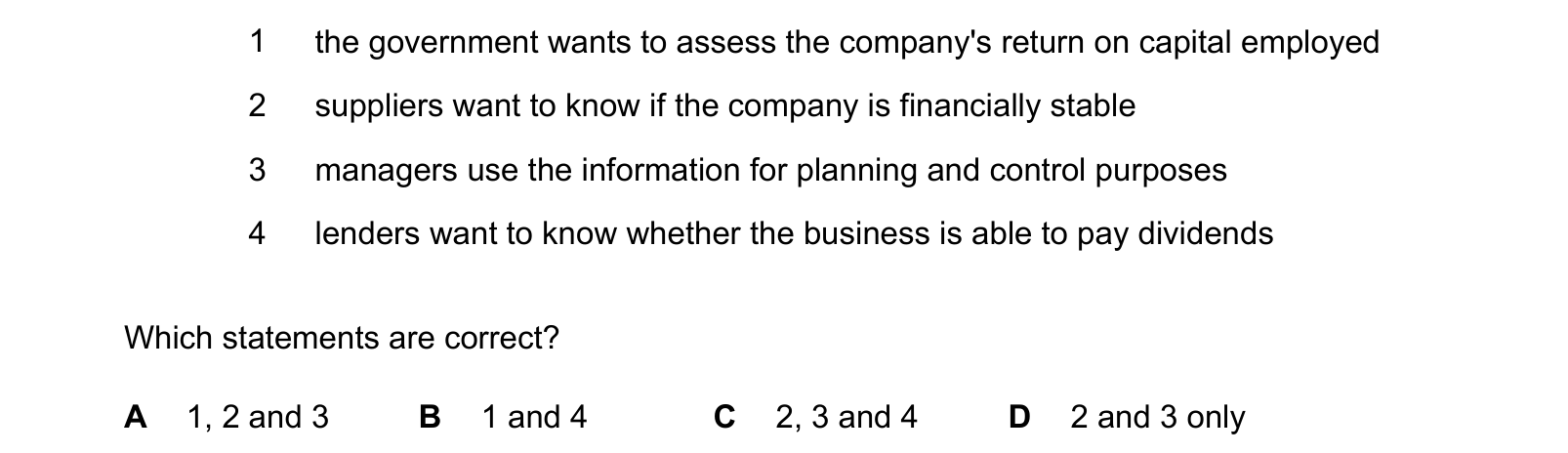
Answer: D.
Question 2
Who are internal users of accounting information?
Answer: B.
What the syllabus asks for on this topicSyllabus points
Syllabus points
- Identify the users of accounting information and explain what each one needs from it.
- Explain the qualitative characteristics of useful financial information.
- Explain the limitations of published financial statements.
Related CIE 9706 Accounting topics
Not the topic you were looking for? Describe what you are stuck on in your own words and we will take you to the notes that answer it.