Double entry and the accounting equation
Contents: 7 sections
The accounting equation
assets = liabilities + capital
Rearranged, capital = assets − liabilities, which is the same statement read as "what the owners are left with".
The equation always balances, after every single transaction, because every transaction has two effects that keep it in balance. That is the dual aspect, and it is the whole basis of double entry.
Three shapes of transaction, and every example is one of them:
- Two assets change. Buy a machine for cash: machines up, bank down. Total assets unchanged.
- An asset and a liability change together. Buy inventory on credit: inventory up, trade payables up. Both sides rise.
- An asset and capital change together. The owner introduces cash: bank up, capital up.
If you can name which of the three a transaction is, you can write the entry.
Debits and credits
The rule that does the most work:
| Increased by a | Decreased by a | |
|---|---|---|
| Asset | Debit | Credit |
| Expense | Debit | Credit |
| Drawings | Debit | Credit |
| Liability | Credit | Debit |
| Income | Credit | Debit |
| Capital | Credit | Debit |
DEAD CLIC is the usual mnemonic: Debits are Expenses, Assets and Drawings; Credits are Liabilities, Income and Capital.
Debit is the left side of an account, credit the right. Those words carry no meaning beyond that. A debit is not "good" and a credit is not "money in": a credit to the bank account means the bank balance has gone down.
Worked examples
The owner pays $10 000 into the business bank account. Bank is an asset going up, so debit bank $10 000. Capital goes up, so credit capital $10 000.
Goods bought on credit for $2 400. Purchases is an expense going up, so debit purchases $2 400. Trade payables is a liability going up, so credit trade payables $2 400.
A credit customer pays $800. Bank up, so debit bank $800. Trade receivables, an asset, goes down, so credit trade receivables $800.
The owner takes $500 for personal use. Drawings up, so debit drawings $500. Bank down, so credit bank $500.
Notice the last one. Drawings is not an expense: it is a reduction of capital, kept in its own account so the owner can see how much has been withdrawn, and deducted from capital in the statement of financial position rather than charged against profit.
Ledger accounts
Each account has a debit side on the left and a credit side on the right. The balance is the difference between the two sides.
- Assets and expenses normally carry a debit balance.
- Liabilities, income and capital normally carry a credit balance.
An account showing the opposite of its normal balance is a signal, not necessarily an error: a credit balance on a trade receivables account usually means a customer has overpaid or been refunded.
Capital and revenue
Two distinctions with the same names, both examined and easy to blur:
- Capital expenditure buys or improves a non-current asset and appears in the statement of financial position. Revenue expenditure is the running cost of the period and goes to the income statement.
- Capital receipts come from selling non-current assets or raising finance. Revenue receipts are the income of the period.
Getting this wrong misstates both profit and asset values at once, which is why the marks follow it around the syllabus.
Common mistakes
- Treating drawings as an expense in the income statement.
- Reading a credit to the bank account as money coming in.
- Debiting the supplier rather than crediting them when buying on credit.
- Recording only one half of a transaction, so the equation stops balancing.
- Confusing purchases, which is an expense, with the purchase of a non-current asset, which is not.
- Saying the accounting equation only balances at the year end. It balances after every transaction.
Check you have it
Question 1
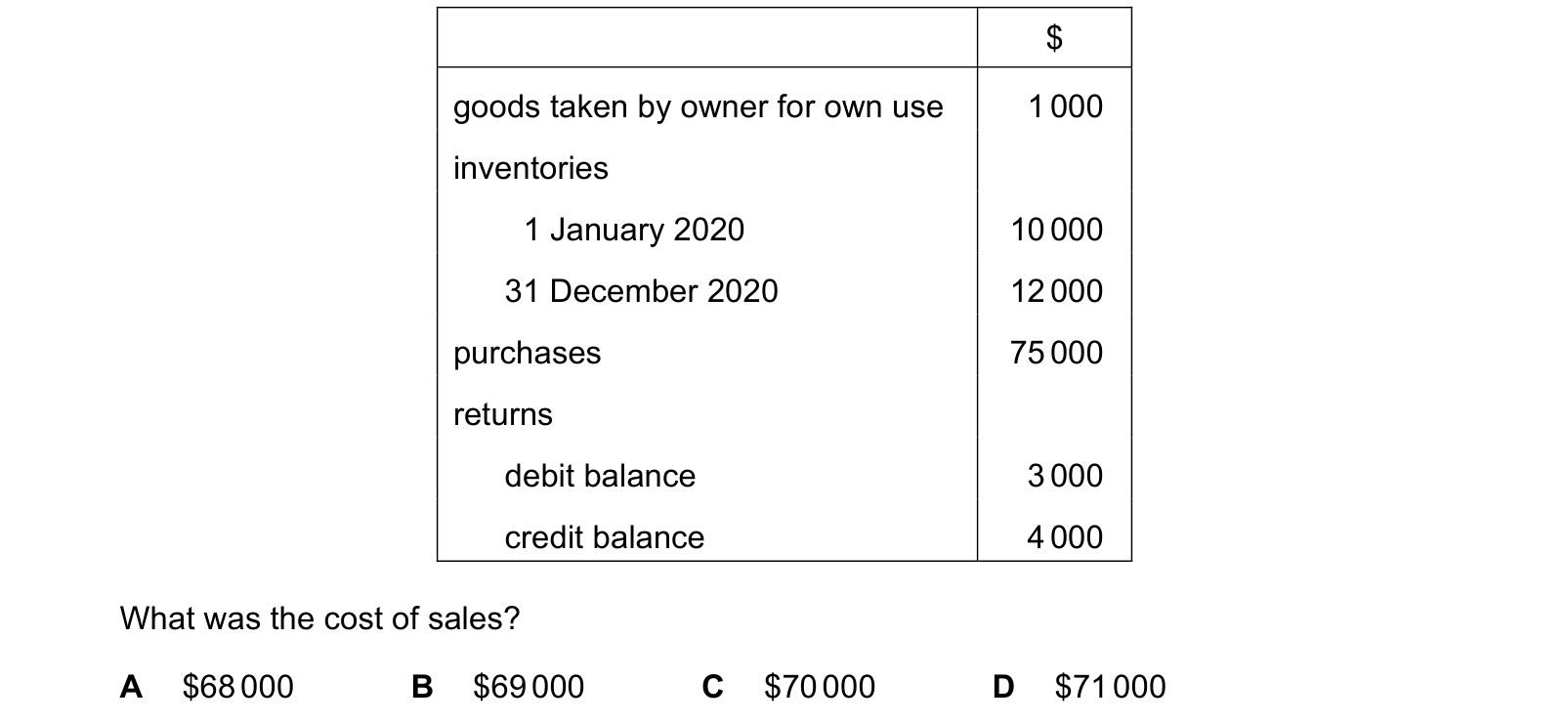
The following information is available for a sole trader at 31 December 2020. $ goods taken by owner for own use 1 000
inventories
1 January 2020 10 000
31 December 2020 12 000
purchases 75 000
returns
debit balance 3 000
credit balance 4 000
What was the cost of sales?
Answer: A.
Question 2
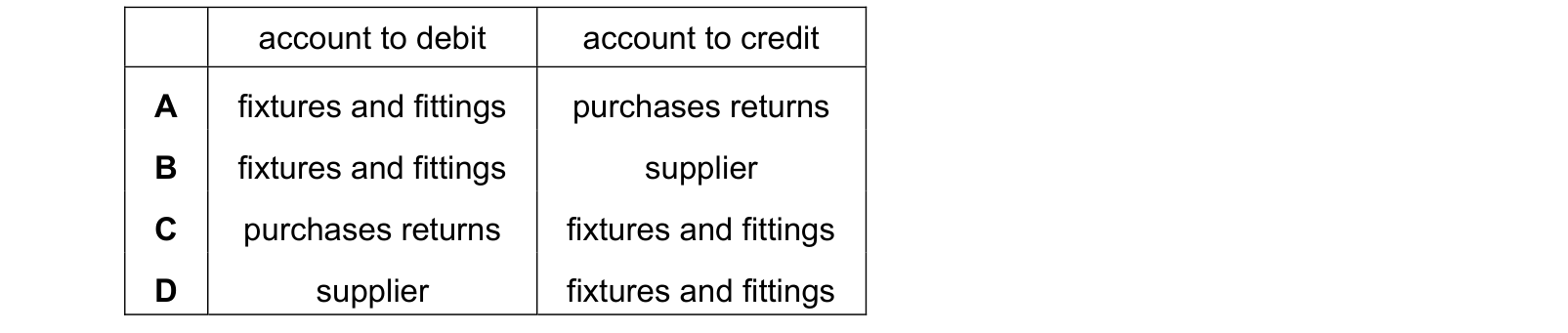
A trader purchased fixtures and fittings on credit from a supplier. These were faulty and were returned to the supplier. Which entry in the trader’s books of account recorded the return? Each answer gives, in order: account to debit; account to credit.
Answer: D.
Question 3
An invoice for purchases was credited to the purchases account.
How will the balance on the purchases account be corrected?
Answer: D.
What the syllabus asks for on this topicSyllabus points
Syllabus points
- State and apply the accounting equation.
- Explain the dual aspect of every transaction.
- Record transactions using double entry in ledger accounts.
- Distinguish assets, liabilities, capital, income and expenses, and know which side each is increased on.
Related CIE 9706 Accounting topics
Not the topic you were looking for? Describe what you are stuck on in your own words and we will take you to the notes that answer it.