Double entry and the accounting equation Exam Questions
27 past-paper questions on this unit. Five of them are below. Answer on the page: each one is marked the moment you pick, the correct option is shown whether or not you found it, and the full explanation opens either way.
CIE 9706 AccountingPaper 1 MCQsFree account
Double entry and the accounting equation: five questions to try now
Real past-paper questions, the answer key from the mark scheme, and the explanation that goes with it. No account needed to answer them.
Question 1
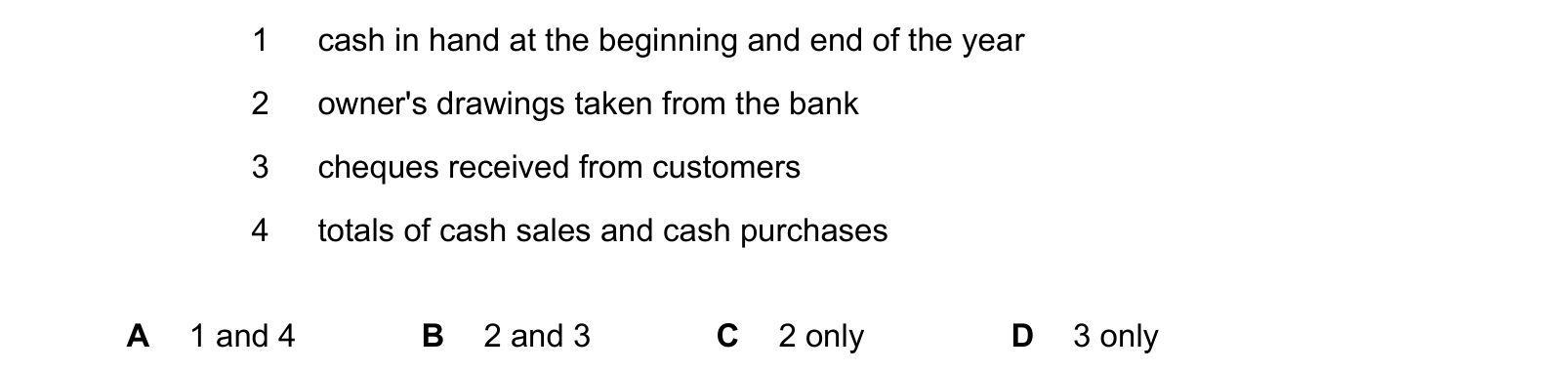
A sole trader does not keep a complete set of books of account. He believes a staff member has stolen some cash. Which items will not be needed to calculate the amount missing?
Answer: B.
2 and 3. Missing cash is found by reconstructing the cash account: opening cash, plus receipts, less payments, gives what SHOULD be there, and the shortfall against the actual balance is the amount taken. That needs the opening and closing cash in hand and the totals of cash sales and cash purchases. The two items not needed are the ones that never pass through the cash account: drawings taken from the BANK and cheques received from customers are both bank transactions, so neither affects the cash the thief could reach.
Question 2
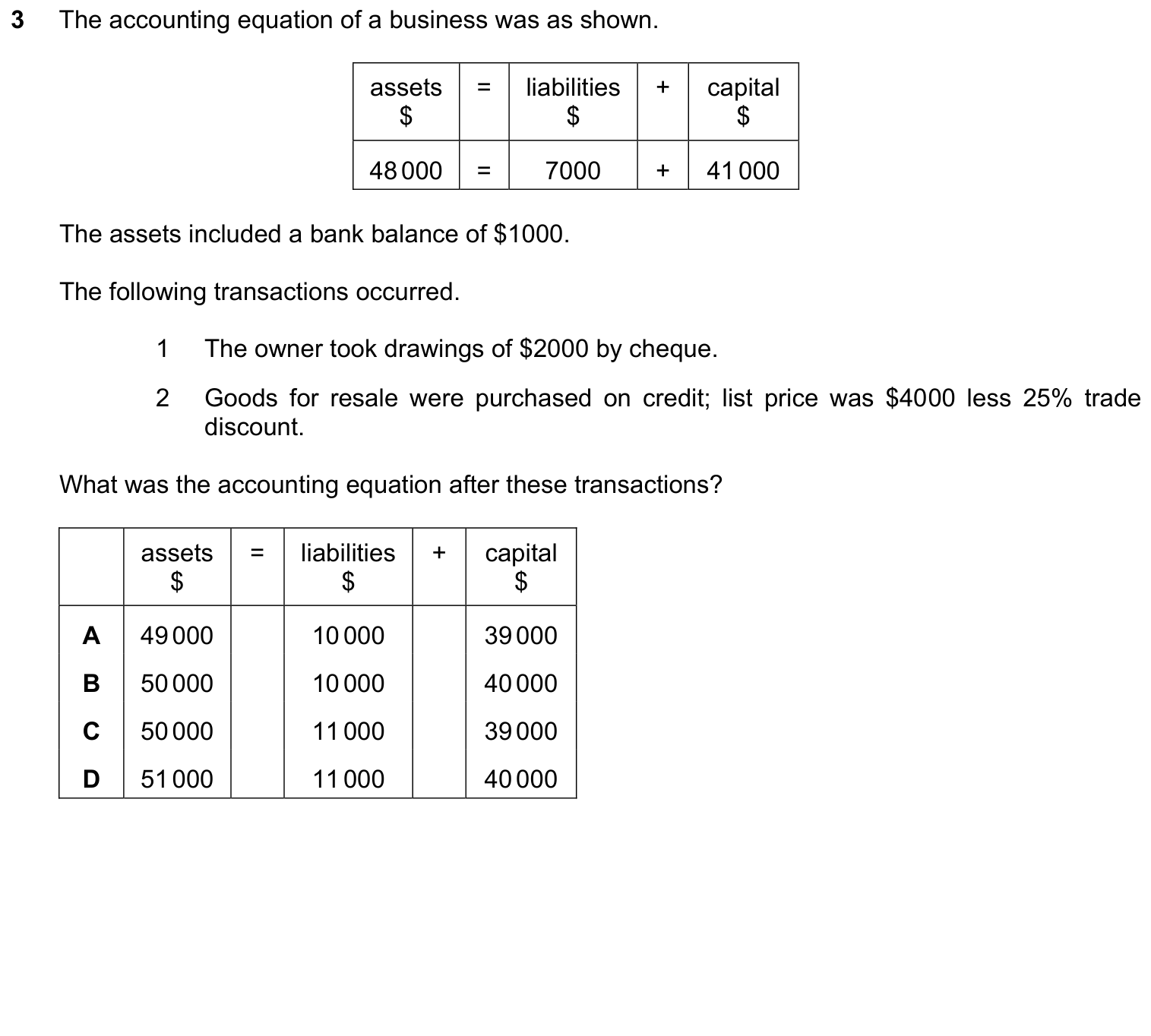
What is the accounting equation after the two transactions shown? Use the complete source image for the figures and answer choices.
Answer: C.
Take the two transactions in turn. Drawings of $2000 by cheque against a bank balance of only $1000 wipes out the asset and creates a $1000 OVERDRAFT, which is a liability. So assets fall by 1000 to $47 000, liabilities rise by 1000 to $8000 and capital falls by the full $2000 to $39 000. The credit purchase is $4000 less 25% trade discount, which is $3000, raising both inventory and trade payables. Assets reach $50 000, liabilities $11 000 and capital stays at $39 000. Recording the drawings as a straight $2000 fall in assets, or using the $4000 list price, gives the other rows.
Question 3
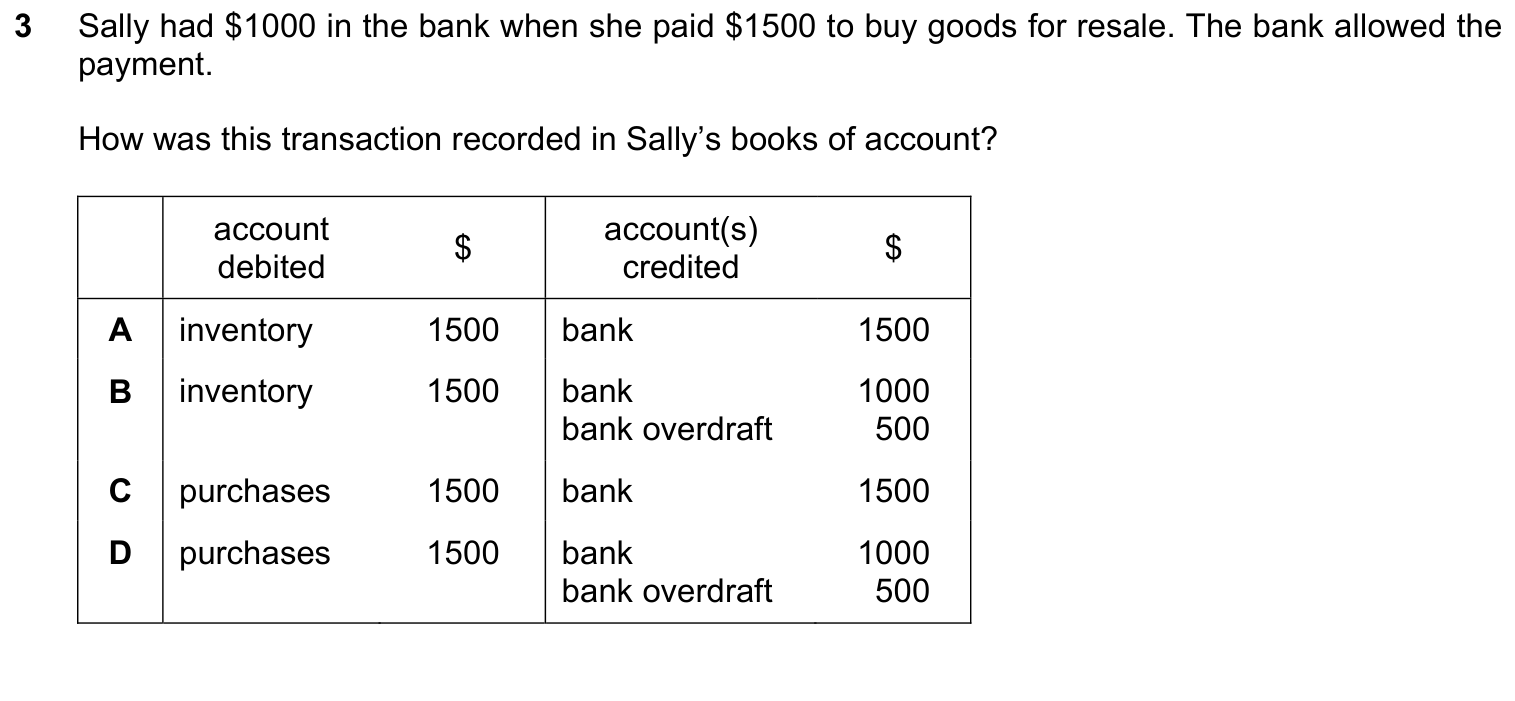
How was a purchase that created a bank overdraft recorded? Use the complete source image for the figures and answer choices.
Answer: C.
Two separate points. Goods bought for RESALE go to the purchases account, not to inventory, because inventory is only adjusted at the year end; that rules out A and B. And the bank is a single account which simply goes into overdraft when the payment takes it below zero, so the whole $1500 is credited to bank. Splitting it into $1000 of bank and $500 of overdraft invents a second account that does not exist in the ledger. The overdraft shows up as a credit BALANCE on the bank account, not as a separate entry.
Question 4
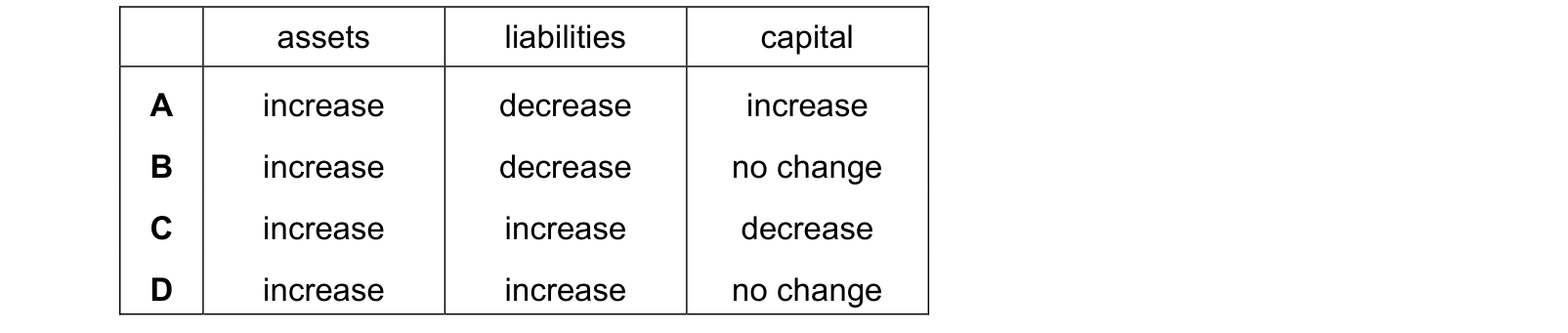
An asset is purchased on credit by a business. What is the effect of this transaction on the accounting equation? Each answer gives, in order: assets; liabilities; capital.
Answer: D.
Buying an asset on credit raises an asset and creates a liability of the same amount, so assets increase, liabilities increase and capital is unchanged. Capital only moves for profit, loss, drawings or new capital introduced, and none of those has happened here. Every other option changes capital or moves liabilities the wrong way, which would leave the accounting equation out of balance.
Question 5
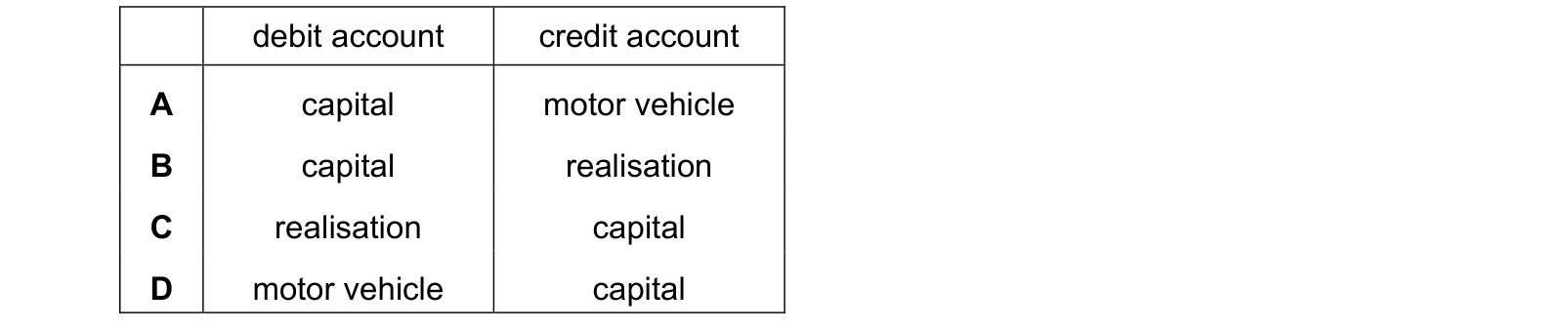
On the dissolution of a partnership, one of the partners takes a motor vehicle in part settlement of the amount due to him. How is this entered in the books of account? Each answer gives, in order: debit account; credit account.
Answer: B.
On dissolution, assets are transferred into the REALISATION account and partners' balances sit in their capital accounts. A partner taking an asset in part settlement reduces what the firm owes him and disposes of the asset, so debit CAPITAL and credit REALISATION. The motor vehicle account itself has already been cleared into realisation, which is why it does not appear here, and reversing the entry would increase what the partner is owed.
These questions are drawn from past CIE 9706 Accounting papers and filtered to double entry and the accounting equation. You answer, you find out immediately whether you were right, and you get the reasoning for the correct option and for each distractor. Wrong answers go to a mistakes locker so you can come back to exactly those.
Practice is free. You need an account only so your progress and your mistakes are still there next time.
These are the errors that cost marks on double entry and the accounting equation, taken from our own topic notes. Read them before you practise and you will recognise the traps in the questions.
Treating drawings as an expense in the income statement.
Reading a credit to the bank account as money coming in.
Debiting the supplier rather than crediting them when buying on credit.
Recording only one half of a transaction, so the equation stops balancing.
Confusing purchases, which is an expense, with the purchase of a non-current asset, which is not.
Saying the accounting equation only balances at the year end. It balances after every transaction.