66 past-paper questions on this unit. Five of them are below. Answer on the page: each one is marked the moment you pick, the correct option is shown whether or not you found it, and the full explanation opens either way.
CIE 9706 AccountingPaper 1 MCQsFree account
Marginal costing: five questions to try now
Real past-paper questions, the answer key from the mark scheme, and the explanation that goes with it. No account needed to answer them.
Question 1
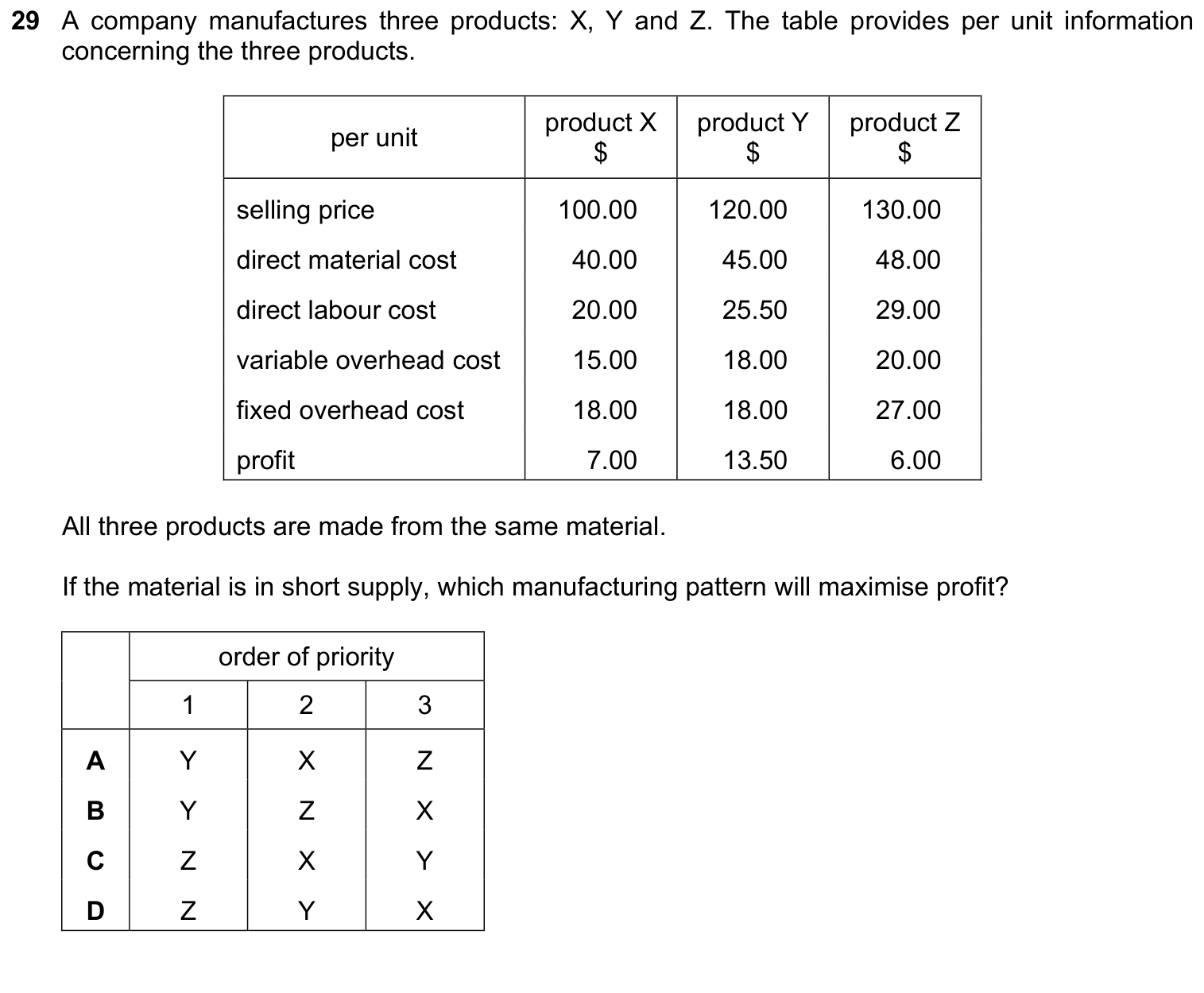
Which production priority maximises profit when material is in short supply? Use the complete source image for the figures and answer choices.
Answer: B.
Material is scarce, so rank by contribution per DOLLAR of material, since all three use the same material and its cost stands in for the quantity used. Contribution is selling price less all three VARIABLE costs: X gives 100 less 40 less 20 less 15, which is $25, Y gives $31.50 and Z gives $33. Dividing by material cost gives 25 over 40, which is 0.625 for X, 31.50 over 45, which is 0.70 for Y, and 33 over 48, which is 0.6875 for Z. The order is Y, Z, X. Ranking on the profit row puts Y first but then X ahead of Z, and that row includes fixed overhead, which does not change with the decision.
Question 2
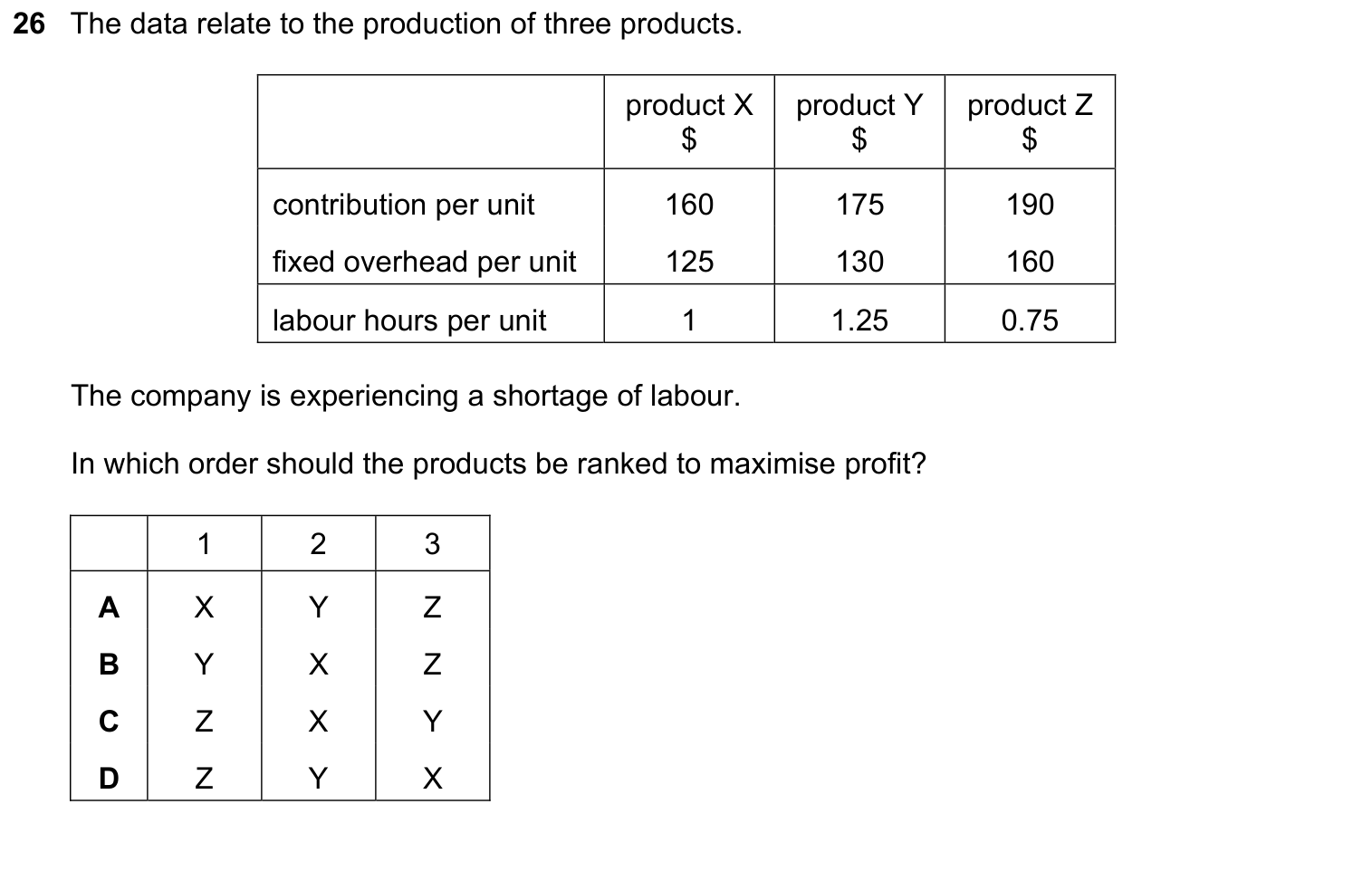
Rank three products to maximise profit when labour is in short supply. Use the complete source image for the figures and answer choices.
Answer: C.
Labour is scarce, so rank by contribution per LABOUR HOUR rather than per unit. X earns 160 over 1 hour, which is $160. Y earns 175 over 1.25 hours, which is $140. Z earns 190 over 0.75 hours, which is $253.33. The order is Z, then X, then Y. Ranking on contribution per unit alone puts Z first but then X last, and Z wins here precisely because it uses the least labour, not because its contribution is highest. The fixed overhead per unit is a distractor: it does not change with the decision and must be ignored.
Question 3
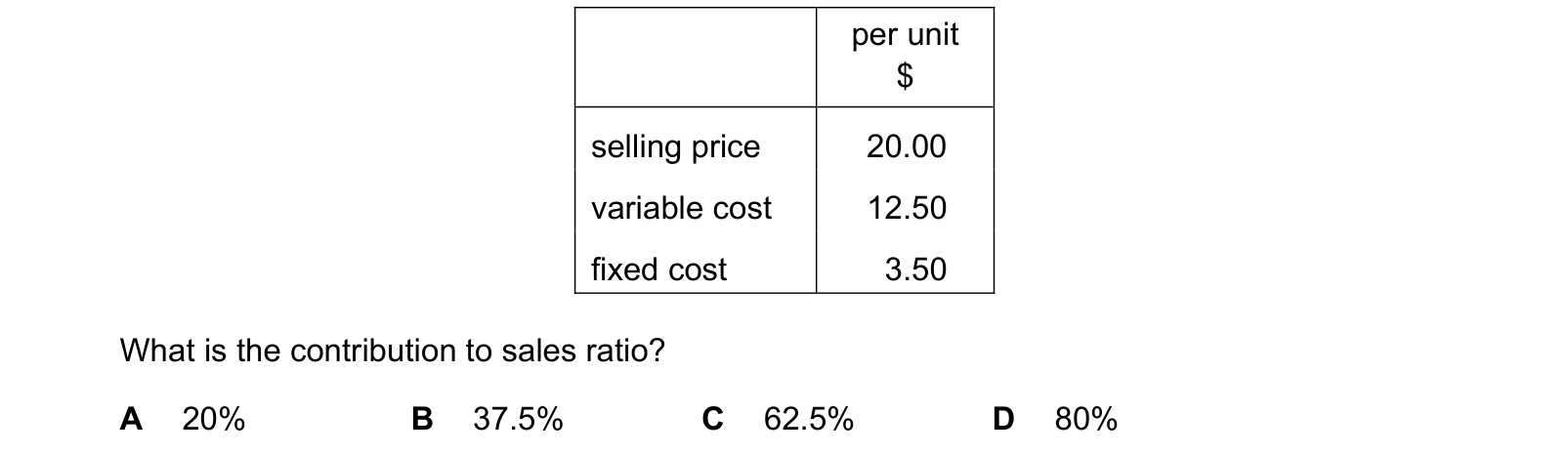
A business provided the following information about a product. per unit $ selling price 20.00 variable cost 12.50 fixed cost 3.50 What is the contribution to sales ratio?
Answer: B.
Contribution is selling price less variable cost, which is 20.00 less 12.50, or $7.50, so the ratio is 7.50 over 20.00, which is 37.5%. The $3.50 of fixed cost per unit stays out of it; deducting it as well gives 20%, which is profit per unit expressed against price. Fixed cost per unit is not even a stable figure, since it depends on the volume it was spread over, which is another reason contribution stops before it.
Question 4
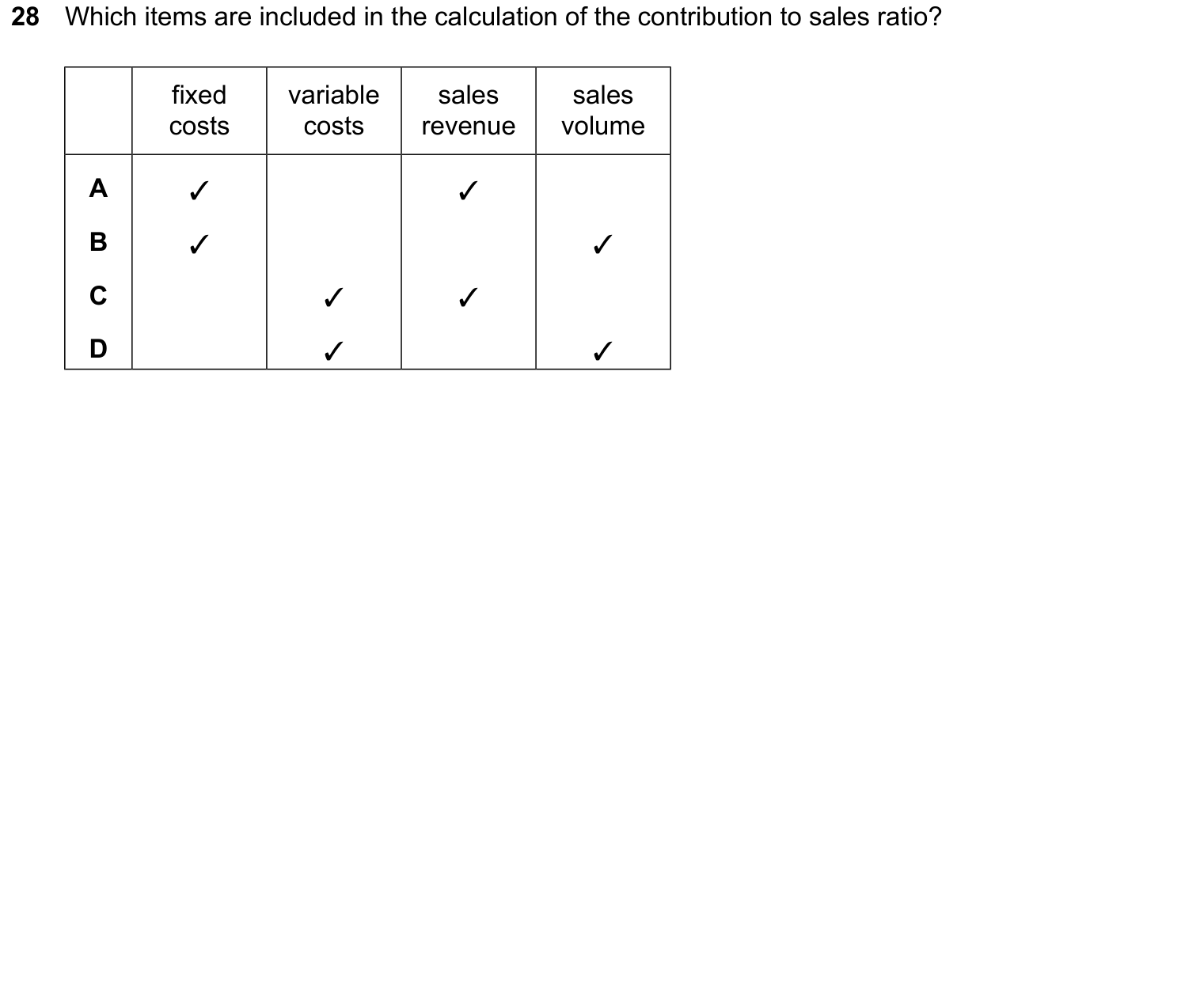
Which items are included in the contribution to sales ratio? Use the complete source image for the figures and answer choices.
Answer: C.
Variable costs and sales revenue. The ratio is contribution over sales revenue, and contribution is sales revenue less VARIABLE costs, so those are the only two inputs. Fixed costs are excluded by definition, which is what makes the ratio constant as volume changes and therefore useful for break-even work. Sales VOLUME is not needed either: the ratio works on values, which is exactly why it can be applied to a business selling several different products where units are not comparable.
Question 5
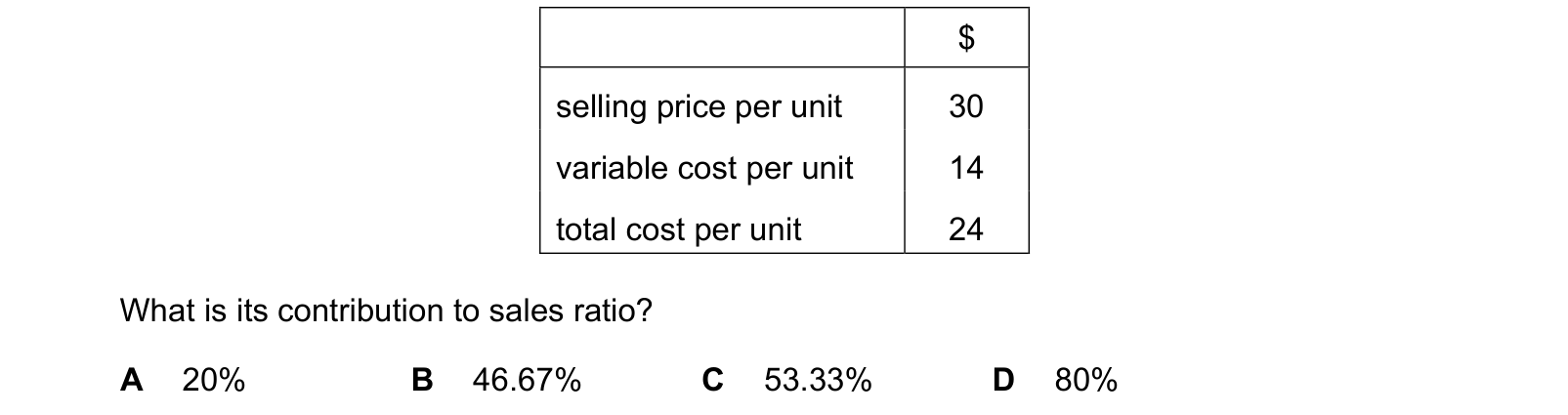
A business has the following information relating to its single product. $ selling price per unit 30 variable cost per unit 14 total cost per unit 24 What is its contribution to sales ratio?
Answer: C.
Contribution is selling price less VARIABLE cost, which is 30 less 14, or $16, so the ratio is 16 over 30, which is 53.33%. The total cost per unit of $24 is a distractor: it includes $10 of fixed cost, and using it gives 20%, which is the profit to sales ratio. Contribution is defined before fixed costs precisely so that it stays constant per unit as volume changes, which is what makes it useful for break-even work.
These questions are drawn from past CIE 9706 Accounting papers and filtered to marginal costing. You answer, you find out immediately whether you were right, and you get the reasoning for the correct option and for each distractor. Wrong answers go to a mistakes locker so you can come back to exactly those.
Practice is free. You need an account only so your progress and your mistakes are still there next time.
These are the errors that cost marks on marginal costing, taken from our own topic notes. Read them before you practise and you will recognise the traps in the questions.
Including fixed costs in the marginal cost of a unit.
Deducting fixed overhead before calculating contribution.
Ranking products by contribution per unit when a limiting factor applies.
Discontinuing a product that makes a positive contribution because absorption costing shows a loss.
Getting the reconciliation the wrong way round when inventory rises.
Forgetting the non-financial factors when a question asks for advice.
Using marginal cost to value closing inventory in the financial statements.