Adjustments to financial statements Exam Questions
86 past-paper questions on this unit. Five of them are below. Answer on the page: each one is marked the moment you pick, the correct option is shown whether or not you found it, and the full explanation opens either way.
CIE 9706 AccountingPaper 1 MCQsFree account
Adjustments to financial statements: five questions to try now
Real past-paper questions, the answer key from the mark scheme, and the explanation that goes with it. No account needed to answer them.
Question 1
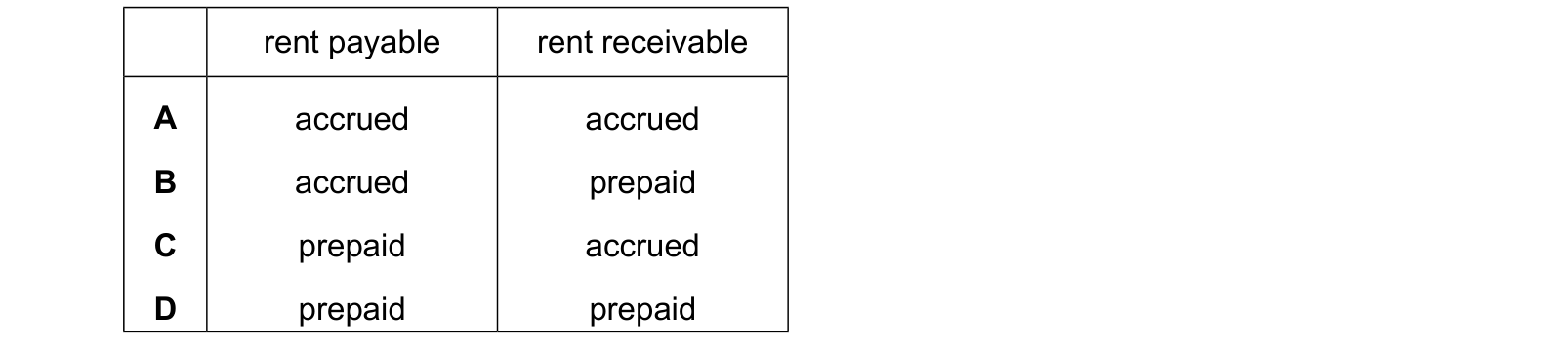
The current assets of a company include the balances on both the rent payable and rent receivable accounts. What do these balances represent? Each answer gives, in order: rent payable; rent receivable.
Answer: C.
An expense account only shows up among current assets when the business has paid for something it has not yet used, so the rent payable balance must be a prepayment. An income account shows up among current assets when income has been earned but not yet received, so the rent receivable balance must be accrued. That gives prepaid then accrued. A and B call the rent payable balance accrued, which would be an amount owed and would sit under current liabilities. D calls the rent receivable balance prepaid, which would mean a tenant had paid in advance, and that is income received in advance, a liability.
Question 2
When preparing a sole trader’s financial statements, no adjustment was made for a prepayment at the end of the year. What is the effect of this omission?
Answer: B.
A prepayment is an expense paid in advance, so recording it takes part of the charge back out of the income statement and sets up a current asset. Omitting it means too much expense has been charged, so profit for the year is understated, and no asset has been recognised, so current assets are understated too. Profit belongs to the owner, so an understated profit means understated capital as well, which is B. A has both effects overstated, which is the exact reverse. C and D bring trade payables into it, but a prepayment arises from paying early, so payables are not affected at all.
Question 3
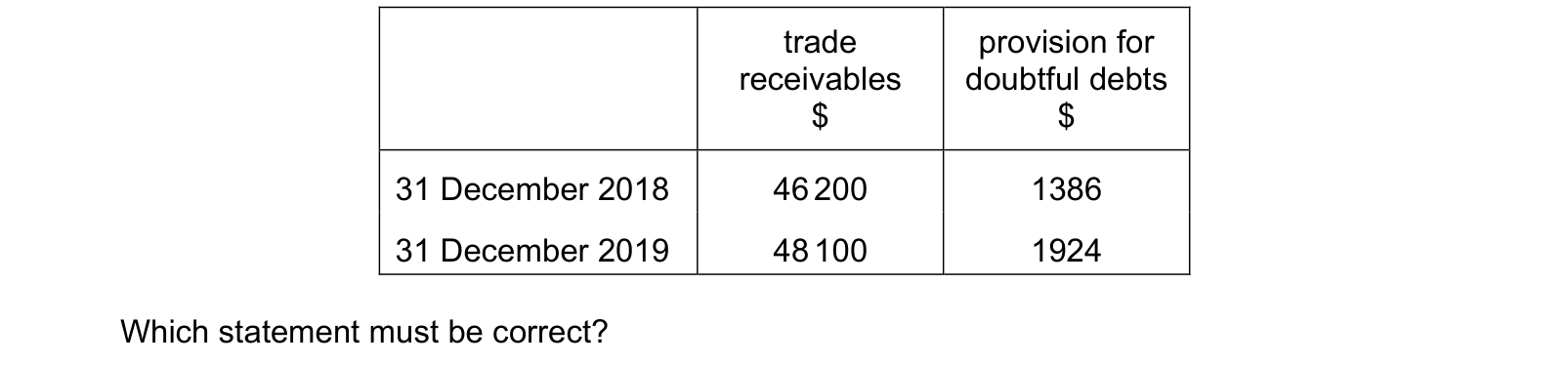
A business provides the following information. trade provision for receivables doubtful debts $ $ 31 December 2018 46 200 1386 31 December 2019 48 100 1924 Which statement must be correct?
Answer: B.
Compare the RATE, not the amounts. In 2018 the provision was 1386 on 46 200, which is 3%, and in 2019 it was 1924 on 48 100, which is 4%, so the rate has risen. Receivables grew too, but not nearly enough to explain the larger provision on its own. The statements about irrecoverable debts cannot be tested from these figures at all: the provision covers debts still thought collectable, and nothing here says what was actually written off.
Question 4
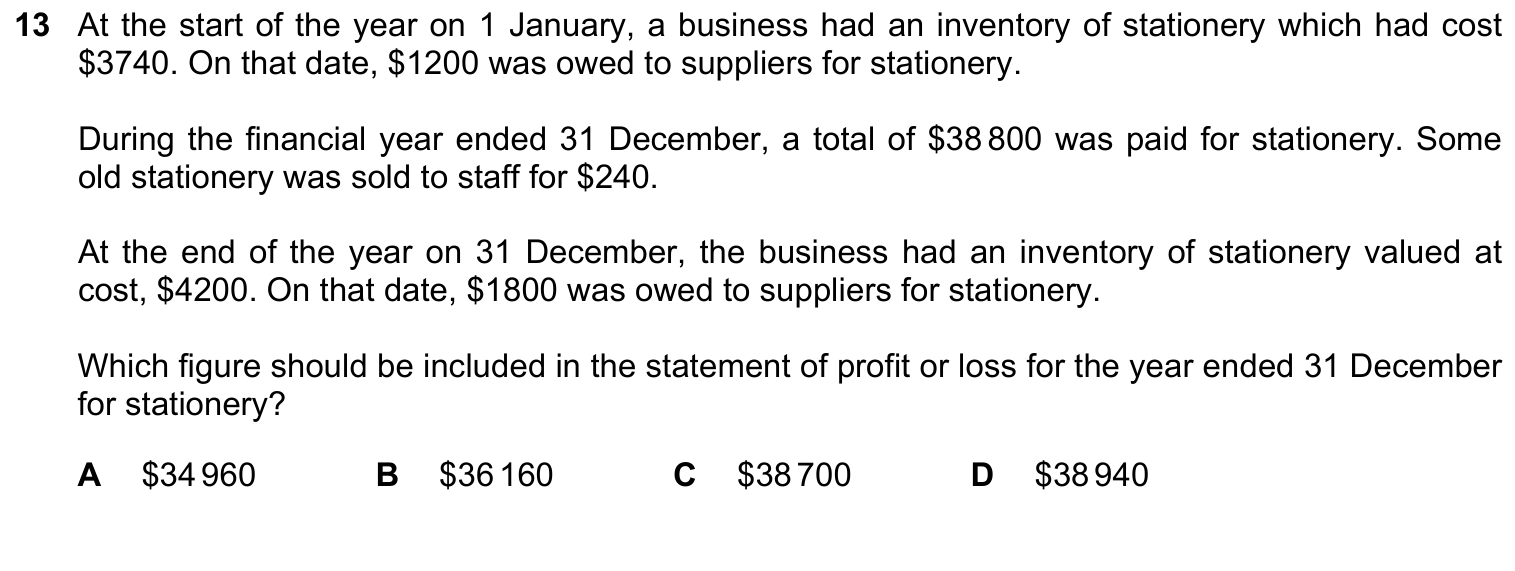
Calculate the stationery expense for the statement of profit or loss. Use the complete source image for the figures and answer choices.
Answer: C.
Convert payments into the expense, then adjust for what was consumed. Purchases are the $38 800 paid less the $1200 owed at the start plus the $1800 owed at the end, which is $39 400. The expense is opening inventory 3740 plus purchases 39 400 less closing inventory 4200, which is $38 940, and the $240 of old stationery sold to staff comes off as well, giving $38 700. Forgetting the sale to staff leaves $38 940, and ignoring the two payables balances gives $36 160.
Question 5
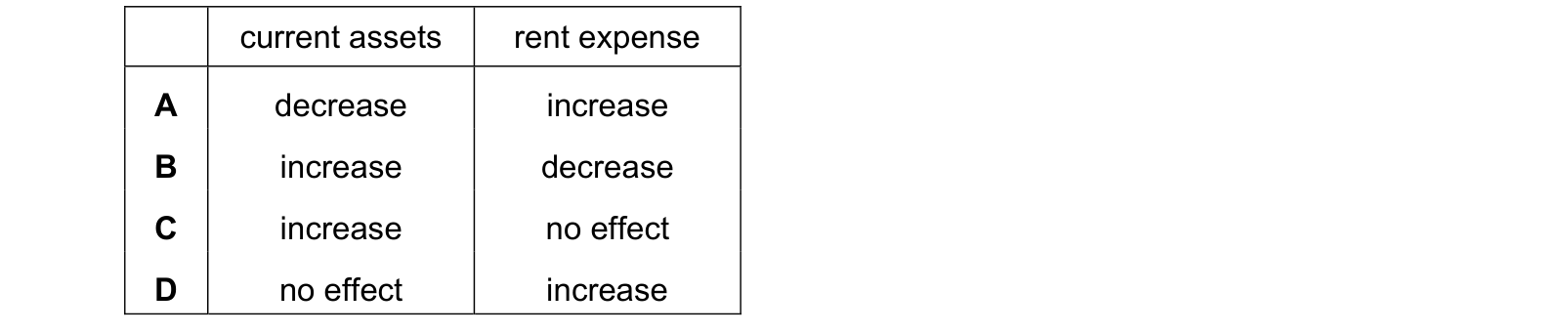
A business prepaid its rent. What is the effect of this on the current assets and the rent expense at the year end? Each answer gives, in order: current assets; rent expense.
Answer: B.
Current assets increase and the rent expense decreases. A prepayment is rent paid for a period after the year end, so it is taken OUT of this year's expense, which reduces the charge, and carried forward as a benefit still to come, which is a current asset. The two move in opposite directions by the same amount, and the mirror case is an accrual, which raises the expense and creates a current liability.
These questions are drawn from past CIE 9706 Accounting papers and filtered to adjustments to financial statements. You answer, you find out immediately whether you were right, and you get the reasoning for the correct option and for each distractor. Wrong answers go to a mistakes locker so you can come back to exactly those.
Practice is free. You need an account only so your progress and your mistakes are still there next time.
These are the errors that cost marks on adjustments to financial statements, taken from our own topic notes. Read them before you practise and you will recognise the traps in the questions.
Charging the full allowance to the income statement instead of the movement in it.
Calculating the allowance before writing off irrecoverable debts.
Reversing accruals and prepayments, or putting a prepaid expense in liabilities.
Applying the lower of cost and net realisable value to the total rather than line by line.
Valuing inventory at selling price.
Adjusting only the income statement and leaving the statement of financial position untouched.
Treating a recovered debt as a reduction in the irrecoverable debts of a customer who still owes money.