Correction of errors and suspense accounts Exam Questions
47 past-paper questions on this unit. Five of them are below. Answer on the page: each one is marked the moment you pick, the correct option is shown whether or not you found it, and the full explanation opens either way.
CIE 9706 AccountingPaper 1 MCQsFree account
Correction of errors and suspense accounts: five questions to try now
Real past-paper questions, the answer key from the mark scheme, and the explanation that goes with it. No account needed to answer them.
Question 1
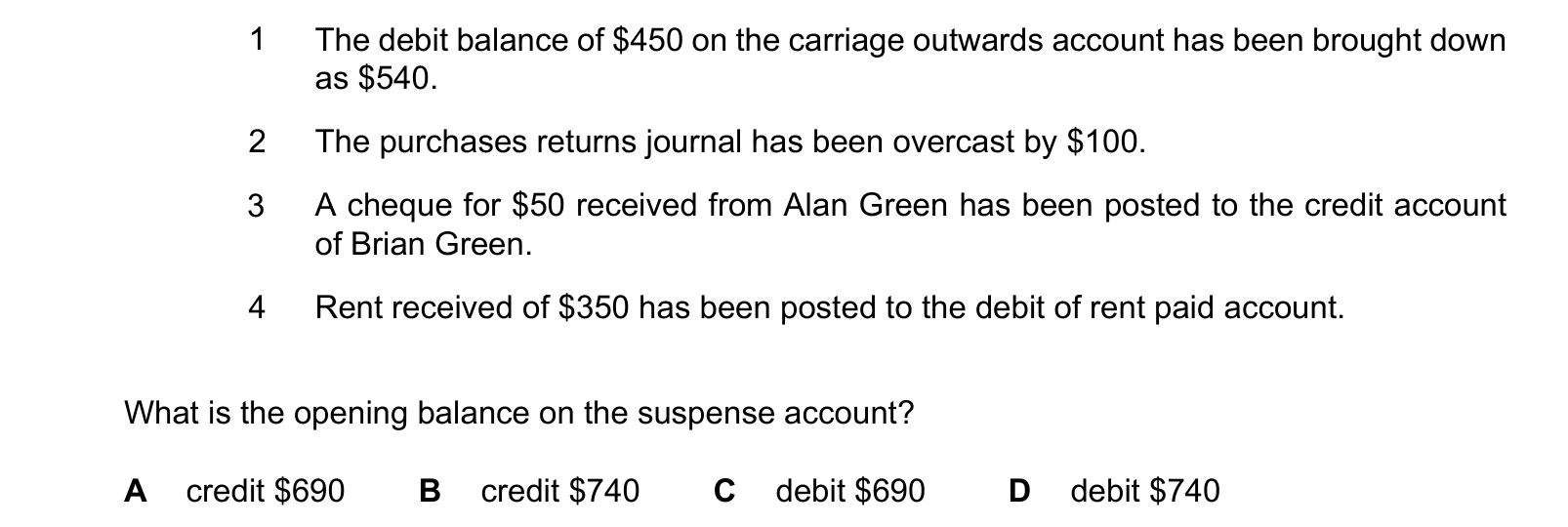
A trial balance does not balance and a suspense account is opened. On investigation, the following errors are found. What is the opening balance on the suspense account?
Answer: A.
Four errors, and two of them cost double because the entry is on the wrong side. A debit balance of $450 brought down as $540 leaves debits $90 too high. The overcast purchases returns journal leaves credits $100 too high. Rent RECEIVED posted to the debit of rent paid is on entirely the wrong side, so debits are $350 too high and credits $350 too low, a $700 gap. The cheque posted to Brian Green instead of Alan Green is an error of commission and does nothing. Debits exceed credits by $690, so the suspense account opens with a CREDIT of $690.
Question 2
A suspense account was opened to record the difference on a trial balance. The following errors were then discovered. What was the opening balance on the suspense account?
Answer: A.
Both errors are one-sided, so both reach the suspense account. The discount allowed entered only in the sales ledger control account leaves its matching DEBIT to the discounts allowed account missing, so debits are $2000 short. The repairs cheque entered as $5100 instead of $1500 leaves debits $3600 too high. Netting the two, debits exceed credits by $1600, so the suspense account opened with a CREDIT of $1600. Adding the two rather than netting them gives $5600.
Question 3
Iga is worried that her book-keeper may have been forgetting to record credit notes received. What should she do to find out?
Answer: B.
1 only. A missing credit note has been left out of the books entirely, so any check built from those same books will miss it too. A purchases ledger control account is compiled from the returns journal, so a credit note never entered is absent from both the control account and the individual supplier accounts and the two still agree. A trial balance is no better, because an omission leaves both sides equally short. Only an EXTERNAL document breaks the circle, and the supplier's statement of account shows the credit note the books never recorded.
Question 4
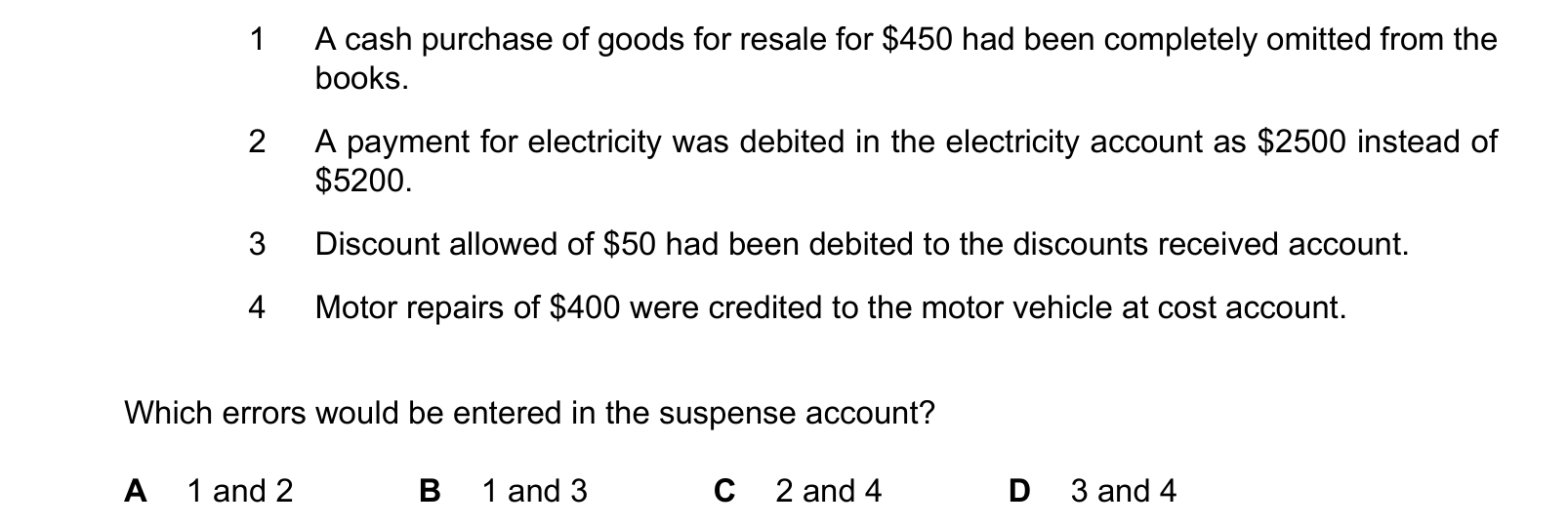
The following errors were found after a suspense account was opened. Which errors would be entered in the suspense account?
Answer: C.
2 and 4. A suspense account only opens when the trial balance disagrees, which needs a ONE SIDED error. Debiting electricity $2500 against a payment of $5200 leaves the two sides $2700 apart, and crediting motor repairs to the motor vehicle account gives two credits and no debit. Both unbalance the books. The other two do not: a complete omission leaves out both halves equally, and posting a discount allowed to the discounts received account is still a debit of $50, so the totals agree even though the accounts are wrong.
Question 5
Henry received a credit note from a supplier. He treated this in error as an invoice received and entered it in his purchases journal. When was the error revealed?
Answer: B.
Comparing the purchases ledger with the suppliers' statements of account. Treating a credit note as an invoice puts the entry on the wrong side of the supplier's account, but the SAME wrong entry flows through the purchases journal into the control account, so the two internal records still agree and neither a control account nor a trial balance reveals anything. Only the supplier's own statement, an external document prepared from their records, shows the balance the business should have.
These questions are drawn from past CIE 9706 Accounting papers and filtered to correction of errors and suspense accounts. You answer, you find out immediately whether you were right, and you get the reasoning for the correct option and for each distractor. Wrong answers go to a mistakes locker so you can come back to exactly those.
Practice is free. You need an account only so your progress and your mistakes are still there next time.
These are the errors that cost marks on correction of errors and suspense accounts, taken from our own topic notes. Read them before you practise and you will recognise the traps in the questions.
Using the suspense account to correct a two-sided error.
Correcting a reversal with the original amount instead of double it.
Adjusting profit for an error that only moved figures between two statement of financial position accounts.
Getting the direction wrong: an overstated expense increases corrected profit.
Leaving a suspense balance in the final accounts.
Writing "correct the error" as the journal narrative instead of describing what was done.
Forgetting that a corrected profit changes the capital figure in the statement of financial position too.