103 past-paper questions on this unit. Five of them are below. Answer on the page: each one is marked the moment you pick, the correct option is shown whether or not you found it, and the full explanation opens either way.
CIE 9706 AccountingPaper 1 MCQsFree account
Partnerships: five questions to try now
Real past-paper questions, the answer key from the mark scheme, and the explanation that goes with it. No account needed to answer them.
Question 1
A partnership agreement only provides for interest on capital at a rate of 6% and interest on drawings at a rate of 8%. What will be the interest payable on a loan from a partner?
Answer: B.
The agreement deals with interest on capital and interest on drawings but says nothing about a loan from a partner, so the Partnership Act fills the gap and its default rate is 5% per annum. That is B. A is wrong because a partner who lends money to the firm is treated as a lender, so interest is due even when the agreement is silent. C and D take the rates the agreement does give, but those apply to capital and to drawings and have nothing to do with a loan. Interest on a partner's loan is also an expense of the business, charged before profit is appropriated rather than being an appropriation itself.
Question 2
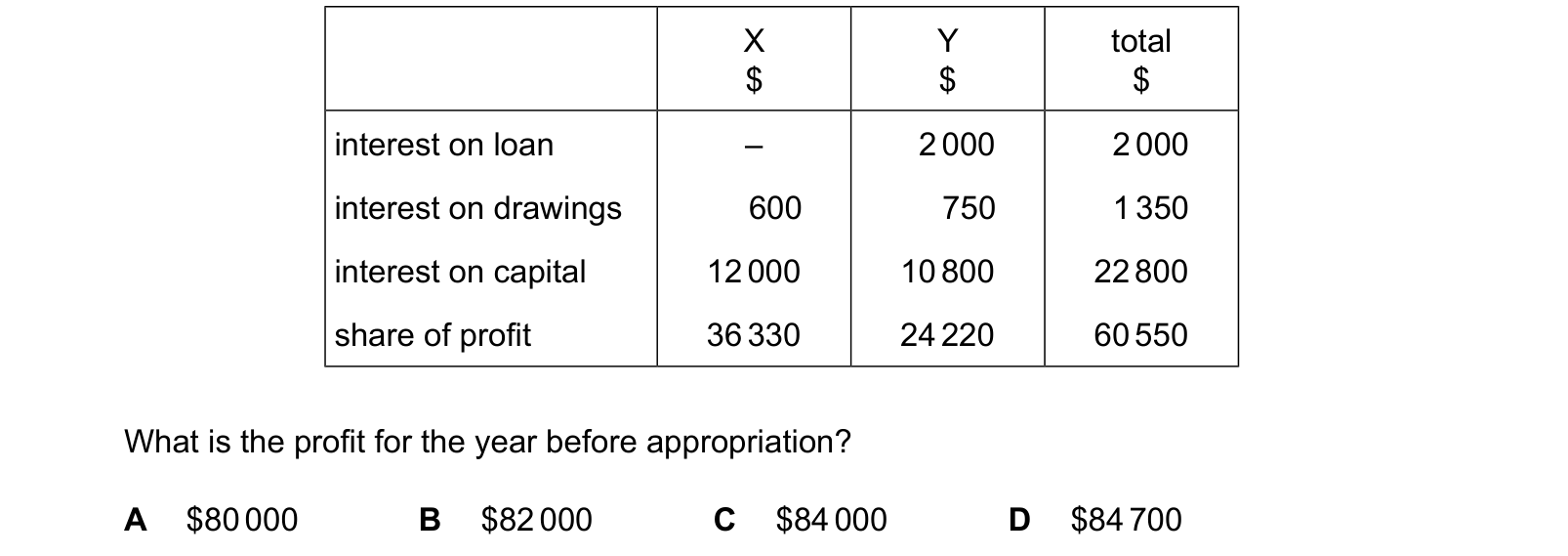
X and Y are in partnership. The following information is available at the end of the year. What is the profit for the year before appropriation?
Answer: B.
Add up what the appropriation account gave out and take off what it took in. Interest on capital of 22 800 plus profit shares of 60 550 is 83 350, and the 1350 of interest charged on drawings was credited to that account, so it comes off: 82 000. Interest on the loan is an expense in the statement of profit or loss, so the 2000 has already been deducted in reaching the profit for the year: C of 84 000 adds it back and A of 80 000 deducts it a second time. D of 84 700 adds the 1350 of interest on drawings instead of deducting it.
Question 3
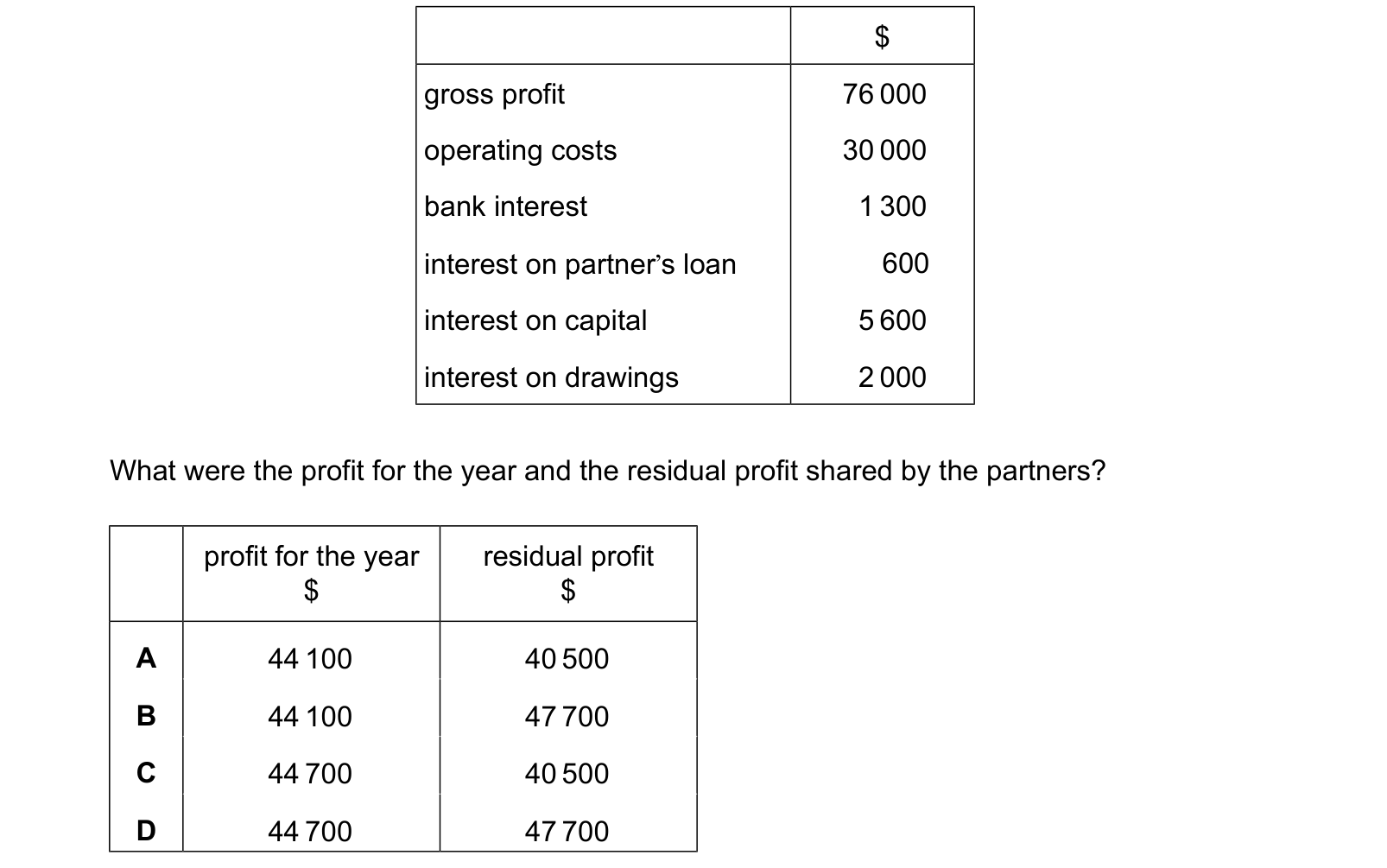
A partnership provided the following information for the year. What were the profit for the year and the residual profit shared by the partners? Each answer gives, in order: profit for the year $; residual profit $.
Answer: A.
Two lines separate the two figures. Profit for the year is struck after all EXPENSES, and both the bank interest of $1300 and the interest on the partner's loan of $600 are expenses, because a loan is a liability of the firm rather than capital. That gives 76 000 less 30 000 less 1300 less 600, or $44 100. The residual is then found in the appropriation account: deduct the $5600 of interest on capital and add back the $2000 of interest charged on drawings, giving $40 500. Treating the loan interest as an appropriation gives $44 700.
Question 4
Anne and Margaret have formed a partnership but have not made a partnership agreement. Which statement is correct for this situation?
Answer: A.
With no agreement the Partnership Act supplies the terms, and its list is short: profits and losses are shared equally, no interest is allowed on capital, no interest is charged on drawings, no salaries are paid, and a loan from a partner carries interest at 5% per annum. Only A matches that list. B and C attach the 5% to drawings or to capital, but the Act gives no interest on either, and the 5% belongs solely to a partner's loan. D is wrong because the Act allows no salaries at all, and certainly does not scale them to the capital contributed. The trap is assuming the 5% applies to whichever item the option happens to name.
Question 5
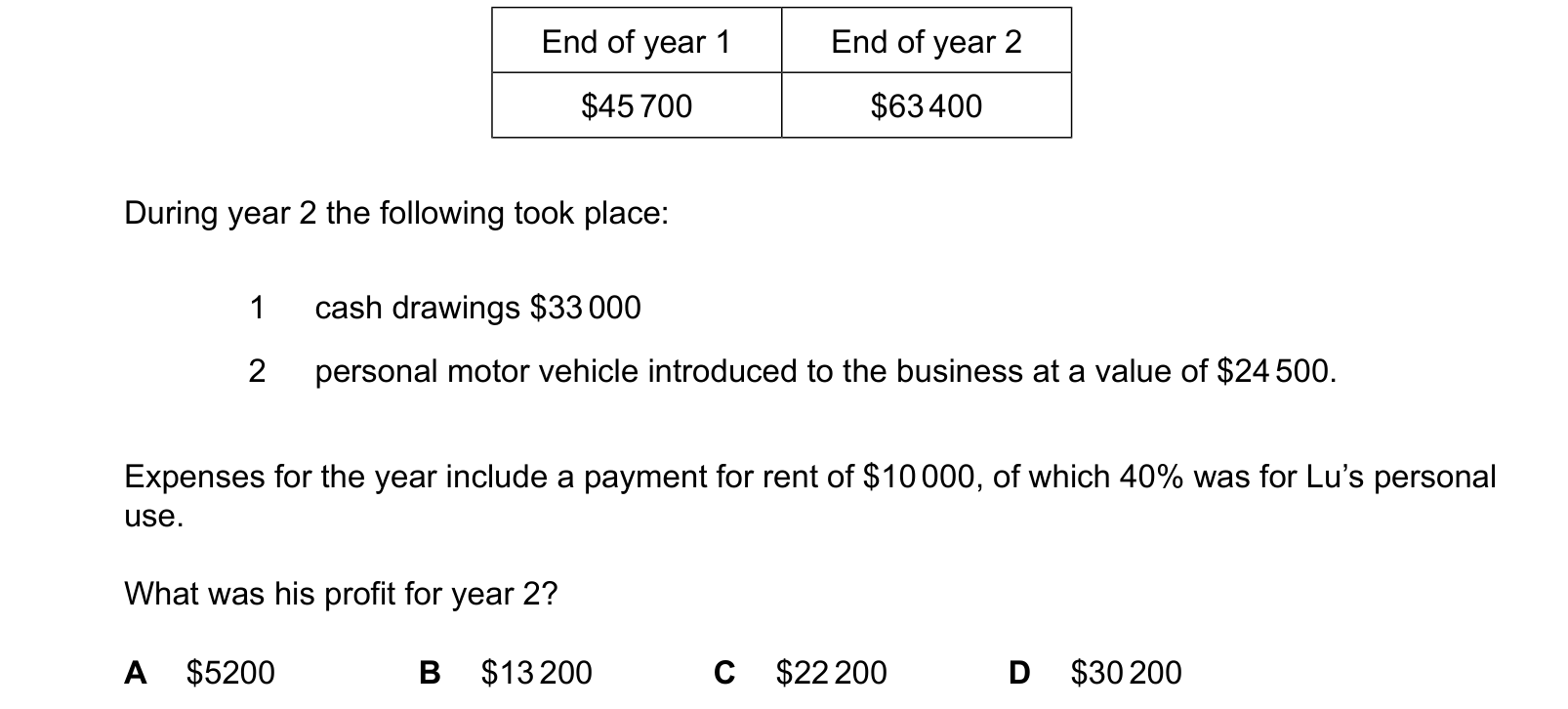
Lu had the following capital account balances. During year 2 the following took place: Expenses for the year include a payment for rent of $10000, of which 40% was for Lu’s personal use. What was his profit for year 2?
Answer: D.
Profit is the change in capital adjusted for what the owner put in and took out: capital grew 63 400 - 45 700 = 17 700. Drawings are the 33 000 of cash plus the 4000 of private rent, 40% of the 10 000, which was never a business expense, so 37 000 is added back. The 24 500 vehicle Lu brought in is capital introduced, so it is deducted: 17 700 + 37 000 - 24 500 = 30 200. C of 22 200 deducts the 4000 of private rent instead of adding it back, and A of 5200 reverses the signs on both the drawings and the capital introduced.
These questions are drawn from past CIE 9706 Accounting papers and filtered to partnerships. You answer, you find out immediately whether you were right, and you get the reasoning for the correct option and for each distractor. Wrong answers go to a mistakes locker so you can come back to exactly those.
Practice is free. You need an account only so your progress and your mistakes are still there next time.
These are the errors that cost marks on partnerships, taken from our own topic notes. Read them before you practise and you will recognise the traps in the questions.
Treating a partner's salary or interest on capital as an expense in the income statement.
Deducting interest on drawings from the profit available instead of adding it.
Sharing profit in the ratio of capital balances when a profit-sharing ratio is given.
Applying the Partnership Act defaults when an agreement exists, or forgetting them when it does not.
Crediting goodwill to the new partners in the new ratio when creating it. It is created in the old ratio.
Putting a debit balance on a current account among current assets.
Charging interest on a partner's loan in the appropriation account. It is an expense.