11 past-paper questions on this unit. Five of them are below. Answer on the page: each one is marked the moment you pick, the correct option is shown whether or not you found it, and the full explanation opens either way.
CIE 9706 AccountingPaper 1 MCQsFree account
Liquidity ratios: five questions to try now
Real past-paper questions, the answer key from the mark scheme, and the explanation that goes with it. No account needed to answer them.
Question 1
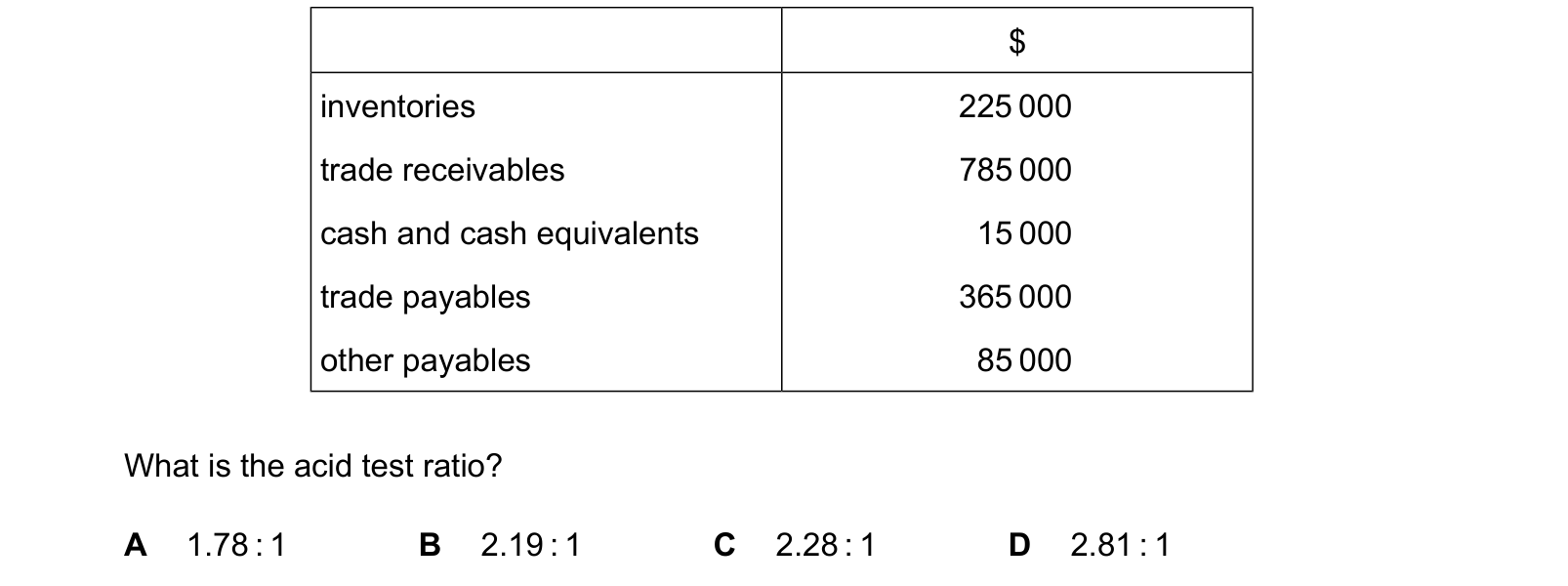
A business provided the following information at 31 March. $ inventories 225 000 trade receivables 785 000 cash and cash equivalents 15 000 trade payables 365 000 other payables 85 000 What is the acid test ratio?
Answer: A.
The acid test strips inventory out of current assets, because inventory is the one current asset that cannot be turned into cash quickly. That leaves trade receivables $785 000 plus cash and cash equivalents $15 000, so $800 000. Every current liability goes in the denominator, so trade payables $365 000 plus other payables $85 000, which is $450 000, and $800 000 over $450 000 is 1.78 : 1, giving A. C of 2.28 leaves the $225 000 of inventories in the numerator, which is the current ratio and not the acid test. B of 2.19 gets the numerator right but forgets the $85 000 of other payables, and D of 2.81 commits both errors together.
Question 2
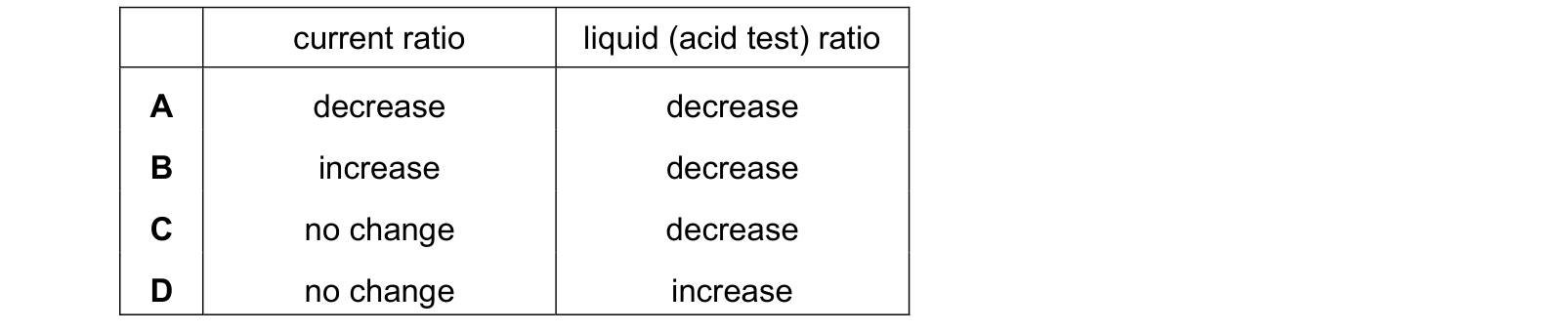
A business buys goods for resale, paying by cheque rather than buying on credit. What effect will this have on the current ratio and the liquid (acid test) ratio? Each answer gives, in order: current ratio; liquid (acid test) ratio.
Answer: C.
Paying by cheque for goods for resale swaps one current asset for another: inventory rises and the bank balance falls by the same amount. Total current assets are therefore unchanged, and current liabilities are untouched because nothing was bought on credit, so the current ratio does not move at all. The acid test deliberately excludes inventory, so its numerator loses the money paid out and gains nothing back, and that ratio falls. No change then decrease is C. A and B assume the current ratio shifts, which happens only when the total of current assets or of current liabilities changes, and D has the acid test rising just as cash leaves the business.
Question 3
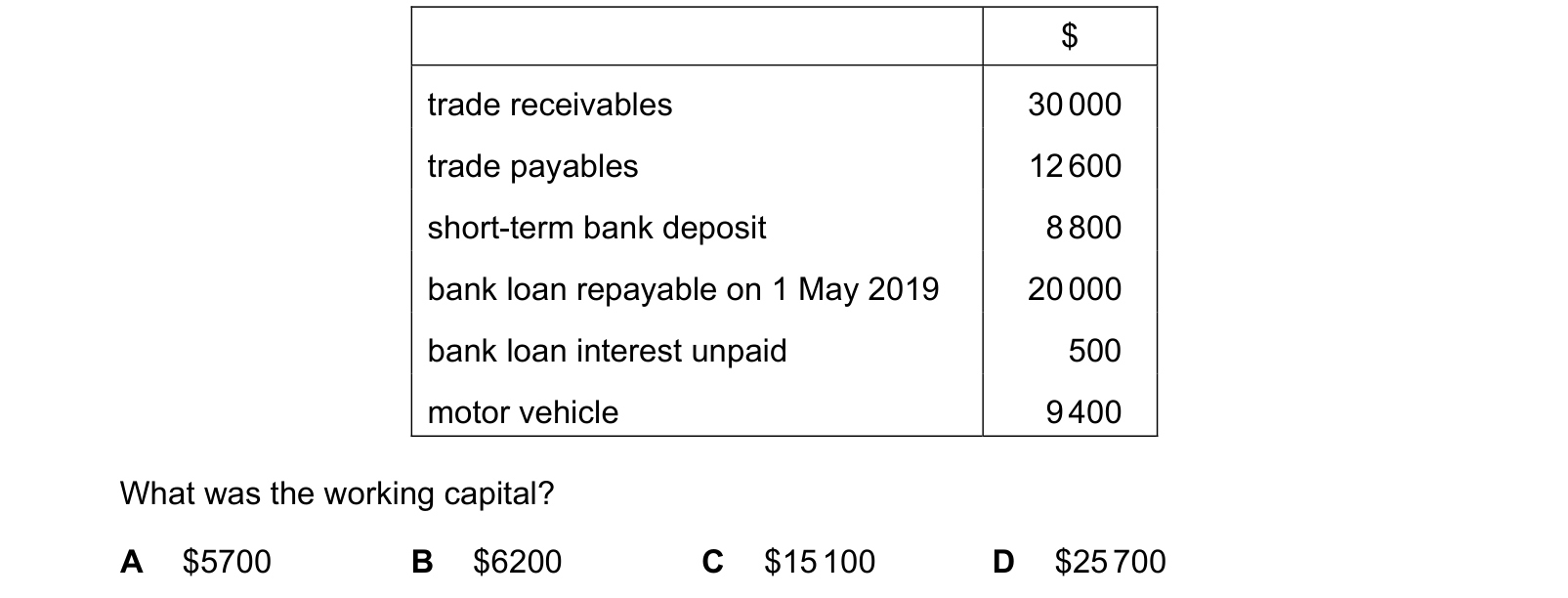
A company had the following assets and liabilities at 31 December 2018. $ trade receivables 30 000 trade payables 12 600 short-term bank deposit 8 800 bank loan repayable on 1 May 2019 20 000 bank loan interest unpaid 500 motor vehicle 9 400 What was the working capital?
Answer: A.
Working capital is current assets less current liabilities, so the first job is sorting the six lines. Current assets are trade receivables $30 000 and the short-term bank deposit $8800, giving $38 800; the motor vehicle is a non-current asset and never enters working capital. Current liabilities are trade payables $12 600, the $500 of unpaid loan interest and the $20 000 loan, which is repayable on 1 May 2019 and so falls due within twelve months of the 31 December 2018 year end. $38 800 less $33 100 is $5700, which is A. D of $25 700 is the trap, reading bank loan as long term and leaving the $20 000 out; B of $6200 forgets the unpaid interest, and C of $15 100 counts the $9400 motor vehicle as a current asset.
Question 4
A trader has a current ratio of 2 : 1. Which event would cause this ratio to increase?
Answer: C.
The current ratio is current assets divided by current liabilities, so at 2 : 1 it improves whenever current liabilities fall without current assets falling with them. Converting an overdraft into a long-term loan moves the balance out of current liabilities and into non-current liabilities, so the denominator shrinks and the ratio rises, which is C. A adds the same amount to inventory and to trade payables, and adding an equal amount to both parts of a ratio above 1 drags it down towards 1. B adds a current liability while the machinery goes into non-current assets, so current liabilities rise with no matching current asset. D simply swaps trade receivables for cash, both of which are current assets, so the ratio does not change at all.
Question 5
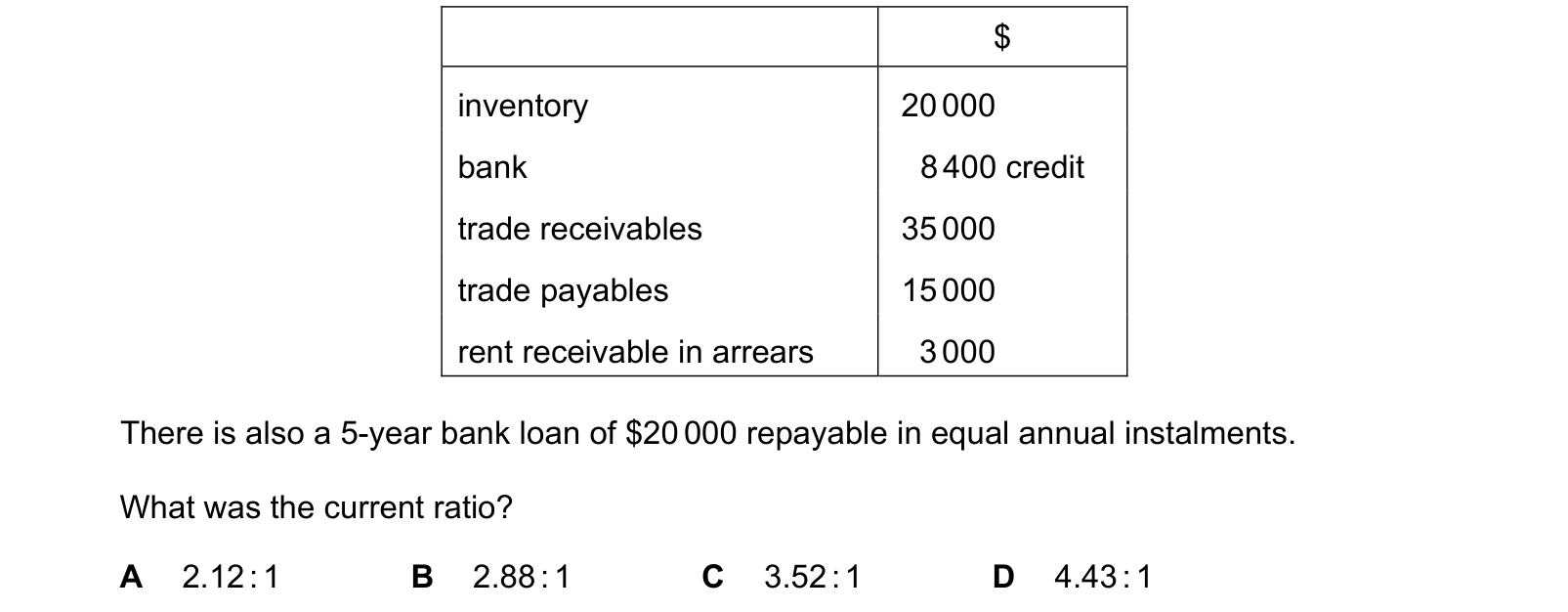
The following information for a business was available at the end of its financial year. $ inventory 20 000 bank 8 400 credit trade receivables 35 000 trade payables 15 000 rent receivable in arrears 3 000 There is also a 5-year bank loan of $20 000 repayable in equal annual instalments. What was the current ratio?
Answer: A.
The word beside the bank balance is the whole question: $8400 credit means an overdraft, so it belongs in current liabilities and not in current assets. Current assets are inventory $20 000, trade receivables $35 000 and the $3000 of rent receivable in arrears, which is money owed to the business, giving $58 000. Current liabilities are the $8400 overdraft, trade payables $15 000 and one year's instalment of the loan, $20 000 over 5 years, so $4000, giving $27 400. $58 000 over $27 400 is 2.12 : 1, which is A. B of 2.88 and C of 3.52 both leave the $8400 on the asset side and then treat the rent arrears as something owed by the business, and D of 4.43 keeps the overdraft as an asset while ignoring the loan instalment altogether.
These questions are drawn from past CIE 9706 Accounting papers and filtered to liquidity ratios. You answer, you find out immediately whether you were right, and you get the reasoning for the correct option and for each distractor. Wrong answers go to a mistakes locker so you can come back to exactly those.
Practice is free. You need an account only so your progress and your mistakes are still there next time.
These are the errors that cost marks on liquidity ratios, taken from our own topic notes. Read them before you practise and you will recognise the traps in the questions.
Including inventory in the liquid ratio.
Treating 2 : 1 as a rule that applies to every business.
Saying a high current ratio is always good.
Confusing liquidity with profitability, and using profit figures to explain a liquidity ratio.
Quoting the ratio without saying what it means for paying debts.
Suggesting improvements without noting the cost of each.
Writing the ratio as a percentage. It is a ratio to one.