Classification and behaviour of costs Exam Questions
61 past-paper questions on this unit. Five of them are below. Answer on the page: each one is marked the moment you pick, the correct option is shown whether or not you found it, and the full explanation opens either way.
CIE 9706 AccountingPaper 1 MCQsFree account
Classification and behaviour of costs: five questions to try now
Real past-paper questions, the answer key from the mark scheme, and the explanation that goes with it. No account needed to answer them.
Question 1
The manufacture of product type X incurs a specific cost. Data relating to this is as follows: units produced 6000 9000 cost per unit $3 $2 Which type of cost is this?
Answer: A.
Do not read the per unit figures as the behaviour of the cost, because a fixed cost always LOOKS as though it is falling once it is spread over more units. Multiply out instead: 6000 units at $3 is $18 000, and 9000 units at $2 is also $18 000. The total is identical at both levels, so the cost does not respond to output at all, which is the definition of a fixed cost, answer A. D, variable, would show a CONSTANT cost per unit and a rising total, the opposite of what this table shows. B, semi-variable, needs the total to rise by its variable part and C, stepped, needs the total to jump at some threshold, and neither total here moves by a single dollar.
Question 2
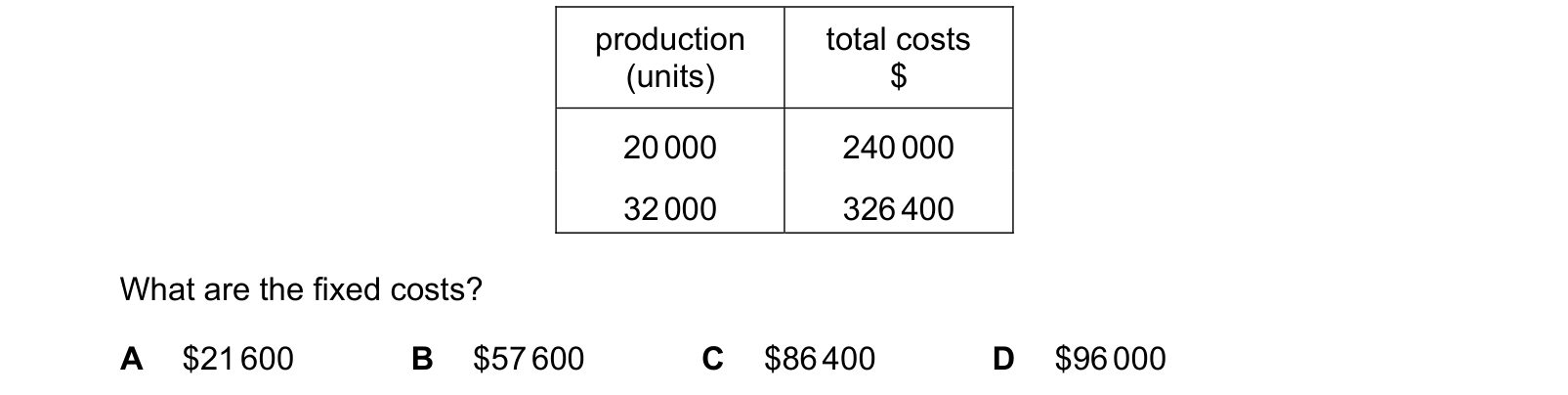
The following budgeted information is available. production total costs (units) $ 20 000 240 000 32 000 326 400 What are the fixed costs?
Answer: D.
High low compares the two levels: total costs rise by $86 400 when output rises by 12 000 units, so the variable cost is $86 400 over 12 000, which is $7.20 per unit. Fixed costs are then found by stripping the variable element out of either row, and $240 000 less 20 000 times $7.20 is $96 000, with the other level agreeing, since $326 400 less 32 000 times $7.20 is also $96 000. The answer is D. C of $86 400 stops at the change in total cost and calls that the fixed cost, when it is in fact the whole variable cost of the extra 12 000 units. B of $57 600 and A of $21 600 both work from the fall in average cost per unit, $12.00 down to $10.20, multiplying that $1.80 by 32 000 units and by the 12 000 unit increase, and neither isolates a fixed cost.
Question 3
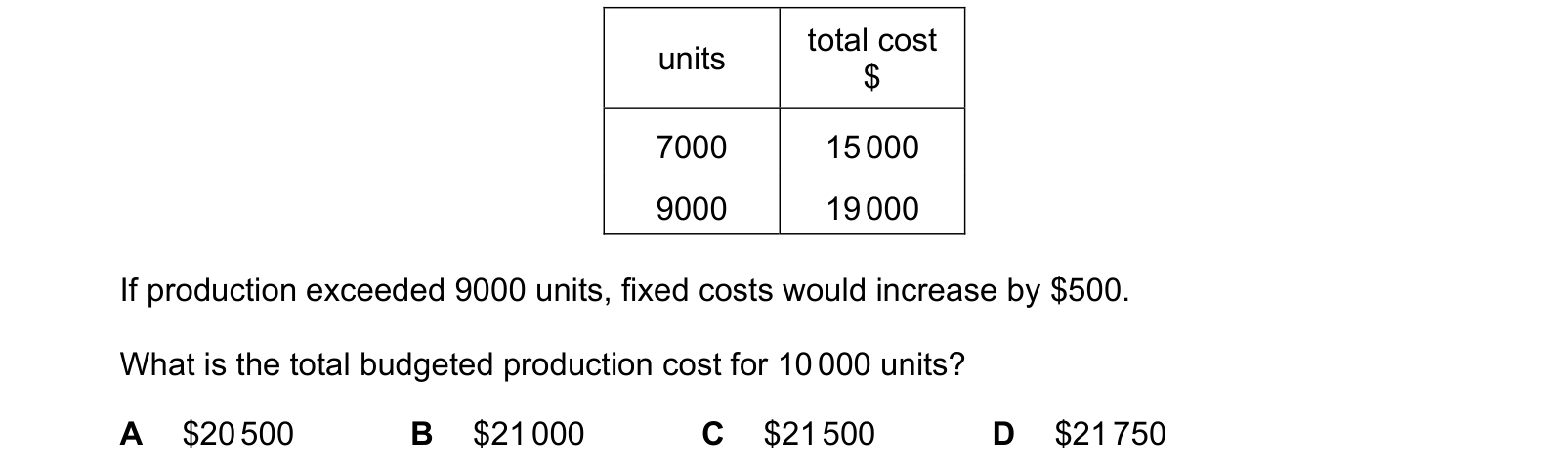
The following budgeted information is available. total cost units $ 7000 15 000 9000 19 000 If production exceeded 9000 units, fixed costs would increase by $500. What is the total budgeted production cost for 10 000 units?
Answer: C.
High low first: costs rise by $4000 when output rises by 2000 units, so the variable cost is $2 per unit, and fixed costs are $15 000 less 7000 times $2, which is $1000. At 10 000 units the variable cost is $20 000, the original $1000 of fixed cost still applies, and because output has passed 9000 units the $500 step goes on top, giving $21 500, answer C. B of $21 000 stops before the step, treating fixed costs as though they never move at any level. A of $20 500 does the opposite, adding the $500 increase while dropping the $1000 it is an increase to. D of $21 750 follows from no consistent split of the two totals.
Question 4
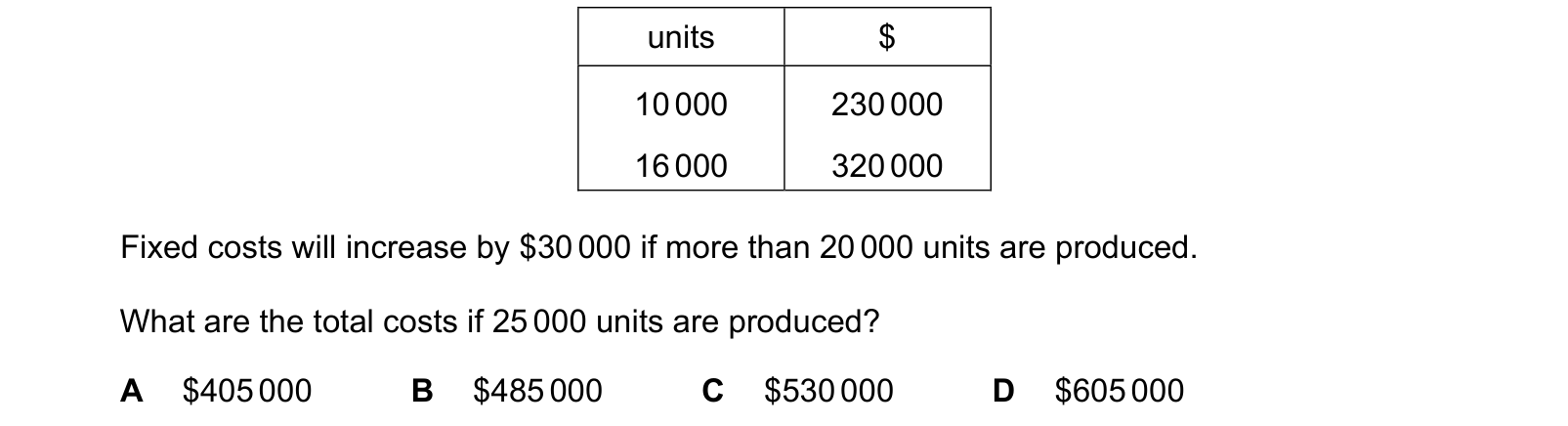
Total costs at two levels of production are as follows. units $ 10 000 230 000 16 000 320 000 Fixed costs will increase by $30 000 if more than 20 000 units are produced. What are the total costs if 25 000 units are produced?
Answer: B.
Use high low on the two given levels: costs rise by $90 000 when output rises by 6000 units, so the variable cost is $15 per unit. Fixed costs are then $230 000 less 10 000 times $15, which is $80 000. At 25 000 units the variable cost is $375 000, the fixed cost is still $80 000, and because output passes 20 000 units the extra $30 000 step is added as well, giving $485 000, which is B. A of $405 000 adds the step to the variable cost but forgets the original $80 000 of fixed costs underneath it. C of $530 000 and D of $605 000 treat every dollar as variable, scaling up the average cost per unit of $20 and $23 from the 16 000 and 10 000 unit rows, which charges fixed cost again on every extra unit.
Question 5
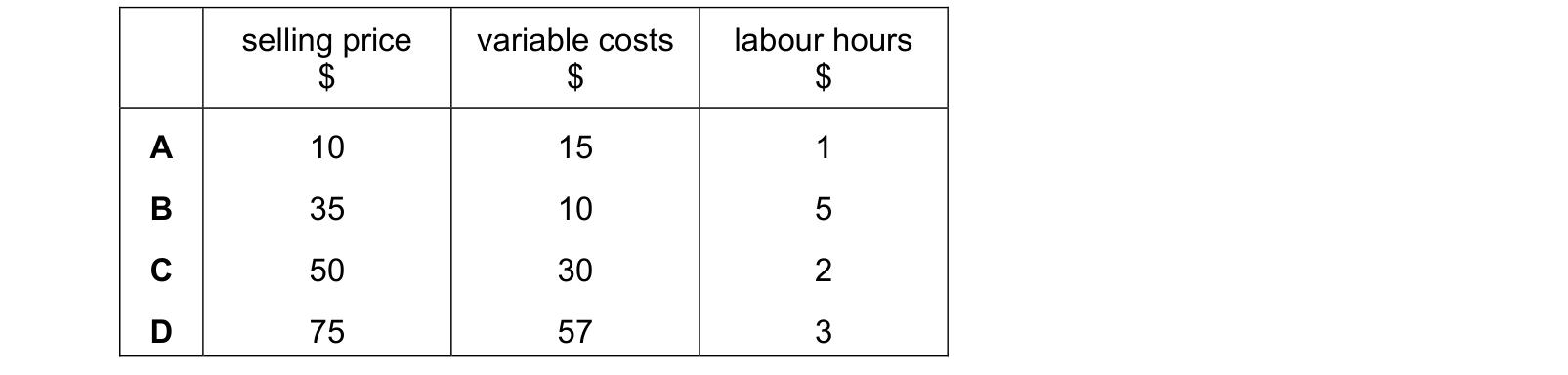
A business makes and sells four products A, B, C and D. Which product should be produced first when labour hours are not sufficient to produce all four products? Each answer gives, in order: selling price $; variable costs $; labour hours $.
Answer: C.
Labour hours are the limiting factor, so rank by contribution per LABOUR HOUR and not per unit. Product C contributes $50 less $30, so $20, spread over 2 hours, which is $10 an hour, and nothing else is close: B earns $25 over 5 hours, so $5, and D earns $18 over 3 hours, so $6. Product A should not be made at all, because its variable cost of $15 exceeds its $10 selling price and every unit loses $5 before a single fixed cost is met. C is therefore produced first. B is the tempting answer because its contribution per unit of $25 is the largest on the table, but it takes five hours to earn, and D tempts through its $75 selling price, which tells you nothing until the costs come off.
These questions are drawn from past CIE 9706 Accounting papers and filtered to classification and behaviour of costs. You answer, you find out immediately whether you were right, and you get the reasoning for the correct option and for each distractor. Wrong answers go to a mistakes locker so you can come back to exactly those.
Practice is free. You need an account only so your progress and your mistakes are still there next time.
These are the errors that cost marks on classification and behaviour of costs, taken from our own topic notes. Read them before you practise and you will recognise the traps in the questions.
Saying fixed costs are constant per unit, or that variable costs are constant in total.
Calling every material cost direct.
Forgetting that classifications depend on the purpose, so one cost can be direct for a department and indirect for a unit.
Using an output level other than the true highest and lowest in the high-low method.
Finding the variable cost and stopping, without substituting back for the fixed element.
Including a sunk cost in a decision.
Ignoring the relevant range when saying a fixed cost never changes.