Macroeconomic Policy Objectives and Their Conflicts: five questions to try now
Real past-paper questions, the answer key from the mark scheme, and the explanation that goes with it. No account needed to answer them.
Question 1
The table shows real GDP and unemployment for an economy.
economic indicators 2019 2021
real GDP ($ billions) 40000 38000 unemployment (millions) 2 3
What can be concluded from the data?
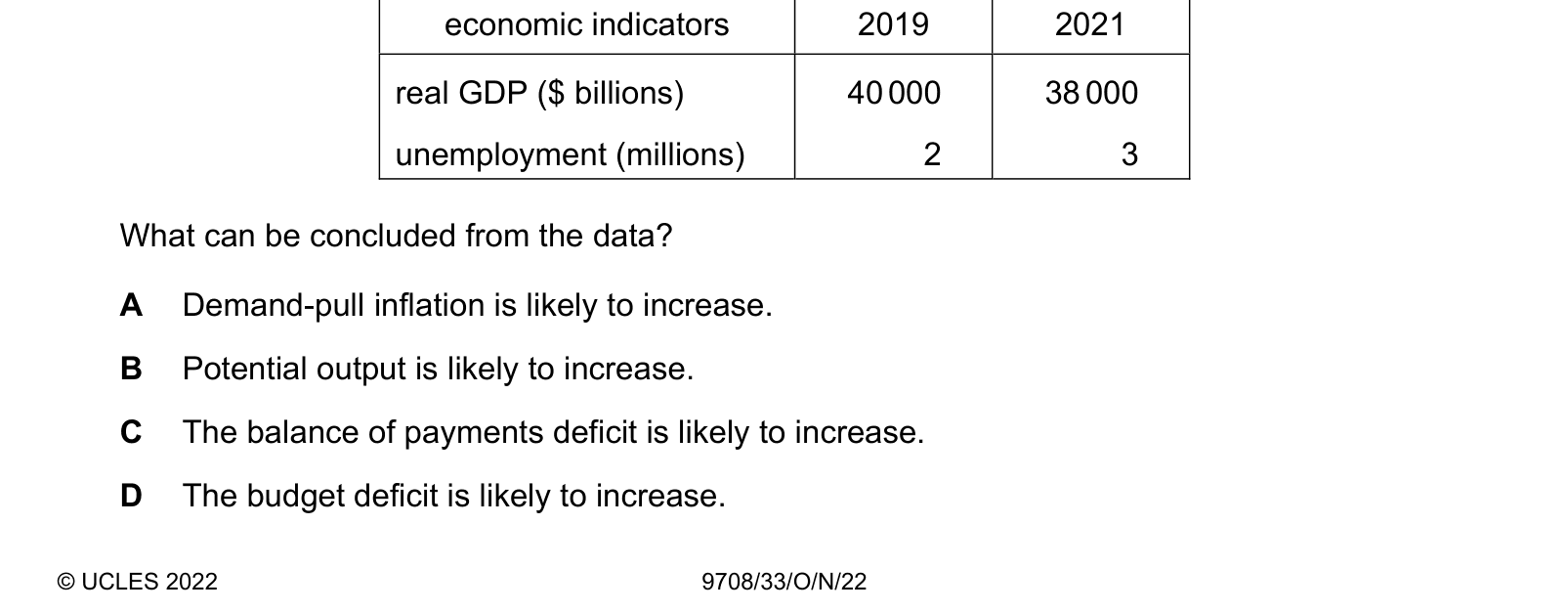
Answer: D.
Question 2
The government’s chief economist says that increasing the top rate of income tax from 40% to 45% is likely to reduce tax revenue by 2%.
Which economic concept might explain this prediction?
Answer: B.
Question 3
What is most likely to be an appropriate government action to reduce both a balance of payments current account surplus and the rate of inflation?
Answer: D.
Question 4
In many countries it has been observed that, when high marginal rates of income tax imposed on richer groups are reduced, the tax revenue raised increases. What is an implication of this observation?
Answer: C.
Explanation: The observation that reducing high marginal rates of income tax on the rich increases tax revenue implies that the rich may engage in less tax avoidance or evasion when tax rates are lower. This does not necessarily mean that the government should aim to minimise income tax altogether (option A) as it is a crucial revenue source for funding public services. Sales taxes are not always superior to income taxes (option B) as they can be regressive, disproportionately burdening lower-income individuals. Levying proportional rather than progressive income taxes (option D) may not address the potential benefits of reducing high marginal rates for the rich. Thus, the implication lies in option C, suggesting that reducing income tax on the rich may have positive effects on the welfare of the poor.
Question 5
What is most likely to increase in the short run following a rise in an economy’s rate of inflation caused by a demand-side shock?
Answer: A.
Explanation:
When an economy experiences a rise in inflation due to a demand-side shock, it is likely that domestic goods and services become relatively more expensive compared to foreign products. This increase in domestic prices can lead to a decrease in international competitiveness, as foreign goods become relatively cheaper in comparison.
As a result, imports might increase due to the relatively lower cost of foreign goods, while exports might decrease because of the higher prices of domestic goods. This imbalance in trade can lead to an increase in the current account deficit on the balance of payments.
Therefore, in the short run, following an increase in inflation caused by a demand-side shock, it is most likely that the current account deficit on the balance of payments will increase.
What this practice covers
These questions are drawn from past CIE 9708 papers and filtered to macroeconomic policy objectives and their conflicts. You answer, you find out immediately whether you were right, and you get the reasoning for the correct option and for each distractor. Wrong answers go to a mistakes locker so you can come back to exactly those.
Practice is free. You need an account only so your progress and your mistakes are still there next time.
What examiners see students get wrong here
These are the errors that cost marks on macroeconomic policy objectives and their conflicts, taken from our own topic notes. Read them before you practise and you will recognise the traps in the questions.
- Asserting a conflict without explaining the mechanism that produces it.
- Treating zero inflation or zero unemployment as the objective.
- Ignoring where the economy sits on the aggregate supply curve, which determines how severe the inflation conflict is.
- Failing to distinguish demand-led from supply-side growth, which have opposite implications for the inflation conflict.
- Presenting every objective as conflicting with every other, when supply-side improvement advances several together.
- Omitting the time dimension, when several conflicts are short run only.
- Concluding without prioritising, when the question supplies the data needed to prioritise.
Revise it first
If any of the above is unfamiliar, work through the notes before practising: Macroeconomic Policy Objectives and Their Conflicts revision notes.