Macroeconomic Policy Objectives and Their Conflicts
Why Governments Cannot Achieve Every Objective at Once
Contents: 9 sections
1. Why this topic matters
A government pursues several macroeconomic objectives simultaneously. The examinable difficulty is that policies which advance one often set back another, so macroeconomic management is a matter of trade-offs rather than solutions.
This topic is the organising frame for the whole of chapter 10. Every policy in 10.2 and 10.3 is evaluated against these objectives, and the conflicts here are what makes that evaluation possible.
The essential move, and the one that separates strong answers, is to treat a conflict as a mechanism to be explained rather than a fact to be asserted. Saying "there is a conflict between growth and inflation" earns little. Explaining that a demand-led expansion raises output along the upward sloping section of the aggregate supply curve, so that the closer the economy is to capacity the greater the share of the stimulus that appears as prices rather than output, earns a great deal.
2. The objectives
2.1 The four principal objectives
- Economic growth, meaning a sustained rise in real GDP, and ideally in real GDP per head.
- Low and stable inflation, commonly a target around 2 per cent rather than zero, since a small positive rate allows relative prices and real wages to adjust and provides a margin against deflation.
- Low unemployment, meaning unemployment close to the natural rate, covered in 9.6, rather than zero.
- A satisfactory balance of payments position, usually meaning a current account deficit that can be financed sustainably.
2.2 Further objectives
- An equitable distribution of income and wealth, which links to 8.2.
- Balanced government finances over the cycle.
- Environmental sustainability, developed in 10.6.
Note that several objectives are defined as ranges rather than extremes. Zero inflation and zero unemployment are not targets, and treating them as such is a common error.
3. The conflicts
3.1 Unemployment against inflation
The most examined conflict, and the one with the fullest theory behind it in 9.6.
Reducing unemployment through demand expansion moves the economy up the short run Phillips curve, raising inflation. Reducing inflation requires demand restraint, raising unemployment above the natural rate for a period.
The strength of the conflict depends on where the economy sits. With a large output gap, expansion raises output with little inflation, so the conflict is weak. Near capacity; it is severe.
The long run qualification from 9.6 matters here: the trade-off is short run only, and attempts to exploit it permanently produce accelerating inflation without lasting employment gains.
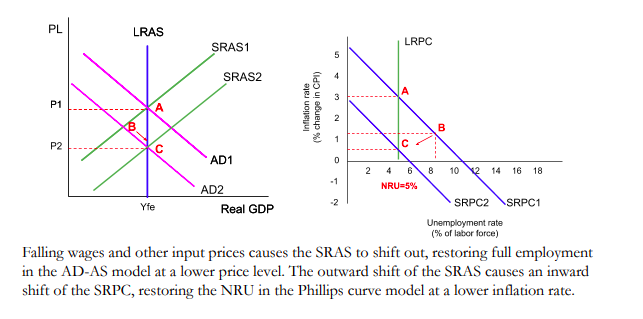
The diagram illustrates that last point rather than the trade-off above it, and the order of the letters is the argument. A to B is the trade-off working in reverse: demand falls, unemployment rises above the natural rate and inflation comes down, a movement ALONG the short-run curve. B to C is the part the trade-off cannot explain: falling wages and input prices shift the short-run curve itself, so unemployment returns to 5 per cent while inflation falls further.
So the economy ends at the same unemployment rate it started with and a permanently lower inflation rate. No point on this diagram shows lower unemployment bought with higher inflation, which is exactly why the trade-off is described as short run only.
3.2 Growth against the balance of payments
Rising national income raises imports, because the marginal propensity to import from 9.1 is positive. Faster growth therefore tends to worsen the current account.
Worked illustration. An economy grows by $40 billion with an MPM of 0.3. Imports rise by approximately $12 billion. Unless exports rise by a similar amount, the current account deteriorates by that order.
This conflict is severe for economies with a high MPM, typically small open economies, and weaker where growth is export-led rather than consumption-led. That distinction is a strong evaluation point: the source of the growth determines whether the conflict bites.
3.3 Growth against inflation
Demand-led growth raises the price level as the economy approaches capacity. Supply-led growth, which shifts aggregate supply rightward, raises output and reduces price pressure, so it does not create this conflict.
This is the central argument for supply-side policy, and it is why an answer that distinguishes demand-led from supply-side growth will outperform one that treats growth as a single thing.
3.4 Growth against environmental sustainability
Higher output typically raises resource use and emissions, and may deplete natural capital. Growth measured by GDP does not deduct environmental degradation, so measured growth can rise while genuine welfare falls.
The counter-argument is that higher income funds cleaner technology and that people demand environmental quality more strongly as they get richer, so the conflict may weaken at higher income levels. Whether this holds is empirical and contested, and saying so is better than asserting either side.
3.5 Growth against equity
Growth does not distribute itself evenly. Where returns accrue to capital and skilled labour, growth can raise the Gini coefficient even while absolute poverty falls, which is exactly the reading required in 8.2.
Conversely, redistribution to reduce inequality may weaken incentives, which is the equity and efficiency trade-off.
3.6 Unemployment against the balance of payments
Reducing unemployment through demand expansion raises income and therefore imports, worsening the current account. Deflating demand to correct a deficit raises unemployment.
3.7 Inflation against the balance of payments
Domestic inflation above that of trading partners makes exports less price competitive and imports relatively cheaper, worsening the current account, unless the exchange rate depreciates to offset it.
4. Where conflicts are weaker or absent
Examiners reward candidates who notice that not everything conflicts.
- Supply-side improvement can raise growth, reduce unemployment, reduce inflationary pressure and improve competitiveness at once, because it shifts capacity rather than pushing against it. Its weakness is that it works slowly and costs money now for benefits later.
- Export-led growth raises output and improves the current account together.
- Reducing structural unemployment raises output while lowering the natural rate, so it does not add inflationary pressure.
The general principle worth stating: conflicts arise mainly from demand-side policy, because demand management moves the economy along a given supply curve. Supply-side policy shifts the curve, so it can advance several objectives together.
That sentence, properly explained, is one of the most useful in A2 macroeconomics.
5. Why conflicts arise: the underlying reason
Ultimately the conflicts exist because in the short run the economy has a capacity constraint. Demand management redistributes activity along the aggregate supply curve; it does not create capacity. Once the constraint binds, more of one thing means less of another, or more inflation.
Trade adds a second constraint, because domestic demand leaks abroad, and the external accounts must ultimately balance over time.
6. Managing the trade-offs
6.1 Assigning instruments to targets
Where a government has several objectives, it needs at least as many independent instruments. Assigning each instrument to the objective it influences most strongly is more effective than using one instrument for everything.
A common assignment is monetary policy to inflation, fiscal policy to demand stabilisation and the public finances, and supply-side policy to capacity and the natural rate.
6.2 Sequencing and time horizons
Some conflicts dissolve over time. Accepting higher unemployment now to reduce inflation lowers expected inflation, which reduces the future sacrifice ratio, covered in 9.6. Investment in education costs output now and raises it later.
Distinguishing short run from long run effects is therefore essential, and a conclusion that says "in the short run X, but over a longer horizon Y" is usually the correct shape.
6.3 Prioritising
Governments weight objectives differently according to circumstance. An economy with 15 per cent unemployment and 1 per cent inflation should not treat the two symmetrically. Saying which objective should take priority in the case given, and why, is what the highest bands require.
7. Integrated analysis and common traps
7.1 A complete chain
An economy has unemployment of 9 per cent, inflation of 2 per cent and a current account deficit of 4 per cent of GDP. The government expands fiscal policy.
Aggregate demand rises. Because unemployment is high, the economy is on or near the elastic section of the Keynesian aggregate supply curve from 9.3, so most of the stimulus raises real output and employment rather than prices. The multiplier from 9.2 magnifies the effect. Unemployment falls and growth rises.
However, higher income raises imports through the marginal propensity to import, so the current account deficit widens. If the MPM is high, the leakage also reduces the domestic multiplier, so the employment gain is smaller than a closed-economy calculation would suggest.
Judgement: with a large output gap the growth and unemployment objectives are advanced at little inflationary cost, so the policy is justified, but the external position deteriorates. The appropriate response is not to abandon the expansion but to pair it with supply-side measures that improve export competitiveness, since those advance both objectives rather than trading one against the other.
7.2 Common examination errors
- Asserting a conflict without explaining the mechanism that produces it.
- Treating zero inflation or zero unemployment as the objective.
- Ignoring where the economy sits on the aggregate supply curve, which determines how severe the inflation conflict is.
- Failing to distinguish demand-led from supply-side growth, which have opposite implications for the inflation conflict.
- Presenting every objective as conflicting with every other, when supply-side improvement advances several together.
- Omitting the time dimension, when several conflicts are short run only.
- Concluding without prioritising, when the question supplies the data needed to prioritise.
8. Paper 3 and Paper 4 mastery
Paper 3 tests: identifying the probable consequence of a stated change for another objective, and recognising which policy advances two objectives at once.
Paper 4 essays commonly present an economy with data on several indicators and ask which policy to pursue. The reliable structure is: read the data to establish where the economy sits, identify which objectives are furthest from target, analyse the chosen policy's effect on each objective in turn, identify the conflicts it creates, and conclude by prioritising with reference to the data.
Always use the figures supplied. An answer that quotes the output gap or the deficit and reasons from it will always beat one that discusses conflicts in the abstract.
Check you have it
Question 1
A government is increasing the role of market forces in its economy. However, it imposed temporary maximum price controls. Why might a government, committed to reducing central planning, introduce price controls?
Answer: D.
Explanation: Introducing temporary maximum price controls could help the government to reduce expectations of inflation by stabilising prices in the market. Price controls can prevent prices from rising rapidly during times of high inflation, which may lead to a reduction in consumer demand and help in managing inflation expectations. This measure does not necessarily indicate an increase in central planning or a shift away from market forces; rather, it can be a temporary tool used to stabilise the economy during turbulent times. Options A, B, and C are not suitable reasons for a government committed to reducing central planning to introduce price controls.
Question 2
What is the least likely consequence of a significant rise in unemployment during an economic recession?
Answer: B.
Question 3
What would most likely result from a sustained increase in real GDP in an economy?
Answer: A.
Explanation:
1. A sustained increase in real GDP signifies economic growth in an economy. When the economy is growing, tax revenues tend to increase as businesses and individuals earn more income. This results in higher tax collections for the government, which can help decrease the government's budget deficit as there is more revenue available to cover government expenditures.
2. Economic growth also leads to increased consumer spending and business investment, which can further boost government revenues through consumption taxes and corporate taxes.
3. Additionally, as the economy expands, there is a potential for more job creation and reduced reliance on government welfare programs, which could also contribute to lowering the budget deficit.
Therefore, option A is the most likely outcome of a sustained increase in real GDP in an economy. The other options are less likely because economic growth typically leads to positive outcomes such as lower deficits, increased productivity, improved trade balance, and lower unemployment rates.
9. Final checklist
A fully prepared learner can:
- state the four principal macroeconomic objectives and explain why several are ranges rather than extremes;
- explain the unemployment and inflation conflict using the Phillips curve, including the long run qualification;
- explain the growth and balance of payments conflict using the marginal propensity to import, with a calculation;
- explain why demand-led and supply-side growth differ in their inflationary consequences;
- explain the growth and sustainability conflict and the counter-argument;
- identify at least three cases where objectives do not conflict;
- state the underlying reason conflicts exist, namely the capacity constraint;
- explain the principle of assigning instruments to targets;
- explain how the time horizon dissolves some conflicts; and
- prioritise objectives with reference to supplied data rather than in the abstract.
Related CIE 9708 topics
Not the topic you were looking for? Describe what you are stuck on in your own words and we will take you to the notes that answer it.