Fiscal Policy
Contents: 8 sections
Cambridge International AS & A Level Economics 9708 (AS Level) Current syllabus: 2026–2028, Version 2 Official syllabus points: 5.2.1–5.2.7
Exam Essentials
1. Meaning of fiscal policy
Fiscal policy is the use of government spending and taxation to influence economic activity and pursue macroeconomic objectives.
The two principal instruments are:
- government spending;
- taxation.
A fiscal decision can change:
- the level of aggregate demand;
- the government budget balance;
- incentives to work, save and invest;
- the economy’s productive capacity if spending or tax measures affect productivity.
For AS analysis, the main short-run channel is usually through aggregate demand.
2. Meaning of a government budget
A government budget is a statement of the government’s planned or actual revenue and expenditure over a period, usually one financial year.
Revenue commonly includes taxation and other receipts. Expenditure includes current and capital spending and may also include transfer payments.
A budget is a flow: it is measured over a period of time.
Budget balance
A simple budget balance can be written as:
Budget balance = government revenue − government expenditure
- A positive result is a budget surplus.
- A negative result is a budget deficit.
- A zero result is a balanced budget.
The sign convention must be stated. Some sources instead write expenditure minus revenue, which reverses the sign. In an exam, define your convention clearly.
Government Budget Deficits, Surpluses and National Debt
3. Budget deficit
A government budget deficit occurs when government expenditure exceeds government revenue during a period.
Example:
- government revenue = $470 billion;
- government expenditure = $520 billion;
- budget balance = $470bn − $520bn = −$50bn;
- therefore, there is a $50bn deficit.
A deficit normally has to be financed by borrowing or by using accumulated financial assets.
4. Budget surplus
A government budget surplus occurs when government revenue exceeds government expenditure during a period.
Example:
- revenue = $610 billion;
- expenditure = $580 billion;
- budget balance = $610bn − $580bn = +$30bn;
- therefore, there is a $30bn surplus.
A surplus can be used to repay debt, build financial reserves or finance future spending.
5. Deficit versus debt: flow and stock
This is one of the most important distinctions in the topic.
| Concept | Type | Meaning |
|---|---|---|
| Budget deficit | Flow | Excess of expenditure over revenue during a period |
| Budget surplus | Flow | Excess of revenue over expenditure during a period |
| National debt | Stock | Accumulated outstanding government borrowing at a point in time |
A deficit is not the same as debt.
Deficit adds to borrowing during one period; national debt is the outstanding stock built up over time.
A government can have:
- a deficit while debt is already very high;
- a smaller deficit than last year while debt still rises;
- a surplus while debt remains positive;
- falling debt as a percentage of GDP even if nominal debt rises, provided GDP grows faster.
Simplified debt accumulation
At AS level, a useful simplified relationship is:
New debt ≈ previous debt + budget deficit
A budget surplus can reduce debt if it is used for repayment.
In real public accounts, the change in debt may not equal the headline deficit exactly because asset sales, valuation changes and other financial transactions can create stock-flow adjustments. This is an extension point, not a core calculation requirement.
6. Meaning and significance of national debt
National debt is the outstanding stock of government borrowing. It is often measured in currency terms or as a percentage of GDP.
The significance of debt depends on more than its absolute size. Relevant factors include:
- the debt-to-GDP ratio;
- the interest rate paid;
- the maturity structure of debt;
- whether debt is denominated in domestic or foreign currency;
- who holds the debt;
- the government’s tax-raising capacity;
- the credibility of fiscal institutions;
- whether borrowing financed productive investment or current consumption;
- the rate of economic growth.
Possible costs of high or rapidly rising debt
- Interest payments: more government revenue may be required to service debt.
- Opportunity cost: debt-interest spending may displace spending on services or investment.
- Reduced fiscal space: future governments may have less room to respond to recessions or emergencies.
- Confidence risk: lenders may demand higher interest rates if repayment appears less secure.
- Future adjustment: taxes may need to rise or spending may need to fall.
- Foreign-currency risk: depreciation can increase the domestic-currency burden of foreign-currency debt.
Why debt is not automatically harmful
- Borrowing can support aggregate demand during a recession.
- Capital spending can raise productivity and future tax revenue.
- Long-maturity, domestic-currency debt may be easier to manage.
- If nominal GDP grows faster than debt, the debt-to-GDP ratio can fall.
- A government is not identical to a household: it has taxation powers, a long time horizon and can roll over debt, although it still faces financing constraints.
Exam judgement: assess the purpose, cost, currency, maturity and growth context of the debt rather than declaring all debt “good” or “bad”.
Taxation
7. Direct and indirect taxes
Direct taxes
A direct tax is imposed directly on the income, profits or wealth of a person or organisation and is paid to the government by the legally liable taxpayer.
Examples include:
- personal income tax;
- corporation tax;
- taxes on property or wealth.
Indirect taxes
An indirect tax is imposed on expenditure on goods and services. It is usually collected from sellers and paid to the government, although some or all of the burden may be passed to consumers through higher prices.
Examples include:
- value-added tax or general sales tax;
- excise duties;
- taxes on fuel, alcohol or tobacco.
Two separate classification dimensions
Do not confuse:
- direct versus indirect: based on what is taxed and how it is collected;
- progressive, regressive or proportional: based on how the average tax rate changes as income changes.
A direct tax can be progressive or proportional. An indirect tax can have a regressive effect relative to income even if its legal rate is constant.
8. Progressive, proportional and regressive taxes
The correct test is the behaviour of the average tax rate as income rises.
Progressive tax
A tax is progressive when the average tax rate rises as income rises.
Higher-income taxpayers pay:
- more tax in absolute terms; and
- a larger percentage of income in tax.
Proportional tax
A tax is proportional when the average tax rate remains constant as income rises.
Example: every taxpayer pays 20% of income.
Regressive tax
A tax is regressive when the average tax rate falls as income rises.
A uniform consumption tax can be regressive relative to income if lower-income households spend a larger proportion of their income on taxed consumption.
Exam trap: a tax is not progressive merely because richer people pay more money. Under a proportional tax, they also pay more money, but the percentage is unchanged.
9. Average and marginal tax rates
Average rate of taxation (ART)
ART = total tax paid ÷ total income × 100
Example:
- income = $50,000;
- total tax = $10,000;
- ART = $10,000 ÷ $50,000 × 100 = 20%.
Marginal rate of taxation (MRT)
MRT = change in tax paid ÷ change in income × 100
The marginal tax rate is the percentage of an additional unit of income paid in tax.
Example:
- income rises from $50,000 to $60,000;
- tax rises from $10,000 to $13,000;
- MRT = $3,000 ÷ $10,000 × 100 = 30%.
The marginal rate can be higher than the average rate in a progressive system.
Why the distinction matters
- ART measures the overall tax burden on total income.
- MRT influences the return from earning additional income and may affect incentives at the margin.
10. Reasons for taxation
Governments tax for several reasons.
Raise revenue
Taxation finances:
- public services;
- administration;
- infrastructure;
- social protection;
- interest payments;
- other government programmes.
Manage aggregate demand
Higher taxation can reduce disposable income and consumption, lowering AD. Lower taxation can raise disposable income and consumption, increasing AD.
Redistribute income
Progressive direct taxes can reduce post-tax income inequality, especially when combined with transfers and public services.
Correct market failure
Indirect taxes may reduce consumption or production of goods with external costs or information failures. This microeconomic use was introduced in Unit 3.
Influence incentives and behaviour
Taxes can affect:
- work;
- saving;
- investment;
- consumption;
- location and production decisions.
Promote wider objectives
Tax reliefs or differentiated tax rates may encourage investment, research, employment or environmentally preferable activity.
Evaluation point: tax design matters. A tax may raise revenue but also alter incentives, prices, distribution and administrative costs.
Government Spending
11. Current spending
Current government spending is recurring expenditure on the day-to-day provision and operation of government services.
Examples include:
- salaries of teachers, nurses and civil servants;
- medicines and school materials;
- maintenance;
- administration;
- recurring purchases of goods and services.
Current spending does not mean “unimportant”. Education, health and maintenance can raise productivity even though they are classified as current expenditure.
12. Capital spending
Capital government spending is expenditure on the acquisition or creation of assets expected to provide services over several years.
Examples include:
- roads;
- rail infrastructure;
- hospitals and schools;
- digital networks;
- water systems;
- major equipment.
Capital spending may increase both:
- AD in the short run; and
- productive capacity in the long run, if the project is efficient.
Exam trap: capital spending is not automatically productive. Poorly selected or delayed projects can create high costs with limited benefits.
13. Transfer payments
Transfer payments, such as some pensions or unemployment benefits, are government payments for which no current good or service is supplied in return.
They are economically important but are not a separate spending type required by the current 5.2.5 wording, which specifically names current and capital spending.
A transfer does not enter the expenditure component G of aggregate demand as a direct government purchase. It can affect AD indirectly when recipients spend the income.
14. Reasons for government spending
Governments spend to:
- provide public goods and merit goods;
- finance health, education, defence, justice and administration;
- build and maintain infrastructure;
- support incomes and reduce hardship;
- influence aggregate demand and employment;
- correct market failure;
- support productivity and long-run growth;
- respond to emergencies;
- meet debt-interest obligations.
A strong answer distinguishes the purpose of spending from its classification.
Expansionary and Contractionary Fiscal Policy
15. Expansionary fiscal policy
Expansionary fiscal policy aims to increase aggregate demand.
It may involve:
- increasing government spending;
- reducing taxation;
- or a combination of both.
The budget balance usually moves toward a larger deficit or smaller surplus, other things equal.
Government spending channel
- higher government spending
- direct rise in G
- AD shifts right
Taxation channel
- lower taxation
- higher disposable income and/or retained profits
- consumption and possibly investment rise
- AD shifts right
The tax channel is indirect because households may save some of the tax reduction or spend part of it on imports.
16. Contractionary fiscal policy
Contractionary fiscal policy aims to reduce aggregate demand.
It may involve:
- reducing government spending;
- increasing taxation;
- or a combination of both.
The budget balance usually moves toward a smaller deficit or larger surplus, other things equal.
Main chain
- lower government spending and/or higher taxation
- consumption or G falls
- AD shifts left
AD/AS Analysis
17. Expansionary fiscal policy with spare capacity
Suppose the economy is initially below full employment.
- Government spending rises or taxes fall.
- AD shifts right from AD1 to AD2.
- Equilibrium national income and real output rise.
- Firms increase production.
- Derived demand for labour rises, so employment rises and unemployment falls.
- The price level may rise, but the increase may be relatively small when SRAS is elastic and spare capacity is substantial.
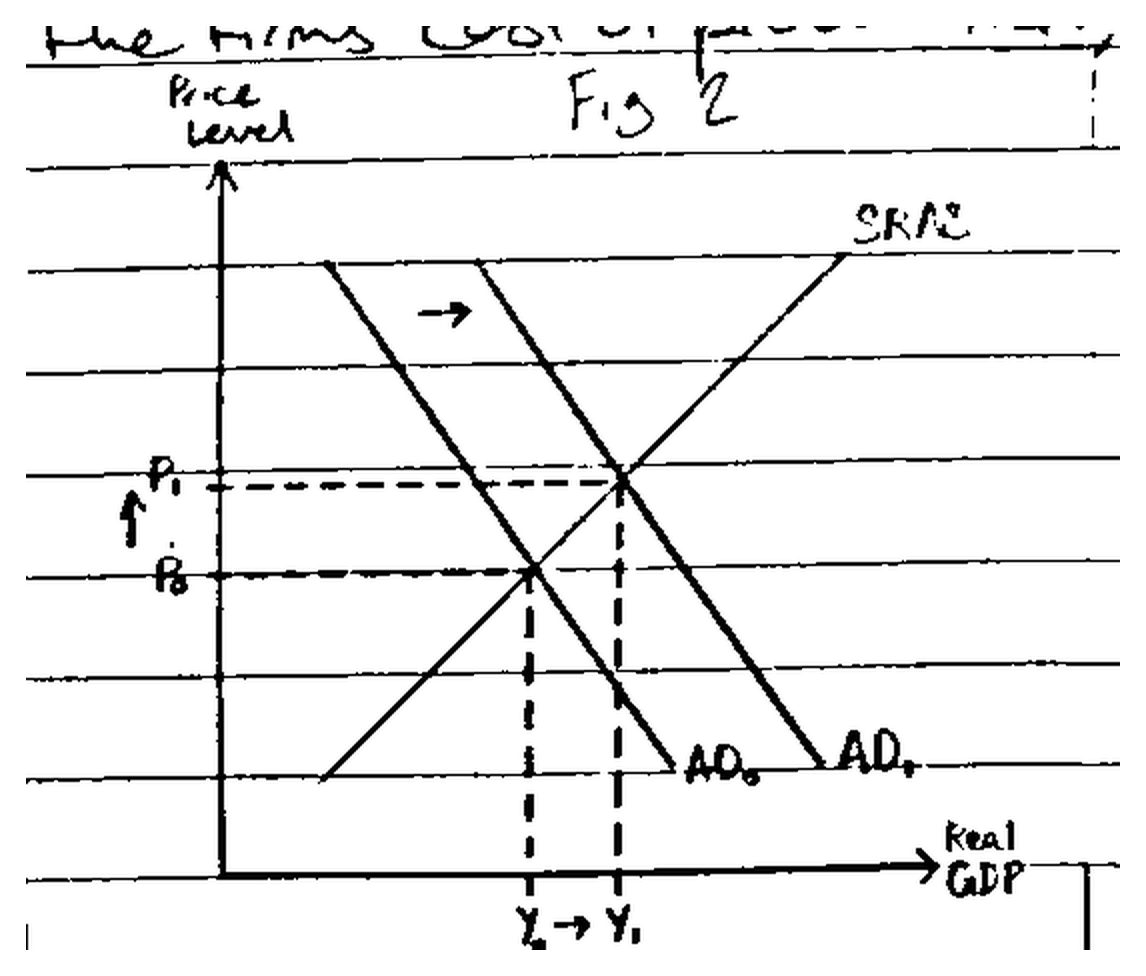
The diagram is the whole chain in one picture: the rightward shift is the policy, the movement along SRAS is why output and the price level move together, and the slope of SRAS is what decides how the increase splits between the two.
Strong analysis chain
- expansionary fiscal policy
- AD rises
- real output and national income rise
- firms require more labour
- employment rises
- cyclical unemployment falls
18. Expansionary fiscal policy near full capacity
When the economy is close to productive capacity:
- SRAS may be relatively inelastic;
- a rightward shift of AD produces a larger rise in the price level;
- the rise in real output and employment may be smaller.
Therefore, the effect depends on the economy’s initial position and the shape of AS.
19. Contractionary fiscal policy
- Government spending falls or taxes rise.
- AD shifts left.
- Equilibrium national income and real output fall.
- The price level falls or rises more slowly.
- Firms require fewer workers, so employment may fall and unemployment may rise.
This may be appropriate when excessive AD is causing demand-pull inflation.
20. National income versus real output
In basic AD/AS analysis, equilibrium national income and real output move together because income is generated by production. Use the graph’s horizontal axis label consistently, such as real national output or real GDP.
21. Composition matters
Two fiscal packages of the same headline size may have different effects.
- A direct increase in government purchases enters AD immediately.
- A tax cut depends on household and firm responses.
- Capital spending may also shift LRAS right over time.
- A tax on business investment may affect both AD and productive capacity.
- Spending with high import content creates a larger leakage from domestic demand.
22. Conditions affecting the size of the impact
For AS-level analysis, useful conditions include:
- the size of the fiscal change;
- spare capacity;
- consumer and business confidence;
- how much of a tax cut is spent;
- import leakages;
- the speed of implementation;
- whether spending is current or capital;
- whether the economy faces a demand-side or supply-side problem.
Detailed multiplier calculations, loanable-funds crowding-out diagrams and full A Level policy-effectiveness debates are not required core material in this topic.
Exam Mastery
23. Common errors
Error 1: Deficit equals debt
Wrong: “The national debt is this year’s deficit.” Correct: the deficit is a flow; debt is an accumulated stock.
Error 2: A smaller deficit means debt is falling
A smaller positive deficit usually means debt is still rising, just more slowly.
Error 3: Progressive means richer people pay more money
Progressive means the average tax rate rises with income.
Error 4: Marginal tax rate equals average tax rate
The marginal rate applies to additional income. The average rate applies to total income.
Error 5: All government payments are direct G
Transfers affect AD indirectly when recipients spend them.
Error 6: Expansionary policy always creates large real growth
Near full capacity, much of the effect may appear as a higher price level.
Error 7: Capital spending is always beneficial
The effect depends on project quality, timing, capacity constraints and opportunity cost.
24. Paper 2 paragraph structure
A strong fiscal-policy paragraph can follow:
- identify the instrument;
- state whether it is expansionary or contractionary;
- explain the relevant spending or tax transmission channel;
- show the AD shift;
- analyse real output, national income, price level and employment;
- add one condition, such as spare capacity or confidence.
Example
A reduction in personal income tax is expansionary fiscal policy. It raises households’ disposable income, so consumption is likely to increase. Since consumption is a component of aggregate demand, AD shifts right. If the economy has spare capacity, equilibrium real output and national income rise and firms employ more labour, reducing cyclical unemployment. The price level is also likely to rise, with a larger inflationary effect if the economy is close to full capacity.
Check you have it
Question 1
Why are higher interest rates together with increased taxation on expenditure likely to cause domestic deflation?
Answer: B.
Question 2
A government reduced the tax on company profits from 28% to 20%.
Which statement best describes this policy?
Answer: B.
The measure has two aspects. It is fiscal, because it changes a tax rate, and expansionary, because cutting corporation tax from 28% to 20% leaves firms with more retained profit and reduces government revenue, both of which add to aggregate demand. It is also a supply-side policy, because a lower tax on profits raises the post-tax return on investment. Firms therefore invest more in capital and innovation, which raises the economy's productive capacity and shifts aggregate supply outward over time.
Why the other options are wrong:
- A calls it contractionary. A tax cut cannot be contractionary; reducing revenue and increasing firms' spending power both expand demand.
- C and D describe it as monetary policy. Monetary policy works through interest rates, the money supply and credit conditions, and is conducted by the central bank. A change to a tax rate is a decision of government, so it is fiscal.
Question 3
What is most likely to be increased by a policy of increased direct taxes and lower government spending?
Answer: D.
25. Final checklist
A student should be able to:
- define fiscal policy and a government budget;
- calculate and interpret a deficit or surplus;
- distinguish a budget flow from the debt stock;
- explain why national debt matters conditionally;
- classify direct and indirect taxes;
- identify progressive, proportional and regressive tax structures;
- calculate average and marginal tax rates;
- explain reasons for taxation;
- classify current and capital spending;
- explain reasons for government spending;
- distinguish expansionary from contractionary fiscal policy;
- trace both policies through an AD/AS model to national income, real output, the price level and employment.
What the syllabus asks for on this topicCurrent Cambridge requirements
Current Cambridge requirements
This topic must cover:
- the meaning of a government budget;
- the distinction between a budget deficit and a budget surplus;
- the meaning and significance of national debt;
- taxation: direct and indirect taxes, progressive/regressive/proportional taxes, marginal and average tax rates, and reasons for taxation;
- government spending: capital and current spending, and reasons for spending;
- expansionary and contractionary fiscal policy;
- AD/AS analysis of the effects on equilibrium national income, real output, the price level and employment.

Related CIE 9708 topics
Not the topic you were looking for? Describe what you are stuck on in your own words and we will take you to the notes that answer it.