Scarcity, Choice and Opportunity Cost
Contents: 17 sections
The complete conceptual chain
- Unlimited wants + limited resources
- scarcity
- choice
- opportunity cost
- resource allocation
Key definitions
| Term | Examination-ready definition |
|---|---|
| Want | Something an individual would like to consume or possess because it provides satisfaction. |
| Resource | An input that can be used to produce goods and services. |
| Scarcity | The condition in which limited resources are insufficient to satisfy unlimited wants. |
| Choice | The selection of one option from two or more alternatives. |
| Opportunity cost | The benefit or value of the next best alternative forgone when a choice is made. |
| Resource allocation | The process through which scarce resources are distributed between competing uses. |
The fundamental economic problem
Human wants are treated as effectively unlimited. People may want:
- additional goods and services;
- higher quality;
- more leisure;
- improved housing;
- better healthcare and education;
- new products generated by technological development.
Resources are limited at any point in time. These include:
- natural resources;
- labour and skills;
- capital and infrastructure;
- enterprise;
- time;
- income;
- government revenue.
Scarcity is universal. A wealthy individual has limited time. A high-income government still faces competing claims on tax revenue. Growth may expand productive capacity but does not eliminate scarcity because wants continue to change.
Why scarcity is not the same as poverty
This is the distinction that separates a secure answer from a shaky one, and examiners test it directly.
Poverty is a shortage of resources relative to a standard of need. Scarcity is a shortage of resources relative to WANTS, and wants are unlimited by assumption. So poverty can in principle be eliminated, and scarcity cannot.
Switzerland faces scarcity. Its government must still choose between spending on hospitals and spending on railways, because its tax revenue is finite even though it is large. A student with unlimited money still faces scarcity of time, because the evening in which they might revise or see friends is one evening and cannot be two.
If a resource were genuinely unlimited relative to the demand for it, there would be no need to choose how to use it, no price would arise, and economics would have nothing to say about it. That is precisely the case of a free good, which is why free goods are defined by the ABSENCE of scarcity rather than by being unpriced.
Scarcity versus shortage
Scarcity is the continuous economic condition caused by limited resources relative to wants.
A shortage is a market situation in which quantity demanded exceeds quantity supplied at a particular price. It may be temporary and can be corrected.
The test that settles which one a question is about: can a price change fix it?
A shortage can be removed by the price rising. If bottled water sells out during a heatwave, a higher price rations the remaining stock and draws in more supply, and the shortage disappears. Scarcity is untouched by that. There is still not enough water in the world for every possible use of it, and there never will be.
So a shortage is a disequilibrium at a particular price in a particular market at a particular time. Scarcity is a permanent condition of the whole economy. Writing "there is a scarcity of housing in London" when you mean a shortage is one of the most common opening errors in the whole syllabus.
Why scarcity creates choice
Resources have alternative uses.
A piece of land might be used for:
- housing;
- farming;
- a hospital;
- a factory;
- a public park.
The same land cannot usually serve all uses simultaneously.
Analytical chain:
- Resources are limited
- wants compete for them
- not all wants can be satisfied
- priorities are required
- one option is selected
- another option is sacrificed
- opportunity cost arises.
Choice by individuals
Individuals allocate limited income, time and energy.
Examples:
- consumption versus saving;
- work versus leisure;
- education versus full-time employment;
- laptop versus holiday;
- revision versus social activity.
Choice by firms
Firms allocate limited finance, labour, productive capacity and management time.
Examples:
- product A versus product B;
- workers versus machinery;
- advertising versus research;
- new factory versus digital expansion;
- dividends versus retained profit.
A firm's choice, costed. A bakery has 60 hours of oven time a week. Bread earns $4 profit per oven hour; cakes earn $7 per oven hour. If the bakery devotes all 60 hours to bread it earns $240. If it devotes all 60 to cakes it earns $420.
The opportunity cost of the all-bread plan is the $420 of cake profit given up, and the opportunity cost of the all-cake plan is the $240 of bread profit given up. Because the cake profit exceeds the bread profit, the all-bread plan costs more than it earns in opportunity-cost terms, and the firm should move oven hours towards cakes.
That is the whole logic of rational choice at the level Cambridge tests it: value the next best alternative, compare, and reallocate if the alternative is worth more.
Choice by governments
Governments allocate limited revenue and productive resources across:
- healthcare;
- education;
- defence;
- infrastructure;
- housing;
- welfare;
- environmental protection.
Borrowing does not eliminate opportunity cost. It may create future interest, taxation and reduced borrowing capacity.
Opportunity cost in depth
Opportunity cost is the benefit or value of the next best alternative forgone.
Only the next best alternative counts. It is not:
- every rejected alternative combined;
- automatically the price paid;
- necessarily monetary.
Opportunity cost may involve:
- wages;
- profit;
- output;
- time;
- leisure;
- health;
- educational achievement;
- environmental quality.
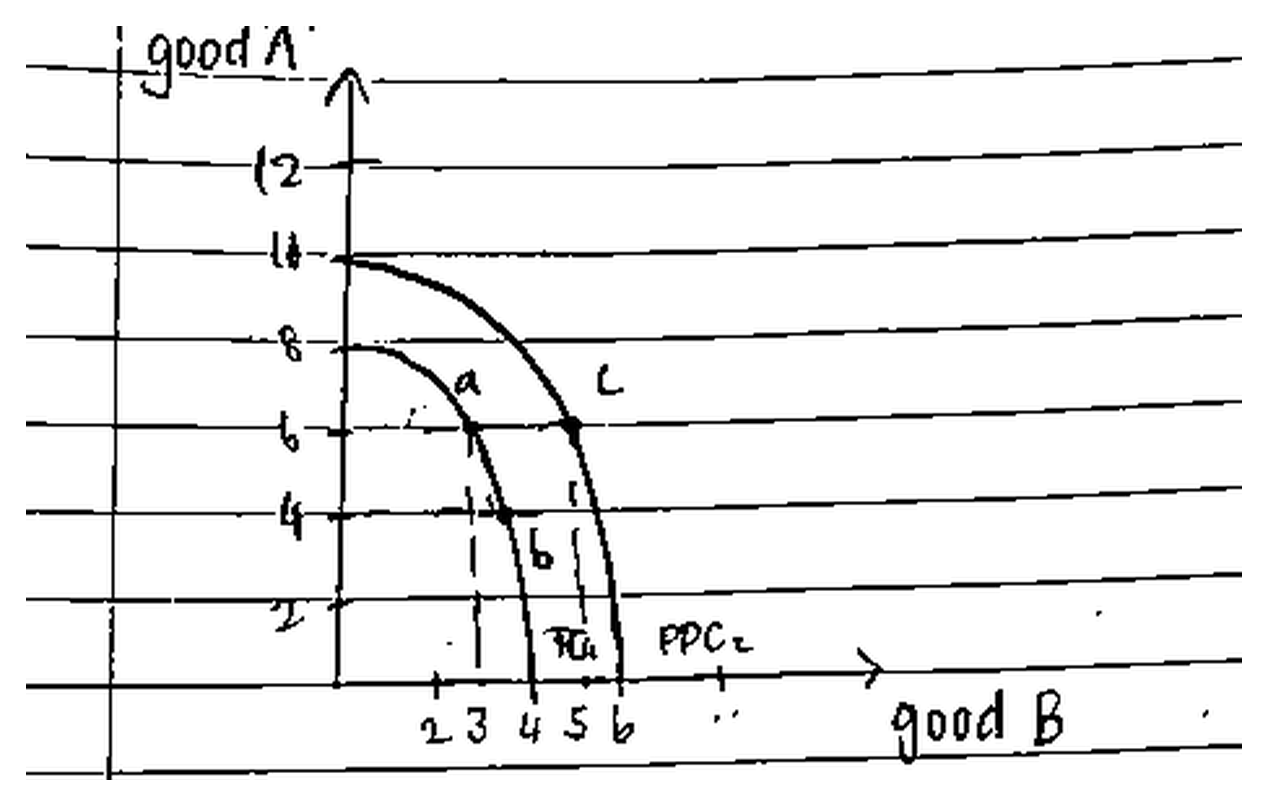
Two distinct ideas are on one diagram, and separating them is worth a mark. Moving from a to b along the same curve is opportunity cost: more of good B is only available by giving up good A. Moving from a to c, onto the outer curve, is growth: it is not a choice between the two goods, because more of both has become possible.
Four-step identification method
- Identify the decision-maker.
- Identify the chosen option.
- Identify realistic alternatives.
- Select the next best alternative.
Worked examples
Individual
A worker attends a free event rather than working for $120.
Opportunity cost: $120 of wages forgone, assuming work was the next best option.
Firm
A firm uses its warehouse rather than renting it for $100,000.
Opportunity cost: the rental income forgone.
Government
A government builds hospitals rather than schools.
Opportunity cost: the benefits the schools would have provided, assuming they were the next best alternative.
Farmer
A field could produce:
- wheat worth $50,000;
- maize worth $42,000;
- vegetables worth $35,000.
If wheat is chosen, opportunity cost is the $42,000 of maize output.
Financial cost versus opportunity cost
A financial cost is the monetary payment made for the chosen activity.
Opportunity cost is the benefit from the next best alternative sacrificed.
A free activity can therefore have a positive opportunity cost.
When opportunity cost may be zero
Opportunity cost may be close to zero when a resource has no realistic alternative use. An otherwise empty seat may have a very low immediate opportunity cost. This is an extension point and should not distract from the usual next-best-alternative method.
Three questions of resource allocation
Every economy, whatever its system, must answer the same three questions, because scarcity applies to all of them. What differs between a market economy and a command economy is not the questions but the MECHANISM used to answer them, which is the link forward into topic 1.4.
What to produce?
Which goods and services should be produced, and in what quantities?
Examples:
- hospitals or luxury hotels;
- food or biofuel;
- consumer goods or capital goods;
- housing or commercial offices.
How to produce?
Which production methods and factor combinations should be used?
Examples:
- labour or automation;
- renewable or non-renewable energy;
- domestic or imported components;
- small-scale or large-scale production.
For whom to produce?
How should output be distributed?
Possible mechanisms:
- willingness and ability to pay;
- income earned;
- government provision;
- assessed need;
- rationing;
- welfare payments.
Applying it to an exam question
The commonest 4-mark question on this topic is some version of "explain why scarcity means choices must be made". A full-mark answer has a predictable shape, and it is worth practising until it is automatic.
Define. Scarcity is the condition in which resources are limited relative to unlimited wants.
>
Explain the consequence. Because resources are limited, not every want can be satisfied, so the available resources must be allocated between competing uses.
>
Name the mechanism. Allocating a resource to one use makes it unavailable for another, so a choice must be made between them.
>
Introduce opportunity cost. The value of the next best alternative forgone is the opportunity cost of the choice made.
>
Apply. Give one concrete example at the level the question specifies, individual, firm or government.
The two marks most often lost are the third and the fifth. Candidates define scarcity and name opportunity cost but never say WHY one forces the other, and they answer in the abstract when the question named an agent.
A data-response habit worth forming
Where a question gives you a government budget or a firm's resources, do not describe the numbers. Identify what was chosen, then name what was given up because of it, and if the data allows, put a value on it. An answer that says "spending rose on defence by $2bn, so $2bn of health spending was forgone, and that is the opportunity cost" is doing the thing the topic exists to teach.
Common misconceptions
- Scarcity means poverty.
- Scarcity means a temporary shortage.
- Opportunity cost is the chosen option.
- Opportunity cost is the price paid.
- Opportunity cost includes all rejected options.
- A free item has no opportunity cost.
- Borrowing removes government trade-offs.
- Growth eliminates scarcity.
- How to produce and for whom to produce are interchangeable.
Exam technique
AO1
Use precise definitions and relevant examples.
AO2
Develop the causal chain rather than stating an isolated fact.
Weak:
Government spending has an opportunity cost.
Strong:
Revenue and productive resources are limited. More healthcare spending may reduce resources available for education. If education was the next best use, the forgone educational benefit is the opportunity cost.
AO3
Where evaluation is relevant, consider:
- measurability;
- uncertainty;
- non-monetary effects;
- different stakeholder values;
- time period;
- whether the true next best alternative is clear.
Rapid revision
- Scarcity: limited resources relative to unlimited wants.
- Choice: required because not every want can be satisfied.
- Opportunity cost: benefit of the next best alternative forgone.
- What: composition and quantity of output.
- How: methods and resources.
- For whom: distribution of output.
Check you have it
Question 1
Professional gardeners now use power tools instead of hand tools to maintain their customers’ gardens. What can be concluded from this information?
Answer: D.
The other options claim more than the evidence supports. Gardeners are still doing the work, so labour has not been replaced entirely (A). Swapping hand tools for machinery makes the job MORE capital-intensive, not more labour-intensive (B). And nothing at all is said about output per unit of land, so C cannot be concluded either.
Question 2
The nature of a typical car assembly plant has changed. The industry has fewer firms, operates on larger sites and has more automated machinery.
How is this change most likely to have affected the relative use of factors of production in the industry?
Answer: D.
Take the three changes in turn. "Larger sites" means more land is used per plant. "More automated machinery" means more capital. "Fewer firms" means fewer separate businesses organising production and bearing risk, so less enterprise. And automation substitutes machines for workers, so less labour per unit of output. Land and capital up, enterprise and labour down.
Why the other options are wrong:
- A gets capital right but pairs it with enterprise, which falls as the number of firms falls, and puts land in the decreasing group despite the larger sites.
- B has labour increasing, which contradicts automation.
- C is the mirror image of the correct answer, treating automation as labour-intensive.
Question 3
What is the opportunity cost to a person of spending $20 on a new pair of sports shoes?
Answer: D.
What the syllabus asks for on this topicSyllabus coverage
Syllabus coverage
Students must be able to:
- explain the fundamental economic problem of scarcity;
- explain choices at the level of individuals, firms and governments;
- define and apply opportunity cost;
- explain what, how and for whom to produce.
Related CIE 9708 topics
Not the topic you were looking for? Describe what you are stuck on in your own words and we will take you to the notes that answer it.