Factors of Production
Contents: 23 sections
The topic in one chain
Factors of production are combined to produce goods and services. Greater specialisation can raise productivity and output, while entrepreneurs organise resources and accept uncertainty in pursuit of profit.
Essential definitions
| Term | Examination-ready definition |
|---|---|
| Factor of production | A resource used to produce goods and services. |
| Land | All natural resources used in production. |
| Labour | Human physical and mental effort used in production. |
| Capital | Man-made resources used to produce other goods and services. |
| Enterprise | The function of organising the other factors of production and taking the risks involved in production. |
| Human capital | The education, skills, training, experience and productive abilities embodied in people. |
| Physical capital | Man-made productive assets such as machinery, tools, buildings and infrastructure. |
| Division of labour | The breaking down of a production process into separate tasks, with different workers specialising in particular tasks. |
| Specialisation | The concentration of a worker, firm, region or economy on a narrower range of tasks or products. |
| Productivity | Output produced per unit of input, often output per worker or per hour. |
| Entrepreneur | A person who organises resources and takes the risks involved in creating or operating an enterprise. |
1. What are factors of production?
Goods and services do not appear automatically. Production requires resources.
Economists group productive resources into four categories:
- land;
- labour;
- capital;
- enterprise.
The classification depends on the economic function of the resource, not merely its physical appearance.
For example:
- a river used for hydroelectric power is land;
- an engineer is labour;
- a turbine is capital;
- the founder who coordinates the project and accepts commercial risk supplies enterprise.
A complete production example
A coffee shop uses:
Land
- water;
- coffee beans;
- the physical site;
- energy resources;
- other natural inputs.
Labour
- baristas;
- cleaners;
- managers;
- accountants;
- delivery workers.
Capital
- coffee machines;
- refrigerators;
- tills;
- furniture used in production;
- the shop building;
- delivery vehicles.
Enterprise
- choosing the business model;
- arranging finance;
- deciding the product range;
- coordinating staff, premises and machinery;
- accepting the risk of losses.
All four factors may be required, although their relative importance varies between industries.
2. Land
Examination-ready definition
Land consists of all natural resources used in production.
The term does not refer only to the surface area of the earth.
It includes:
- agricultural land;
- forests;
- rivers;
- oceans;
- fish stocks;
- oil;
- natural gas;
- coal;
- minerals;
- sunlight;
- wind;
- water;
- geographical location.
Renewable and non-renewable resources
Renewable resources
These can regenerate or be replenished when managed sustainably.
Examples:
- forests;
- fish stocks;
- solar energy;
- wind;
- flowing water.
Renewable does not mean unlimited. A fish stock can be depleted if harvesting exceeds natural reproduction.
Non-renewable resources
These exist in finite stocks or regenerate extremely slowly.
Examples:
- crude oil;
- natural gas;
- coal;
- many mineral deposits.
Quantity and quality of land
The productive value of land depends on both quantity and quality.
Quality may be affected by:
- soil fertility;
- climate;
- access to water;
- transport links;
- location;
- mineral concentration;
- environmental condition.
A small urban site may command a high return because of its location, while a larger remote site may have a lower productive value.
Mobility of land
Land is geographically immobile: a field cannot be moved to another country.
However, land can have occupational mobility because the same site may be changed from one use to another, subject to:
- planning rules;
- cost;
- physical suitability;
- time.
A site may be used for housing, retail, farming or industry.
Common trap
Money is not land merely because it may be used to buy natural resources. Classification concerns the productive resource itself.
3. Labour
Examination-ready definition
Labour is the human physical and mental effort used in the production of goods and services.
Labour includes:
- construction workers;
- teachers;
- surgeons;
- drivers;
- data scientists;
- designers;
- managers;
- carers;
- athletes providing entertainment services.
It includes both paid and productive human effort. In national accounting and labour-market analysis, formal paid work is more easily measured, but productive effort can also occur outside conventional employment.
Quantity of labour
The available quantity of labour depends on factors such as:
- population size;
- working-age population;
- labour-force participation;
- retirement age;
- migration;
- working hours;
- unemployment;
- health;
- social norms;
- education participation.
Quality of labour
Labour quality depends on:
- education;
- training;
- experience;
- health;
- motivation;
- adaptability;
- management;
- technology available to workers.
Higher-quality labour can produce more output or higher-value output in a given period.
Labour productivity
A common measure is:
Labour productivity = output / labour input
Labour input may be measured by:
- number of workers;
- hours worked.
Example:
A factory produces 2,000 units using 20 workers.
Output per worker:
2,000 / 20 = 100 units.
If output rises to 2,400 using the same 20 workers, productivity rises to 120 units per worker.
This does not necessarily mean each worker personally worked harder. The rise may result from:
- better capital;
- improved training;
- superior organisation;
- division of labour;
- technological progress.
Labour mobility
Geographical mobility
The ability of workers to move between locations.
It may be limited by:
- housing costs;
- family responsibilities;
- language;
- migration rules;
- information;
- transport;
- cultural ties.
Occupational mobility
The ability of workers to move between occupations.
It may be limited by:
- qualifications;
- training time;
- licensing;
- experience;
- age;
- information;
- transferability of skills.
Although labour mobility is useful context, the core syllabus focus here is the nature of labour as a productive factor.
4. Capital
Examination-ready definition
Capital consists of man-made resources used to produce other goods and services.
Examples include:
- tools;
- machinery;
- factories;
- warehouses;
- computers;
- commercial buildings;
- roads;
- ports;
- railways;
- delivery vehicles;
- production software and systems where they function as productive assets.
Capital goods versus consumer goods
The same physical product may be classified differently depending on its use.
Example: a computer
- used by a business to process orders
- capital good
- purchased by a household mainly for entertainment
- consumer good.
Example: a vehicle
- delivery van used by a business
- capital
- family car for personal use
- consumer good.
Classification depends on productive purpose.
Money is not capital
This is one of the most important Cambridge-style traps.
Money can be used to finance the purchase of capital, but money itself does not directly produce goods and services.
A bank loan is finance.
A machine purchased using the loan is physical capital.
Fixed and working capital: useful clarification
The current syllabus does not require an extended classification here, but the distinction helps prevent confusion.
Fixed capital
Productive assets used repeatedly over time.
Examples:
- factories;
- machinery;
- computers;
- vehicles.
Working capital
Stocks of materials and partly finished goods used during production.
Examples:
- raw materials;
- components;
- goods in progress.
In some textbooks, "working capital" may be used in an accounting sense to mean current assets minus current liabilities. For this syllabus topic, the safer focus is the standard factors-of-production definition of capital as man-made productive resources.
Capital formation
Capital formation is the creation or acquisition of capital goods.
It requires resources to be directed away from present consumption towards investment.
Potential effects include:
- More or better capital
- greater productive capacity and/or productivity
- higher potential output.
The outcome depends on:
- whether the capital is appropriate;
- worker skills;
- maintenance;
- utilisation;
- complementary infrastructure;
- demand.
Depreciation
Physical capital may lose value or productive ability because of:
- wear and tear;
- age;
- accidental damage;
- technological obsolescence.
Investment may be required merely to replace depreciated capital before the capital stock can grow.
5. Enterprise
Examination-ready definition
Enterprise is the function of organising the other factors of production and taking the risks involved in production.
Enterprise is sometimes called entrepreneurship.
The entrepreneur
An entrepreneur may:
- identify a business opportunity;
- create a new product or process;
- decide what to produce;
- arrange finance;
- hire labour;
- acquire premises and capital;
- coordinate production;
- make strategic decisions;
- accept uncertainty and possible loss;
- respond to changing consumer preferences.
Enterprise versus management
The functions may overlap, but they are not automatically identical.
A professional manager may organise day-to-day operations while bearing little personal financial risk.
An entrepreneur commonly:
- initiates the venture;
- makes uncertain strategic choices;
- risks time, reputation or capital;
- receives residual profit if successful;
- may suffer losses if unsuccessful.
A hired manager generally receives a salary, although incentive pay or share ownership can blur the distinction.
Risk and uncertainty
Entrepreneurs face the possibility that:
- demand is lower than expected;
- costs rise;
- competitors respond;
- technology changes;
- regulation changes;
- finance becomes expensive;
- the project fails.
Not all risk is measurable or insurable. Many business decisions involve uncertainty, where the probabilities of outcomes are not known precisely.
Organisation of other factors
Entrepreneurs combine:
- natural resources;
- workers;
- physical capital;
- information;
- finance.
They choose:
- the scale of production;
- production methods;
- location;
- pricing strategy;
- target market;
- product design.
Enterprise in contemporary economies
Modern entrepreneurship can include:
- technology start-ups;
- social enterprises;
- digital platforms;
- family businesses;
- independent creators;
- franchisees;
- innovators within large companies;
- green-energy ventures.
An entrepreneur does not have to invent a completely new product. Enterprise can involve:
- applying an existing idea in a new market;
- improving organisation;
- adopting technology;
- finding a more efficient method;
- accepting risk others are unwilling to bear.
6. Human capital and physical capital
Human capital: examination-ready definition
Human capital is the education, skills, knowledge, training, experience and productive capabilities embodied in people.
Physical capital: examination-ready definition
Physical capital consists of man-made productive assets such as tools, machinery, buildings and infrastructure.
The key distinction
| Human capital | Physical capital |
|---|---|
| Embodied in people | Embodied in man-made assets |
| Developed through education, training, experience and health | Created through investment in equipment, buildings and infrastructure |
| Moves with the person | Owned separately from workers |
| May depreciate through skill obsolescence or ill health | May depreciate through wear, damage or obsolescence |
| Example: coding skill | Example: computer server |
Examples
Human capital
- a surgeon's medical training;
- an electrician's technical skill;
- a worker's language ability;
- a manager's experience;
- a programmer's coding knowledge;
- improved health that raises productive ability.
Physical capital
- surgical equipment;
- electrical tools;
- office buildings;
- production robots;
- roads;
- computers.
Education spending: consumption or investment?
Education provides present benefits but can also build human capital.
When education and training raise future productivity, they function as investment in human capital.
Complementarity
Human and physical capital often work together.
A sophisticated machine may generate little benefit without trained workers.
A highly skilled worker may be less productive without appropriate tools.
Analytical chain:
Training raises worker capability + suitable machinery raises productive power → stronger combined productivity gain.
Common traps
- A worker is labour; the worker's acquired skill is human capital.
- A machine is physical capital.
- The money used to buy the machine is finance, not physical capital.
- Land improved by irrigation may involve both land and physical capital:
- natural soil is land;
- the irrigation system is capital.
7. Rewards to the factors of production
Traditional factor rewards are:
| Factor | Reward |
|---|---|
| Land | Rent |
| Labour | Wages or salaries |
| Capital | Interest |
| Enterprise | Profit |
Rent
Rent is the reward associated with the use of land and natural resources.
In everyday language, rent may also refer to a payment for a building. In factor terminology:
- the natural site contributes land;
- the constructed building is capital.
The payment may compensate the owner for a bundle of resources. Students should classify according to the economic context rather than everyday labels alone.
Wages and salaries
Wages and salaries reward labour.
They may vary because of:
- skill;
- productivity;
- training;
- scarcity;
- responsibility;
- working conditions;
- bargaining power;
- labour demand and supply.
Detailed wage determination is studied later in the syllabus.
Interest
Interest is the traditional reward to capital.
A useful distinction is required:
- finance allows investment to occur;
- capital is the productive asset;
- interest may be paid to those who provide funds used to acquire capital.
At this level, use the conventional mapping expected by the syllabus:
Capital → interest.
Profit
Profit is the reward to enterprise.
Profit compensates the entrepreneur for:
- organisation;
- innovation;
- decision-making;
- risk and uncertainty.
Profit is not guaranteed.
If total revenue is less than total cost, the entrepreneur may make a loss.
Reward versus payment received
A person may supply more than one factor.
Example:
An owner-manager may receive:
- salary for labour;
- interest on funds lent;
- rent for land or premises;
- profit as entrepreneur.
The classification depends on why the payment is received.
Transfer earnings and economic rent: later extension
At A Level, factor rewards can be analysed further using transfer earnings and economic rent. These should not overload the default Topic 1.3 lesson, but the master content may flag the later connection.
8. Specialisation
Examination-ready definition
Specialisation occurs when a worker, firm, region or economy concentrates on a narrower range of tasks or products.
Specialisation can occur at several levels.
Individual specialisation
A worker concentrates on a particular occupation or task.
Examples:
- surgeon;
- software engineer;
- baker;
- electrician.
Firm specialisation
A firm concentrates on a particular product or stage of production.
Examples:
- a firm producing microchips;
- a logistics company;
- a specialist legal practice.
Regional specialisation
A region concentrates on industries suited to its:
- natural resources;
- skills;
- infrastructure;
- climate;
- location;
- established business network.
National specialisation
A country concentrates on goods and services in which it has an advantage.
This links later to:
- international trade;
- absolute advantage;
- comparative advantage.
Why specialisation becomes possible
Specialisation is supported by:
- exchange;
- markets;
- transport;
- communication;
- reliable money;
- a sufficiently large market.
A specialist worker cannot personally produce every good and service required. The worker relies on exchange with others.
9. Division of labour
Examination-ready definition
Division of labour is the separation of a production process into distinct tasks, with workers specialising in particular tasks.
Example
Instead of one worker making an entire chair, production may be divided into:
- cutting wood;
- shaping components;
- assembling;
- sanding;
- painting;
- quality checking;
- packaging.
Each worker or team repeats one stage.
Division of labour versus specialisation
The terms are closely related but not identical.
- Specialisation is the wider concentration on a narrower task, occupation or product.
- Division of labour is the deliberate splitting of a production process into separate specialised tasks.
Division of labour is therefore one form of specialisation.
10. Advantages of division of labour and specialisation
1. Increased worker skill
Repeating a narrower task allows workers to develop speed and precision.
Chain:
- Repetition
- greater task-specific skill
- higher output per hour
- higher labour productivity.
2. Less time lost switching tasks
Workers do not repeatedly change:
- tools;
- workstation;
- materials;
- mental focus.
This can increase output.
3. Easier use of specialist machinery
When production is divided into standardised stages, machinery can be designed for each stage.
Chain:
- Standardised tasks
- easier mechanisation
- faster production
- lower unit cost.
4. Training may be quicker
A worker may learn one limited task faster than an entire complex production process.
This can reduce training cost and speed up recruitment.
5. Workers can focus on their strongest abilities
Tasks may be allocated to workers with suitable skills.
6. Greater output and lower average cost
Higher productivity can reduce labour cost per unit, although actual average cost also depends on wages, capital costs, quality and capacity utilisation.
7. Large-scale production
Division of labour can support mass production and consistent output.
8. Innovation and expertise
Specialists may accumulate deep knowledge and develop better methods.
9. Wider variety through exchange
At a broader economic level, people, firms and countries can specialise and trade, allowing consumption beyond what each could efficiently produce alone.
11. Disadvantages of division of labour and specialisation
1. Repetitive and monotonous work
A narrow task may reduce:
- motivation;
- job satisfaction;
- concentration.
A common Cambridge-style answer is decreased motivation.
2. Reduced craftsmanship or task understanding
Workers may understand only one stage and lose the ability to produce the whole product.
3. Lower flexibility
A narrowly trained worker may find it harder to change occupation.
A specialised firm or region may struggle if demand changes.
4. Interdependence
Production depends on every stage.
If one worker, supplier or machine fails, the whole process may be disrupted.
5. Risk of unemployment
Workers with narrow skills may be vulnerable to:
- automation;
- relocation;
- changing demand;
- technological obsolescence.
6. Quality problems
Repetition may improve consistency, but low motivation or fragmented responsibility can also reduce quality.
Quality is therefore not automatically higher or lower.
7. Coordination costs
Highly divided production requires:
- scheduling;
- communication;
- monitoring;
- inventory control;
- quality assurance.
8. Market dependence
Specialisation requires exchange. Disruptions to transport, trade or supply chains can create serious shortages.
9. Vulnerability of economies and regions
An economy heavily specialised in one commodity may suffer when:
- world demand falls;
- prices collapse;
- resources are depleted;
- technology changes.
Balanced judgement
The benefits of division of labour are most likely to be strong when:
- the market is large;
- tasks can be standardised;
- quality can be monitored;
- workers receive suitable incentives;
- supply chains are reliable;
- technology complements labour.
The disadvantages may be stronger when:
- work becomes extremely repetitive;
- skills become too narrow;
- demand is unstable;
- one production stage is a bottleneck;
- resilience matters more than minimum unit cost.
12. Productivity, production and productive capacity
Students should not confuse these terms.
Production
The total quantity of output produced.
Productivity
Output per unit of input.
Productive capacity
The maximum output the economy or firm can produce with available resources and technology.
Example
A factory increases total output because it employs more workers.
Production rises, but labour productivity may remain unchanged.
If the same number of workers produce more output, labour productivity rises.
Factors of production affect all three concepts in different ways.
13. Factor quantity, factor quality and productivity
An economy can raise potential output by increasing:
Quantity of factors
- more workers;
- more land brought into production;
- more machinery;
- more entrepreneurs.
Quality of factors
- better education;
- better health;
- improved capital;
- stronger infrastructure;
- better organisation;
- superior technology.
Efficiency of combination
The same resources may produce more when:
- tasks are organised effectively;
- information improves;
- incentives improve;
- bottlenecks are removed;
- specialisation is appropriate.
14. Mobility and substitution between factors
Although detailed factor markets are studied later, students benefit from understanding two ideas.
Factor mobility
How easily a resource can move between uses or places.
Factor substitution
A firm may substitute one factor for another.
Example:
- robots instead of some labour;
- renewable energy instead of fossil fuel;
- software instead of administrative labour.
The choice depends on:
- relative prices;
- productivity;
- technology;
- quality;
- time;
- regulation.
This links back to “how to produce” in Topic 1.1.
15. Integrated applied example: an online retailer
An online retailer combines:
Land
- warehouse sites;
- energy;
- raw materials used in packaging.
Labour
- warehouse workers;
- software engineers;
- drivers;
- customer-service staff;
- managers.
Physical capital
- warehouses;
- servers;
- conveyor systems;
- robots;
- delivery vehicles.
Human capital
- coding skills;
- logistics expertise;
- management experience;
- technical training.
Enterprise
The entrepreneur or entrepreneurial team:
- identifies market opportunities;
- raises finance;
- selects technology;
- coordinates labour and capital;
- accepts the possibility of loss.
Division of labour
Work may be divided into:
- ordering;
- stock management;
- picking;
- packing;
- dispatch;
- delivery;
- returns.
Potential gain
- Specialised tasks + appropriate automation + trained workers
- faster order processing
- higher productivity
- lower unit cost.
Potential cost
- Highly repetitive work + close monitoring
- lower motivation and staff turnover
- recruitment cost and possible quality problems.
The final outcome depends on management, incentives, technology and working conditions.
16. Common misconceptions and exam traps
Trap 1: Money is capital
Incorrect.
Money is finance. Capital is the productive asset purchased with finance.
Trap 2: Capital means every valuable asset
A valuable painting held for enjoyment is not necessarily productive capital.
Trap 3: Land means only farmland
Land includes all natural resources.
Trap 4: Labour means only physical work
Labour includes mental and physical effort.
Trap 5: A worker's skill is physical capital
Skill embodied in the worker is human capital.
Trap 6: The entrepreneur is simply the manager
Management and enterprise can overlap, but entrepreneurship includes risk and uncertain strategic decision-making.
Trap 7: Profit is guaranteed
Enterprise may receive profit or suffer loss.
Trap 8: Division of labour always improves quality
It may improve consistency but may also create boredom, fragmented responsibility and quality problems.
Trap 9: Specialisation and division of labour are identical
Division of labour is one specific form of specialisation.
Trap 10: More production always means higher productivity
Output may rise because more inputs are used without any increase in output per input.
Trap 11: Roads are land
Roads are man-made infrastructure and therefore physical capital. The natural site under the road is land.
Trap 12: Interest is payment for holding money
In the conventional factor-reward framework, interest is the reward to capital. Students should not allow the distinction between finance and physical capital to destroy the expected syllabus mapping.
17. Paper 1 technique
Questions may ask students to:
- identify which item is not a factor of production;
- classify a resource as land, labour, capital or enterprise;
- match factors with rewards;
- distinguish human and physical capital;
- identify an advantage or disadvantage of division of labour;
- identify the role of the entrepreneur;
- calculate simple productivity.
Classification method
Ask:
- Is it natural? → land.
- Is it human effort? → labour.
- Is it a man-made productive asset? → capital.
- Is it organisation and risk-taking? → enterprise.
Reward method
Ask why the payment is received:
- use of natural resource
- rent
- human work
- wage
- productive capital
- interest
- entrepreneurial risk and organisation
- profit.
18. Paper 2 technique
Explain questions
Do not only list the four factors. Define and apply them.
Weak answer
Land, labour, capital and enterprise are factors of production.
Strong answer
Capital consists of man-made resources used to produce goods and services, such as machinery and factories. It differs from money, which finances the purchase of capital but is not itself a productive asset.
Analysis of specialisation
Use a developed chain:
- Division of labour narrows each worker's task
- repetition develops task-specific skill and reduces switching time
- output per worker rises
- unit labour cost may fall
- the firm may become more competitive.
Evaluation of specialisation
Consider:
- nature of the production process;
- market size;
- worker motivation;
- quality control;
- automation;
- resilience;
- degree of interdependence;
- demand stability.
Model four-mark answer
Question:
Explain two benefits of division of labour to a manufacturing firm. [4]
Model answer:
First, workers repeatedly perform a narrower task, so they may become faster and more skilled at it. This raises output per worker and may reduce labour cost per unit. Second, less time is lost moving between tasks or changing tools. More of the working day is therefore spent producing output, which may increase total production.
Model balanced answer
Question:
Assess whether greater division of labour will always benefit a firm. [8]
Possible argument:
- higher skill;
- less switching time;
- mechanisation;
- higher productivity;
- lower unit cost.
Possible evaluation:
- boredom and low motivation;
- quality problems;
- dependency on each stage;
- reduced flexibility;
- coordination cost;
- benefits vary by industry.
Judgement:
Greater division of labour is most likely to benefit firms producing a large, standardised output where tasks can be monitored and machinery can be used. It may be less beneficial in creative, customised or quality-sensitive work, where flexibility and employee ownership of the full task are more important.
19. Active recall
- Define a factor of production.
- Define land.
- Give four examples of land that are not farmland.
- Define labour.
- Define capital.
- Why is money not capital?
- Define enterprise.
- What are the two core roles of the entrepreneur in the syllabus?
- Distinguish human capital and physical capital.
- Match each factor with its reward.
- Define specialisation.
- Define division of labour.
- Explain one productivity benefit of division of labour.
- Explain one motivational disadvantage.
- Why can specialisation create interdependence?
- Distinguish production and productivity.
- Is a delivery van capital or a consumer good?
- Is a road land or capital?
- How can education affect human capital?
- Why might a highly specialised region be vulnerable?
20. One-minute revision
Four factors
- Land: natural resources.
- Labour: human effort.
- Capital: man-made productive resources.
- Enterprise: organisation and risk-taking.
Capital distinction
- Human capital: skills and abilities embodied in people.
- Physical capital: productive assets.
Rewards
- Land
- rent.
- Labour
- wages.
- Capital
- interest.
- Enterprise
- profit.
Specialisation
Concentrating on a narrower task or product.
Division of labour
Breaking production into separate specialised tasks.
Main advantage chain
- Repetition + less switching + machinery
- higher productivity
- potentially lower unit cost.
Main disadvantage chain
- Repetition
- boredom and lower motivation
- errors or staff turnover
- possible quality and cost problems.
Check you have it
Question 1
A country can produce manufactured goods and agricultural products as shown in the diagram. agricultural V products T S Q R O manufactured goods Given this information, which statement is definitely correct?
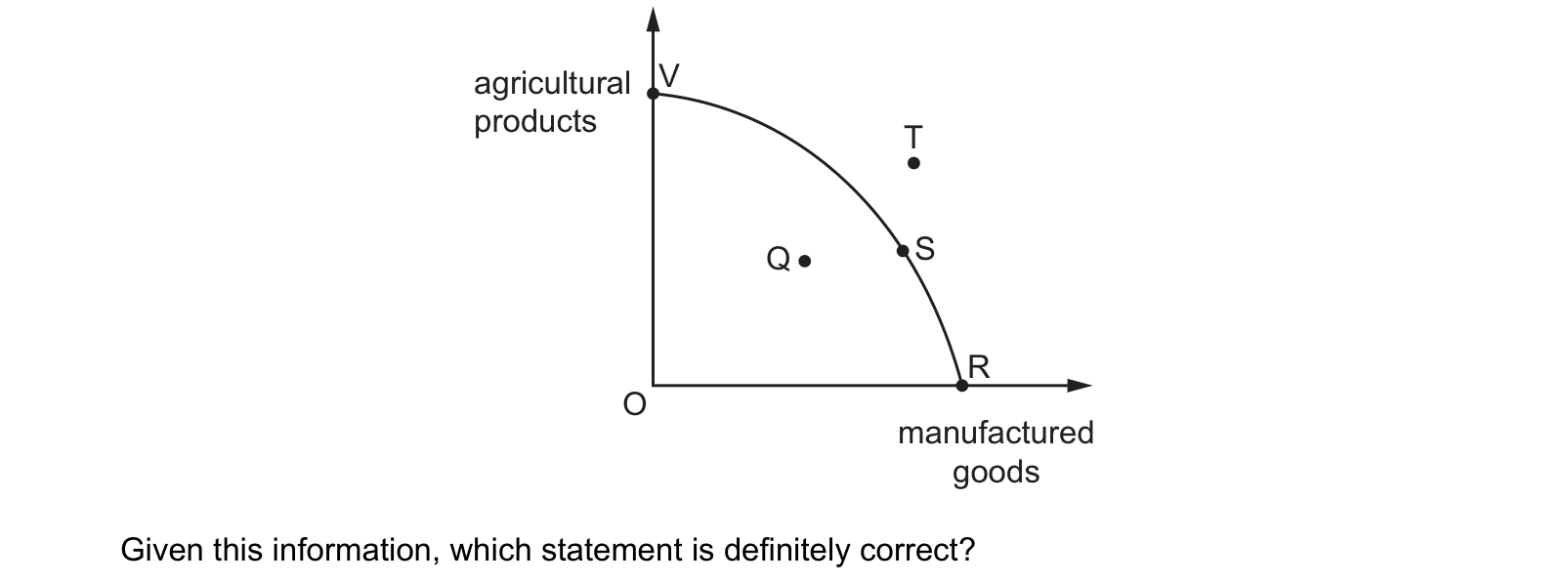
Answer: A.
Question 2
An economist knows the current point at which an economy is operating within its production possibility curve. What can the economist judge from this knowledge about the economy?
Answer: C.
Explanation:
When an economist knows the current point at which an economy is operating within its production possibility curve, they can judge its level of output of two goods. The production possibility curve represents the maximum quantity of two goods that can be produced given the resources and technology available in the economy. The point at which the economy is operating on the curve shows how efficiently resources are being utilised to produce those two goods. If the economy is operating below the curve, it indicates inefficiency or underutilisation of resources, while operating beyond the curve is unattainable with the current resources.
Knowing the current point on the production possibility curve does not provide direct information on the degree of self-sufficiency, international competitiveness, or the rate of economic growth of the economy. These factors depend on various other economic indicators and policies in place apart from the production possibilities of two goods in the economy.
Question 3
Countries X and Y both produce goods M and N. They decide to specialise and trade freely in the goods.
Under which conditions are the gains from specialisation and free trade likely to be smallest?
Answer: C.
Two separate mechanisms shrink the gains here. First, specialisation requires each country to move factors out of one good and into the other. If factors are immobile between goods: workers with the wrong skills, capital that cannot be repurposed, the reallocation is slow and costly, so the theoretical gains from specialising are not realised in practice. Second, if factors are highly mobile between countries, they can simply relocate to wherever they are most productive. Production moves to the factors' new location rather than goods moving between countries, so trade substitutes are available and the specific gains from trade are smaller.
Why the other options are wrong:
- A and B both have high mobility between goods, so each country can reallocate resources easily and capture the gains from specialising.
- D is the most tempting alternative, since low mobility between goods is indeed a limit. But low mobility between countries actually raises the value of trade: when factors cannot move, exchanging goods is the only way to benefit from differences in comparative advantage. C combines the obstacle to specialising with the availability of an alternative to trade, which is the worst of both.
Critical traps
- Money is not capital.
- Roads and machinery are capital.
- Skill is human capital.
- Output and productivity are not the same.
What the syllabus asks for on this topicOfficial syllabus coverage
Official syllabus coverage
Students must understand:
- 1.3.1 the nature and definition of the factors of production:
- land;
- labour;
- capital;
- enterprise;
- 1.3.2 the difference between human capital and physical capital;
- 1.3.3 the rewards to the factors of production;
- 1.3.4 division of labour and specialisation;
- 1.3.5 the role of the entrepreneur in contemporary economies:
- taking risk;
- organising the other factors of production.
Related CIE 9708 topics
Not the topic you were looking for? Describe what you are stuck on in your own words and we will take you to the notes that answer it.