Exchange Rates
Contents: 6 sections
Cambridge International AS & A Level Economics 9708 (AS Level) Current syllabus: 2026–2028, Version 2 Official syllabus points: 6.4.1–6.4.5
Exam Essentials
1. What is an exchange rate?
An exchange rate is the price of one currency expressed in terms of another currency.
For example:
£1 = US$1.25
This means one pound can be exchanged for 1.25 US dollars. It can also be written in the inverse form:
US$1 = £0.80
Both quotations describe the same bilateral exchange rate from opposite viewpoints.
Reading a quotation correctly
If the quotation is £1 = US$1.25, the pound is the currency being priced and the dollar is the currency used to quote the price.
- If the quotation rises to £1 = US$1.35, the pound buys more dollars and has appreciated against the dollar.
- If the quotation falls to £1 = US$1.15, the pound buys fewer dollars and has depreciated against the dollar.
The other currency moves in the opposite direction in the same bilateral quotation. If the pound appreciates against the dollar, the dollar depreciates against the pound.
Supporting conversion skill
Although the current syllabus does not list currency conversion as a separate content point, students should be able to apply a quotation accurately.
If £1 = US$1.25:
- £400 converts to 400 × 1.25 = US$500;
- US$500 converts to 500 ÷ 1.25 = £400.
Always identify which currency is being converted and whether the operation should multiply or divide.
2. What is a floating exchange rate?
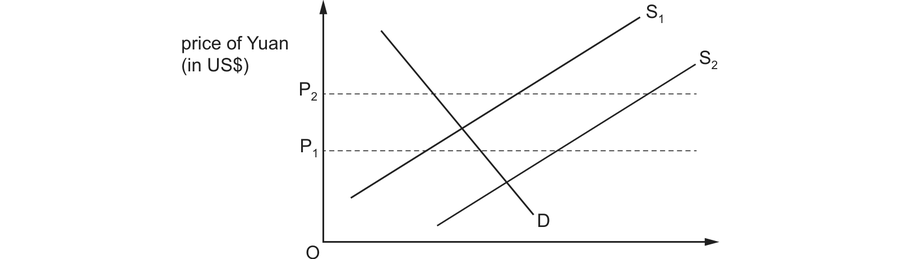
A floating exchange rate is determined by market demand for and market supply of a currency in the foreign-exchange market.
The exchange rate acts as the price of the currency:
- the vertical axis shows the exchange rate, such as dollars per pound;
- the horizontal axis shows the quantity of the currency, such as pounds;
- the demand curve slopes downward;
- the supply curve slopes upward;
- equilibrium occurs where quantity demanded equals quantity supplied.
At the equilibrium exchange rate, the amount of the currency buyers wish to obtain equals the amount sellers wish to exchange.
Disequilibrium and market adjustment
If the exchange rate is above equilibrium, quantity supplied exceeds quantity demanded. There is downward pressure on the currency’s price.
If the exchange rate is below equilibrium, quantity demanded exceeds quantity supplied. There is upward pressure on the currency’s price.
In a floating system, changes in demand and supply move the market towards a new equilibrium rate.
Movement along versus shift
A change in the exchange rate itself causes a movement along a currency demand or supply curve.
A change in another determinant, such as export demand, import demand, expected returns or confidence, causes the relevant curve to shift.
This distinction is crucial in Paper 1 diagrams and Paper 2 analysis.
3. Who demands a currency?
Demand for the domestic currency comes from people and organisations that need it to make payments or hold assets denominated in that currency.
Important sources include:
- foreign consumers buying the country’s exports;
- foreign tourists paying for domestic goods and services;
- foreign firms buying domestic inputs or establishing operations;
- overseas investors buying domestic shares, bonds, property or direct investments;
- speculators expecting the currency to appreciate;
- institutions wishing to hold the currency or domestic assets.
Why is currency demand downward sloping?
Suppose the vertical axis is dollars per pound. A lower price of pounds means each pound costs fewer dollars.
Other things equal:
- British exports become cheaper to US buyers;
- British assets become cheaper in dollar terms;
- more pounds may therefore be demanded.
This gives a downward-sloping demand curve.
The explanation is conditional. Contracts, invoicing currency, expectations and the responsiveness of trade and investment can weaken the immediate response.
4. Who supplies a currency?
Supply of the domestic currency comes from domestic residents and organisations that exchange it for foreign currency.
Important sources include:
- domestic consumers buying imports;
- domestic tourists spending abroad;
- domestic firms buying foreign inputs or investing overseas;
- domestic investors buying foreign shares, bonds or property;
- speculators expecting the domestic currency to depreciate;
- holders shifting their portfolios away from domestic assets.
Why is currency supply upward sloping?
Again suppose the vertical axis is dollars per pound. A higher pound exchange rate means each pound buys more dollars.
Other things equal:
- US goods and services become cheaper to British buyers;
- US assets become cheaper in pound terms;
- British residents may supply more pounds to obtain dollars.
This gives an upward-sloping supply curve.
5. Appreciation and depreciation
An appreciation is a market-driven rise in the value of a currency under a floating exchange-rate system.
It results from:
- an increase in demand for the currency; and/or
- a decrease in supply of the currency.
A depreciation is a market-driven fall in the value of a currency under a floating exchange-rate system.
It results from:
- a decrease in demand for the currency; and/or
- an increase in supply of the currency.
Do not confuse the terminology
| Floating system | Fixed or officially managed system |
|---|---|
| Appreciation | Revaluation |
| Depreciation | Devaluation |
At AS Topic 6.4, the required distinction is appreciation versus depreciation in a floating system. Fixed and managed systems, revaluation and devaluation are A Level material.
Causes of changes in a floating exchange rate
6. Changes in demand for the currency
6.1 Foreign demand for exports
If foreigners buy more domestic exports, they usually need more domestic currency.
- export demand rises
- demand for domestic currency rises
- demand curve shifts right
- currency appreciates
Export demand may rise because of:
- improved quality or productivity;
- stronger overseas incomes;
- successful branding;
- lower domestic inflation relative to trading partners;
- changes in tastes;
- reduced foreign trade barriers.
The effect may be smaller when exports are invoiced and settled in another currency or when firms hedge exchange-rate risk.
6.2 Relative interest rates and expected returns
If domestic interest rates rise relative to those abroad, domestic deposits or bonds may offer a higher expected return.
- relative expected return rises
- demand for domestic financial assets rises
- demand for currency rises
- appreciation pressure
However, the result depends on:
- whether the interest-rate rise was expected;
- perceived default or political risk;
- expected future exchange-rate movements;
- controls on capital flows;
- returns available in other countries.
A high interest rate caused by severe risk or inflation may not attract capital.
6.3 Foreign investment
An increase in foreign direct investment or portfolio investment may increase demand for the domestic currency.
- foreign asset purchases rise
- demand for domestic currency rises
- appreciation pressure
A later outflow of profits is a separate current-account issue. The initial asset purchase affects the financial side of international transactions, while the currency demand can still affect the floating exchange rate.
6.4 Expectations and speculation
If traders expect a currency to appreciate; they may buy it now.
- expected appreciation
- current demand rises
- actual appreciation pressure
Expectations can therefore become partly self-reinforcing. They can also reverse quickly, making exchange rates volatile.
6.5 Confidence and stability
Greater confidence in economic management, institutions or political stability may raise demand for domestic assets and the currency. Loss of confidence can reduce demand.
Confidence is not measured by one variable and should not be used as a vague substitute for a complete causal chain.
7. Changes in supply of the currency
7.1 Domestic demand for imports
If domestic households and firms buy more imports, they generally supply more domestic currency to obtain foreign currency.
- import demand rises
- supply of domestic currency rises
- supply curve shifts right
- depreciation pressure
Import demand may rise because of:
- faster domestic income growth;
- stronger consumer confidence;
- lower foreign prices;
- weak domestic productive capacity;
- dependence on imported food, fuel, machinery or components.
7.2 Investment abroad
If domestic investors buy more overseas assets, they supply domestic currency in exchange for foreign currency.
- outward investment rises
- supply of domestic currency rises
- depreciation pressure
7.3 Relative expected returns
If foreign assets become more attractive, domestic savers may shift funds abroad.
- relative return abroad rises
- outward financial flow rises
- currency supply rises
- depreciation pressure
7.4 Expectations and speculation
If traders expect depreciation; they may sell the currency now.
- expected depreciation
- current supply rises and/or demand falls
- actual depreciation pressure
7.5 Domestic income
A rise in domestic income often raises demand for imports.
- domestic income rises
- import spending rises
- supply of domestic currency rises
- depreciation pressure
The size of this effect depends on the marginal propensity to import and the availability of domestic substitutes.
8. Combining demand and supply changes
Many events affect both curves.
Example: stronger domestic economic growth may:
- raise imports, shifting currency supply right and causing depreciation pressure;
- attract foreign investment, shifting currency demand right and causing appreciation pressure.
The final exchange-rate movement depends on which effect is stronger.
Diagram method
For any floating exchange-rate question:
- identify the currency market;
- label the vertical axis with an unambiguous quotation;
- identify whether demand or supply changes;
- state the shift direction;
- identify the new equilibrium exchange rate and quantity;
- name the resulting appreciation or depreciation;
- explain the transaction that caused the shift.
Do not simply write “demand increases”. State demand for which currency, by whom, and why.
Effects of exchange-rate changes on the domestic economy
9. Price effects on exports and imports
Consider a depreciation of the domestic currency.
Other things equal:
- domestic exports become cheaper in foreign-currency terms;
- imports become more expensive in domestic-currency terms.
An appreciation tends to have the opposite effects:
- exports become more expensive to foreign buyers;
- imports become cheaper to domestic buyers.
These are starting points, not guaranteed final outcomes. Exporters may change profit margins, contracts may fix prices, transactions may be invoiced in a third currency, and quantities may respond slowly.
10. Depreciation: aggregate-demand channel
A depreciation may increase net exports:
- currency depreciates
- exports become relatively cheaper and imports relatively dearer
- export demand rises and import demand falls
- net exports rise
- AD shifts right
Possible macroeconomic effects:
- equilibrium national income rises;
- real output rises where spare capacity exists;
- employment rises as firms expand output;
- the price level rises, especially near full capacity.
This is the demand-side channel.
Conditions
The increase in AD will be stronger when:
- demand for exports and imports is responsive to price changes;
- foreign demand is strong;
- firms have spare capacity;
- domestic substitutes for imports exist;
- exporters can expand production;
- the change persists long enough for contracts and spending patterns to adjust.
Marshall–Lerner and J-curve analysis are not required in AS Topic 6.4, although the general ideas of elasticity and time lags are useful evaluation.
11. Depreciation: aggregate-supply channel
A depreciation makes imported inputs more expensive in domestic-currency terms.
- currency depreciates
- imported fuel, components and machinery cost more
- firms’ production costs rise
- SRAS shifts left
Possible effects:
- the price level rises;
- real output falls relative to what it otherwise would have been;
- employment may fall in import-dependent industries;
- cost-push inflation increases.
This supply-side effect can offset the rise in output from the AD channel.
Combined depreciation analysis
A depreciation can shift:
- AD right through higher net exports;
- SRAS left through dearer imported inputs.
The price level is likely to face upward pressure from both channels. The final effect on real output and employment is ambiguous because AD and SRAS push output in opposite directions.
The outcome depends on:
- import dependence;
- spare capacity;
- elasticities;
- the cause and size of the depreciation;
- exchange-rate pass-through;
- the response of wages and inflation expectations;
- time.
12. Appreciation: aggregate-demand channel
An appreciation may reduce net exports:
- currency appreciates
- exports become relatively dearer and imports cheaper
- export demand falls and import demand rises
- net exports fall
- AD shifts left
Possible effects:
- equilibrium national income falls;
- real output falls;
- employment falls in export and import-competing sectors;
- demand-pull inflationary pressure falls.
The effect is weaker when exports are differentiated, demand is price inelastic, foreign incomes are rising strongly or exporters absorb the appreciation through lower profit margins.
13. Appreciation: aggregate-supply channel
An appreciation lowers the domestic-currency price of imported inputs.
- currency appreciates
- imported fuel, materials and components become cheaper
- firms’ costs fall
- SRAS shifts right
Possible effects:
- the price level falls relative to what it otherwise would have been;
- real output may rise;
- firms using imported inputs become more competitive;
- consumers gain purchasing power from cheaper imports.
Combined appreciation analysis
An appreciation can shift:
- AD left through lower net exports;
- SRAS right through cheaper imported inputs.
Both channels tend to reduce the price level or inflationary pressure. The effect on output and employment is ambiguous because the AD and SRAS effects work in opposite directions.
14. Sectoral and distributional effects
Exchange-rate changes create winners and losers.
A depreciation may benefit
- exporters receiving foreign-currency revenue;
- domestic tourism;
- firms competing with imports;
- workers in sectors where demand expands.
A depreciation may harm
- consumers buying imported goods;
- firms dependent on imported inputs;
- borrowers with foreign-currency debts;
- households whose real income is reduced by imported inflation.
An appreciation may benefit
- consumers buying imports or travelling abroad;
- firms importing raw materials, machinery or components;
- borrowers repaying foreign-currency obligations;
- policymakers seeking lower inflation.
An appreciation may harm
- exporters;
- domestic tourism suppliers;
- import-competing firms;
- workers in sectors facing weaker demand.
A national-level conclusion should not hide these sectoral differences.
Exam Mastery
15. Building a complete AD/AS answer
A strong answer distinguishes both major channels.
Depreciation chain
- Define depreciation under a floating system.
- Explain why exports may become cheaper and imports dearer.
- Analyse net exports and AD shifting right.
- Analyse imported input costs and SRAS shifting left.
- State effects on national income, real output, price level and employment.
- Evaluate using elasticity, spare capacity, import dependence, pass-through and time.
Appreciation chain
- Define appreciation under a floating system.
- Explain why exports may become dearer and imports cheaper.
- Analyse net exports and AD shifting left.
- Analyse imported input costs and SRAS shifting right.
- State effects on national income, real output, price level and employment.
- Evaluate using sector structure, elasticities, spare capacity, pass-through and time.
16. Evaluation framework
Never claim that a currency movement has one automatic effect.
Use the following tests:
Cause
A currency may appreciate because of strong exports, higher interest rates, capital inflows or speculation. The cause itself may already be affecting AD, investment and confidence.
Size and duration
A small temporary change may have little effect. A large persistent movement is more likely to alter contracts, sourcing and investment.
Elasticity and substitution
Export and import quantities respond more when close substitutes exist and buyers can switch suppliers.
Spare capacity
If the economy has spare capacity, higher AD after depreciation can raise real output and employment more. Near full capacity, the effect is more inflationary.
Import dependence
The more firms rely on imported energy, materials and components, the stronger the SRAS and cost-push effects of depreciation.
Pass-through
Firms may absorb part of an exchange-rate movement in profit margins. Prices may be fixed in contracts or invoiced in a vehicle currency. Import and consumer prices therefore may not change one-for-one with the exchange rate.
Time lags
Trade volumes, contracts, production capacity and consumer habits adjust over time. Immediate and long-run effects may differ.
Foreign conditions
Weak overseas demand can limit export growth after depreciation. Strong global demand can support exports despite appreciation.
17. Common exam errors
- Using devaluation for a floating rate. Use depreciation.
- Failing to specify the quotation. State dollars per pound, euros per dollar or another clear price.
- Treating an appreciation as good and depreciation as bad. Both create benefits and costs.
- Ignoring the SRAS channel. Imported-input prices matter.
- Assuming exports and imports respond immediately and fully. Use elasticity, contracts and time.
- Confusing demand for exports with demand for currency. Export purchases usually generate currency demand, but explain the link.
- Confusing a movement along a curve with a shift. The currency’s own price causes movement along; another determinant shifts the curve.
- Claiming AD and SRAS imply a certain output result when they shift in opposite directions. State ambiguity and conditions.
- Importing A Level content into AS. Fixed and managed systems, real and trade-weighted exchange rates, revaluation/devaluation, Marshall–Lerner and J-curve analysis are not core AS 6.4 requirements.
18. Paper 2 answer skeletons
Explain why a currency may appreciate
- Define appreciation.
- Identify one increase in demand or decrease in supply.
- Explain the transaction creating the shift.
- Show the new floating-market equilibrium.
- Add a second determinant or qualification.
Analyse the effect of depreciation on the domestic economy
- Depreciation changes export and import prices.
- Net exports may rise and AD shift right.
- National income, output and employment may rise; the price level may rise.
- Imported input costs increase and SRAS may shift left.
- Output and employment are therefore uncertain; inflation pressure is stronger.
- Evaluate with elasticities, spare capacity, import dependence, pass-through and time.
Discuss whether appreciation benefits an economy
- Benefits: cheaper imports, lower production costs, lower inflation, higher consumer purchasing power.
- Costs: weaker exports and import-competing sectors, lower AD, possible unemployment.
- Judge according to inflation, spare capacity, trade structure, cause, size and duration.
Deep Dive
19. Why the quotation convention matters
A statement such as “the exchange rate rose” is incomplete without knowing the quotation.
If the rate is dollars per pound and it rises, the pound appreciates. If the rate is pounds per dollar and it rises, the dollar appreciates and the pound depreciates.
Students should always identify the base currency and quote currency before interpreting a numerical change.
20. Exchange rates and the current account
Exchange rates can affect export and import prices and therefore the current account, but Topic 6.4 is not a guarantee that depreciation corrects a deficit.
The result depends on:
- price elasticities;
- supply capacity;
- imported content of exports;
- foreign and domestic income;
- contracts and invoicing;
- time lags;
- the reason for the original deficit and currency movement.
Policies specifically aimed at current-account stability belong to Topic 6.5.
Check you have it
Question 1
A country’s currency has depreciated against all the currencies of its main trading partners. How will the depreciation affect its terms of trade?
Answer: C.
C The terms of trade will worsen.
Explanation:
When a country's currency depreciates against its main trading partners, it means that the country's goods and services have become relatively cheaper for its trading partners, while imports have become more expensive for the country's residents. This will likely lead to an increase in exports and a decrease in imports, which can improve the trade balance initially. However, over time, as trading partners adjust their prices and demand, the terms of trade are likely to worsen for the depreciating country.
A depreciation in the currency can lead to a decrease in the real income of the country as the cost of imports increases, leading to a deterioration in the terms of trade. This is because the country will need to export more goods to import the same amount of goods from its trading partners when its currency is depreciating.
Therefore, in the given scenario, the terms of trade will worsen for the country whose currency has depreciated against its main trading partners.
Question 2
Following a long period of depreciation of the US$, both the US and UK monetary authorities raised their domestic interest rate. What will happen to the value of the exchange rate of the US$ in terms of UK£?
Answer: D.
Question 3
A country has a floating exchange rate.
An increase in which variable within that country can cause its exchange rate to appreciate?
Answer: C.
21. Final mastery checklist
A student has mastered Topic 6.4 when they can:
- define and read a bilateral exchange rate;
- determine equilibrium in a floating currency market;
- distinguish appreciation from depreciation;
- identify demand and supply sources for a currency;
- analyse shifts caused by trade, income, returns, investment, expectations and confidence;
- distinguish curve shifts from movements along curves;
- analyse both AD and SRAS channels of appreciation and depreciation;
- explain effects on national income, real output, price level and employment;
- evaluate impacts using elasticity, capacity, import dependence, pass-through, cause and time;
- keep fixed/managed-system and advanced A Level material outside the AS core.
What the syllabus asks for on this topicCurrent Cambridge requirements
Current Cambridge requirements
This topic must cover:
- the definition of an exchange rate;
- determination of a floating exchange rate;
- the distinction between appreciation and depreciation of a floating exchange rate;
- causes of changes in a floating exchange rate through demand and supply of the currency;
- AD/AS analysis of exchange-rate changes on equilibrium national income, real output, the price level and employment.

Related CIE 9708 topics
Not the topic you were looking for? Describe what you are stuck on in your own words and we will take you to the notes that answer it.