Relationship Between Countries at Different Levels of Development
Aid, Trade, Investment and the Debate About What Actually Works
Contents: 11 sections
1. Why this topic matters
Topic 10.4 diagnosed the traps. This topic asks what to do about them, and it is where CIE expects genuine evaluation rather than advocacy.
The organising question is simple to state: development requires closing the savings gap and the foreign exchange gap of 10.4, and raising productivity. Every policy below is an attempt to do one of those things. The evaluation asks whether it does so without creating dependence, distortion or debt.
The strongest answers avoid two opposite errors. One is treating aid as automatically good because it is well intentioned. The other is treating markets as automatically sufficient when the traps of 10.4 are precisely a case of markets failing to lift an economy out of a low level equilibrium.
2. Foreign aid
2.1 Types
- Bilateral aid, given country to country, often with conditions attached.
- Multilateral aid, channelled through institutions such as the World Bank.
- Tied aid, which must be spent on goods or services from the donor.
- Concessional loans, lent below market rates.
- Grants, which need not be repaid.
- Humanitarian aid, for emergencies, which is relief rather than development.
Official development assistance (ODA) is the standard measure. Note the classification question that recurs in Paper 3: foreign direct investment is not aid, because it is a commercial investment expecting a return. Remittances are not aid either, because they are private transfers between individuals.
2.2 The case for
- Fills the savings gap directly, providing the finance that domestic saving cannot.
- Fills the foreign exchange gap, funding imports of capital equipment.
- Funds public goods with high social returns that markets will not supply: basic health, primary education, sanitation, rural roads.
- Can be targeted at the poorest, addressing equity as well as growth.
- Emergency aid saves lives directly.
2.3 The case against
- Dependency, where recipients come to rely on flows rather than developing domestic capacity, including domestic tax capacity.
- Corruption and misallocation, where weak institutions divert funds. This is the 10.4 institutional constraint reappearing: aid works least well exactly where it is most needed.
- Tied aid may be poor value, since the recipient cannot buy at the lowest world price, and it may serve donor exporters more than recipient development.
- Loans create debt, and debt service later diverts foreign exchange, as in 10.2.
- Conditions attached may require policies unsuited to the country's circumstances.
- Volatility and unpredictability make planning difficult.
- Aid may cause the domestic currency to appreciate, reducing export competitiveness, which is a form of Dutch disease.
2.4 Judgement
Aid is most effective where institutions are reasonably sound, where it funds investment rather than consumption, where it is untied and predictable, and where it complements rather than substitutes for domestic revenue. Those conditions state the answer; asserting that aid does or does not work does not.
3. Trade
3.1 Trade rather than aid
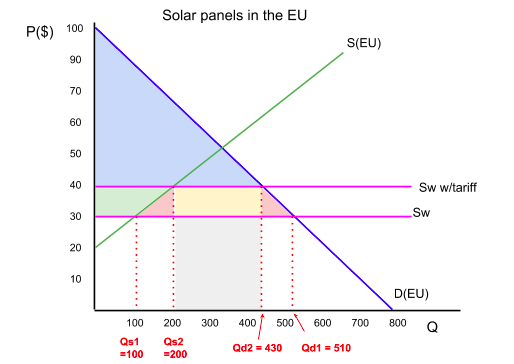
The argument that access to developed country markets does more than transfers, because it generates sustainable earnings rather than dependence, rewards productive activity, and transfers technology and standards through competition.
Barriers matter here. Tariff escalation, where import duties rise with the degree of processing, actively discourages developing countries from adding value: raw cocoa faces a low tariff, chocolate a high one. Agricultural subsidies in developed countries depress world prices and undercut producers who have no comparable support.
3.2 Diversification
Since primary product dependence is a barrier in 10.4, policies to diversify the export base address the cause: developing processing industries, moving up the value chain, and broadening into manufactures and services.
3.3 Import substitution against export promotion
Two strategies, and CIE expects the contrast.
Import substitution industrialisation protects domestic infant industries behind tariffs so they can grow to efficient scale.
- For: allows an industry to develop economies of scale before facing competition; reduces import dependence; may build industrial capability.
- Against: protection removes the incentive to become efficient, so infant industries frequently never mature; the domestic market may be too small for efficient scale; consumers pay higher prices; and protection invites retaliation. The historical record is largely poor.
Export-led growth orients production towards world markets from the outset.
- For: world demand is far larger than the domestic market, so scale economies are attainable; exposure to competition forces efficiency; earns the foreign exchange the economy needs; and it does not conflict with the balance of payments objective of 10.1.
- Against: depends on access to developed markets, which may be restricted; exposes the economy to world demand fluctuations; and may require initial competitiveness the country does not yet have.
The record favours export orientation, and saying so with the reasoning is stronger than presenting the two as evenly balanced.
4. Foreign direct investment
FDI is investment by a foreign firm in productive capacity, such as building a factory.
4.1 The case for
- Brings capital without creating debt, since the investor bears the risk.
- Transfers technology and management practice.
- Creates employment and trains workers, raising human capital.
- May develop supply chains among local firms.
- Generates exports and foreign exchange.
- Widens the tax base.
4.2 The case against
- Profit repatriation means income flows out, which is exactly the GDP against GNI divergence of 10.3. Output rises by more than the income available to residents.
- Enclave development, where the investment has few links to the rest of the economy, so the benefits do not spread.
- Tax competition, where countries offer concessions so generous that the fiscal gain is small or negative.
- Environmental and labour standards may be lower than a developed country would permit.
- Market power, where a large multinational dominates a small domestic economy.
- Investment concentrated in extractive industries may deepen primary product dependence rather than reduce it.
4.3 Judgement
FDI contributes most where the host has enough institutional capacity to negotiate reasonable terms, sufficient human capital for technology transfer to occur, and policies requiring local linkages. Without those; it can raise GDP while leaving development largely unchanged, which is why the GDP and GNI comparison is such a useful diagnostic.
5. Domestic policies
Foreign resources cannot substitute for domestic reform, and examiners reward candidates who say so.
- Investment in human capital: primary and secondary education, and basic healthcare, both of which raise productivity and lower birth rates over time.
- Infrastructure: power, transport, water and communications, which lower costs for every firm and are typically underprovided by markets because of their public good and externality characteristics.
- Institutional reform: securing property rights, enforcing contracts, reducing corruption, which 10.4 identified as often the binding constraint.
- Financial development: banking and microfinance to channel what saving exists into investment, addressing the savings gap from within.
- Agricultural productivity: since most of the poor work in agriculture, raising yields raises incomes directly and releases labour for other sectors.
- Family planning and female education, which lower fertility and raise the female participation rate.
- Broadening the tax base, reducing reliance on aid and creating fiscal capacity.
6. Sustainability
Policies must be assessed against the sustainability criterion of 10.3, since development that depletes natural capital is borrowing from the future.
- Growth based on extracting non-renewable resources raises measured income while reducing future capacity, unless the proceeds are invested in other forms of capital.
- Environmental degradation falls hardest on the poor, who depend most directly on natural resources and can least afford to adapt.
- Renewable energy may allow developing countries to leapfrog the fossil fuel intensive path, though the upfront capital cost is a barrier that aid or FDI could address.
The conflict is genuine but not absolute. Investment in education, health and institutions raises development without resource depletion, which is why those policies score well on both criteria at once.
6. External debt
Syllabus point 11.5.5, and the piece that connects aid, trade and investment to each other.
6.1 Causes of debt
- Borrowing to fill the savings gap, where domestic saving cannot fund the investment the economy needs.
- Concessional loans rather than grants, so aid itself accumulates as debt.
- Persistent current account deficits, financed by borrowing abroad.
- Commodity price falls, which cut export earnings after the debt was taken on.
- Currency depreciation, which raises the domestic cost of debt denominated in foreign currency. This is the trap: the debt is fixed in dollars, the earnings are not.
- Rising world interest rates on variable-rate borrowing.
- Borrowing that funded consumption or prestige projects rather than productive capacity.
6.2 Consequences
- Debt service diverts foreign exchange away from imports of capital equipment, which is the foreign exchange gap of 11.4 made worse.
- Government spending is crowded out: money repaid to creditors cannot fund health, education or infrastructure.
- Deters investment, because a high debt burden signals possible future taxation or default.
- Conditionality: rescheduling usually comes with policy conditions the country did not choose.
- A debt overhang can leave a country paying more in service than it receives in new inflows, so it becomes a net exporter of capital while remaining poor.
Debt relief addresses this by cancelling or rescheduling. The case for it is that the debt is unpayable and is blocking development. The case against is moral hazard: relief may encourage further imprudent borrowing and lending, so relief is normally tied to governance conditions.
7. The International Monetary Fund and the World Bank
Syllabus points 11.5.6 and 11.5.7. Candidates routinely confuse the two, and the distinction is straightforward.
7.1 The IMF
The International Monetary Fund exists to promote monetary cooperation and exchange rate stability, and to lend to members facing balance of payments crises. Its work is short-term and macroeconomic:
- surveillance of member economies;
- emergency lending when a country cannot meet its external obligations;
- technical assistance on monetary and fiscal management.
Its lending carries conditionality, typically requiring fiscal tightening, monetary restraint and structural reform. That is the contested part. Supporters argue the conditions address the mismanagement that caused the crisis. Critics argue that austerity imposed during a downturn deepens the recession, falls hardest on the poorest, and reflects the priorities of creditor countries rather than the borrower's own.
7.2 The World Bank
The World Bank lends for long-term development projects: infrastructure, health, education, agriculture. Its work is project-based and microeconomic in focus, and its lending is concessional or below market rates.
The distinction to hold onto: the IMF stabilises, the World Bank develops. A country with a currency crisis goes to the IMF; a country building a power grid goes to the World Bank.
7.3 Evaluation
Both are criticised for governance weighted towards their largest shareholders, for conditions that constrain policy choice, and for a record on structural adjustment that is at best mixed. Both are defended on the grounds that the alternative for a country in crisis is no lender at all. A strong answer names the specific condition being criticised rather than rejecting the institutions wholesale.
8. Integrated analysis and common traps
7.1 A complete chain
A low income country with a savings ratio of 6 per cent receives aid worth 4 per cent of GDP, directed to primary education and rural roads.
Immediate effect: the savings gap of 10.4 narrows, so investment rises above what domestic saving alone permits. Roads reduce transport costs, raising the return on agricultural output and connecting rural producers to markets. Education raises human capital, which raises productivity over a decade or more.
Evaluation: the education effect is slow, arriving long after the aid, so the political incentives of 8.4 favour more visible projects. The aid must be predictable to justify recurrent spending on teachers, whereas volatile aid can leave a school system unfunded mid-cycle. If institutions are weak, a share is lost to corruption. And unless domestic tax capacity grows, the country substitutes aid for revenue rather than adding to it.
Judgement: aid directed to human capital and infrastructure addresses the actual constraints rather than the symptoms, so the case is strong, conditional on predictability and on institutional capacity adequate to deliver it.
7.2 Common examination errors
- Classifying FDI or remittances as aid.
- Asserting aid is good or bad rather than stating the conditions under which it works.
- Forgetting profit repatriation when evaluating FDI, and so missing the GDP against GNI point.
- Presenting import substitution and export promotion without evaluating the record.
- Recommending only external solutions and omitting domestic reform.
- Ignoring institutions, which condition whether any policy works.
- Treating sustainability as a separate afterthought rather than a criterion applied to each policy.
9. Paper 3 and Paper 4 mastery
Paper 3 tests: classifying items as aid or not, identifying which measure best promotes sustainable growth, and identifying the drawback of a named strategy.
Paper 4 asks whether aid, trade or investment best promotes development. The reliable structure is to identify the constraint the country actually faces, using 10.4, then assess each policy against that constraint, then conclude by stating the conditions rather than the winner. A country whose binding constraint is institutional will not be helped much by any of the three until that is addressed, and saying so is a strong conclusion.
Use the GDP against GNI diagnostic whenever FDI appears. It is concrete, quantitative and frequently overlooked.
Check you have it
Question 1
It is often argued that the UN Human Development Index (HDI) is a better indicator of economic development than income per capita because it adjusts for
Answer: D.
The HDI combines three dimensions, income (GNI per capita), education (years of schooling) and health (life expectancy at birth). Life expectancy is the component that income per capita cannot capture at all: two countries with identical average incomes can differ greatly in how long their citizens live, depending on healthcare, sanitation and nutrition. Adding a health dimension is a large part of why the HDI is treated as a broader measure of development than income alone.
Why the other options are wrong:
- A, average hours worked, is not in the HDI. It would be relevant to welfare, the same income earned in fewer hours implies a better standard of living, but the index does not include it.
- B, environmental pollution, is not in the HDI either. This is a recognised limitation of the index, and it is why separate measures such as the Measure of Economic Welfare exist.
- C, income inequality, is the strongest distractor. The standard HDI uses average income and average outcomes, so it says nothing about distribution. There is a separate Inequality-adjusted HDI that does make this correction, but it is a different index, the plain HDI does not adjust for inequality.
Question 2
Some conditions for providing foreign aid to low-income countries can be restrictive.
Which kind of aid fits this description?
Answer: B.
Tied aid comes with a condition on how the money may be spent: the recipient must buy goods or services from firms in the donor country. That restriction reduces the value of the aid, because the recipient cannot shop for the cheapest or most suitable supplier and may end up paying above the world price. Part of the benefit therefore flows back to producers in the donor economy, which is why tied aid is criticised as serving the donor's commercial interests as much as the recipient's development.
Why the other options are wrong:
- A, emergency food aid after a drought, is given for immediate humanitarian relief and does not restrict the recipient's purchasing decisions.
- C, concessional loans repaid over a long period at low interest, are generous rather than restrictive, the soft terms are the point. A repayment obligation is a cost, but it is not a restriction on how the funds are used.
- D, technical assistance through skilled worker transfers, delivers expertise the recipient lacks. It builds capacity rather than constraining choice.
Question 3
What is likely to happen in a developing country as it becomes more developed?
Answer: B.
Development brings higher incomes and, with them, better nutrition, clean water, sanitation and access to healthcare. Infant and child mortality fall sharply, infectious disease is controlled, and average life expectancy rises. This is one of the most reliable empirical regularities in development economics, which is why life expectancy is one of the three components of the Human Development Index.
Why the other options are wrong:
- A reverses the relationship. Rising incomes and expanding state education mean a higher proportion of people reach tertiary education, not a lower one.
- C is the subtle trap. Population growth typically falls as development proceeds. The demographic transition explains why: death rates fall first, giving a temporary surge in growth, but birth rates then fall too as child mortality declines, women's education and employment expand, and the cost of raising children rises. Mature developed economies have low or even negative natural population growth.
- D reverses the pattern of structural change. Development shifts resources from primary to secondary and then to tertiary activity, so the service sector grows in importance rather than declining.
10. Final checklist
A fully prepared learner can:
- distinguish bilateral, multilateral, tied and concessional aid, and identify what is not aid;
- state at least four arguments for and six against aid, with mechanisms;
- state the conditions under which aid is most effective;
- explain tariff escalation and why it discourages value added;
- compare import substitution with export promotion and evaluate the record;
- state at least five benefits and five drawbacks of FDI;
- explain profit repatriation using the GDP and GNI distinction;
- list at least six domestic policies and explain why each addresses a constraint from 10.4;
- explain why institutional quality conditions the success of every other policy;
- apply the sustainability criterion to individual policies; and
- conclude by identifying the binding constraint rather than ranking policies in the abstract.
Related CIE 9708 topics
Not the topic you were looking for? Describe what you are stuck on in your own words and we will take you to the notes that answer it.