Unemployment
Contents: 4 sections
Cambridge International AS & A Level Economics 9708 (AS Level) Current syllabus: 2026–2028, version 2 Official syllabus points: 4.5.1–4.5.4
Exam Essentials
1. Meaning of unemployment
Unemployment exists when people of working age are without employment, are available for work and are actively seeking work but cannot obtain a job.
This definition is more precise than saying that unemployment means “not having a job”. A person without paid employment is not necessarily unemployed. For example, a full-time student who is not seeking work, a retired person and a person who has chosen not to enter the labour market are normally classified as outside the labour force, not unemployed.
The three central conditions are:
- without work during the reference period;
- available for work;
- seeking work through active steps.
National statistical systems may specify exact reference periods. The widely used International Labour Organization approach allows countries to produce more comparable labour-market statistics.
Employment, unemployment and economic inactivity
The working-age population can be divided into:
- employed: people doing work for pay or profit, including some people temporarily away from a job;
- unemployed: people without work who meet the availability and job-search conditions;
- outside the labour force: people who are neither employed nor unemployed.
The labour force consists of the employed plus the unemployed:
labour force = employed + unemployed
Exam trap: do not divide the number unemployed by the whole population when calculating the unemployment rate.
2. Unemployment, underemployment and inactivity
These ideas must not be confused.
Underemployment
A person is underemployed when they are employed but their labour is not being used as fully as they would prefer or as their skills allow. Examples include:
- a worker who wants full-time hours but can obtain only part-time work;
- a highly qualified worker employed in a role that uses only a small part of their skills.
Underemployed people are normally counted as employed, not unemployed. A low unemployment rate can therefore coexist with substantial labour underutilisation.
Discouraged workers
A discouraged worker would like a job but has stopped actively searching because they believe no suitable work is available. Under a strict job-search definition, that person may be classified outside the labour force. This can make the headline unemployment rate understate weakness in the labour market.
Voluntary and involuntary unemployment
The syllabus does not require a detailed theory of voluntary unemployment. For examination purposes, focus on people who want and are available for work but cannot obtain it. Avoid assuming that everyone without a job is unemployed.
3. Measuring unemployment
Two related measures are commonly used.
The unemployment level
The level of unemployment is the total number of people classified as unemployed.
The unemployment rate
The unemployment rate expresses unemployed people as a percentage of the labour force:
unemployment rate = (number unemployed ÷ labour force) × 100
Because:
labour force = employed + unemployed
we can also write:
unemployment rate = unemployed ÷ (employed + unemployed) × 100
Worked example 1
An economy has:
- 24 million employed people;
- 1.5 million unemployed people.
Labour force:
24m + 1.5m = 25.5m
Unemployment rate:
(1.5 ÷ 25.5) × 100 = 5.88%, or approximately 5.9%.
Worked example 2: do not use the whole population
Suppose the same economy has a total population of 40 million. Dividing 1.5 million by 40 million would give 3.75%, but this is not the unemployment rate because children and adults outside the labour force are included in the denominator.
Interpreting a change in the rate
A fall in the unemployment rate does not always mean that more people have found jobs. The rate can also fall if unemployed people stop searching and leave the labour force. Always examine changes in employment, unemployment and labour-force participation together where the data are available.
4. Main approaches to collecting unemployment data
Labour-force survey
A labour-force survey asks a representative sample of households about employment status, job search and availability. It can apply a consistent definition to people whether or not they claim benefits.
Advantages include:
- broader coverage than benefit records;
- internationally comparable concepts when standard definitions are used;
- information about age, region, duration, qualifications and other characteristics.
Limitations include:
- sampling error because only part of the population is surveyed;
- non-response and inaccurate answers;
- cost and time required to collect and process data;
- revisions when improved information becomes available.
Claimant count or administrative records
A claimant count uses records of people receiving, or required to seek work for, specified unemployment-related benefits.
Advantages include:
- relatively quick and inexpensive collection;
- regular administrative data rather than a sample estimate.
Limitations include:
- some unemployed people are not eligible or do not claim;
- some claimants may not satisfy the economic definition of unemployment;
- rule changes alter the count even if underlying labour-market conditions do not change;
- cross-country comparisons are difficult because benefit systems differ.
Exam technique: a strong answer explains why the chosen method may either understate or overstate unemployment rather than merely saying it is “inaccurate”.
5. Difficulties in measuring unemployment
5.1 Discouraged workers
People who stop searching are no longer counted as unemployed under a strict active-search definition. Measured unemployment may fall even though labour demand has not improved.
5.2 Underemployment
A person working one hour or a small number of hours may be counted as employed even if they want substantially more work. The unemployment rate measures the absence of employment, not the adequacy or quality of employment.
5.3 Informal and unrecorded work
People may undertake undeclared, casual or illegal work while reporting themselves as unemployed. This may overstate unemployment. Conversely, informal workers whose work disappears may not be visible in administrative systems.
5.4 Eligibility and claiming behaviour
A claimant count omits people who are unemployed but not entitled to benefits or who choose not to claim. It may also include people whose status does not match the statistical definition.
5.5 Sampling and response errors
Survey estimates can differ from the true population value because of sample selection, non-response, misunderstanding or deliberate misreporting.
5.6 Changes in definitions and rules
Changing the working-age threshold, search period, availability test or benefit rules can create a statistical change without an equivalent economic change.
5.7 International comparisons
Countries may differ in survey quality, informal-sector size, working-age definitions and data collection. A lower published rate does not necessarily mean a stronger labour market.
5.8 Averages hide variation
A national average can conceal much higher unemployment among young people, particular regions, occupational groups or ethnic groups. This is mainly an interpretation limitation rather than an error in the national rate.
Full Explanation
6. The five syllabus types of unemployment
Cambridge requires five named types:
- frictional;
- structural;
- cyclical;
- seasonal;
- technological.
The categories describe the main reason a person is unemployed. In reality, cases may overlap. Technological unemployment can create a structural skills mismatch, and seasonal workers may also spend time searching between jobs. In an examination, identify the most immediate cause stated in the question.
7. Frictional unemployment
Frictional unemployment is temporary unemployment arising while workers move between jobs or enter the labour market and search for suitable work.
Examples include:
- a graduate searching for a first job;
- a worker who leaves one firm before starting at another;
- a person taking time to find a job matching their location, pay and skills.
Why it occurs
Information is imperfect. Workers need time to discover vacancies, submit applications, attend interviews and compare offers. Firms also need time to advertise, screen and recruit.
Analysis chain
- Worker leaves or enters the labour market
- job search and matching take time
- worker is temporarily without employment
- frictional unemployment exists.
Frictional unemployment may occur even in a healthy, growing economy. A short search period can improve matching between workers and jobs, but prolonged search imposes income and output costs.
Classification trap: seasonal unemployment is listed separately in the current syllabus. Do not automatically label all predictable gaps between jobs as frictional.
8. Structural unemployment
Structural unemployment arises when the pattern of labour demand changes and workers' skills, occupations or locations do not match the jobs available.
Possible causes include:
- a long-term decline in an industry;
- changes in consumer demand;
- international competition and relocation of production;
- regional concentration of declining industries;
- insufficient occupational or geographical mobility;
- changes in the structure of production.
Example
Demand moves away from domestically produced print newspapers towards digital media. Printing plants close, but new vacancies require software and data skills in different locations.
Analysis chain
- Demand for an industry's output falls persistently
- firms reduce production and labour demand
- displaced workers lack the skills or mobility required by expanding industries
- vacancies and unemployment coexist
- structural unemployment persists.
Structural unemployment is often longer lasting than frictional unemployment because retraining, relocation and the creation of new jobs take time.
Important distinction: a temporary economy-wide fall in spending causes cyclical unemployment. A lasting mismatch between available workers and available jobs causes structural unemployment.
9. Cyclical unemployment
Cyclical unemployment, also called demand-deficient unemployment, is caused by a fall in aggregate demand and real output during an economic downturn.
Analysis chain
- Aggregate demand falls
- firms experience lower sales and unwanted inventories
- firms reduce production
- derived demand for labour falls
- redundancies and reduced recruitment increase unemployment.
Cyclical unemployment tends to affect many industries at the same time, although the effect is not identical in every sector. It may reverse as aggregate demand and output recover.
Link to AD/AS
In the AD/AS model, a leftward shift of AD can lower equilibrium real output. Lower output usually reduces firms' demand for labour, increasing cyclical unemployment. Employment is not plotted directly on the standard AD/AS axes, so the employment effect must be explained through the output-to-labour-demand chain.
Exam trap: do not call a permanent decline in one occupation cyclical merely because firms are dismissing workers.
10. Seasonal unemployment
Seasonal unemployment occurs because demand for certain workers varies predictably at different times of the year.
Examples include:
- workers in a ski resort outside the winter season;
- agricultural workers between harvesting periods;
- temporary retail workers after a major holiday shopping season;
- tourism workers during the low season.
Analysis chain
- Season changes
- demand for a seasonal product or service falls predictably
- firms require fewer workers
- temporary seasonal unemployment rises.
Seasonal unemployment is not necessarily evidence of an economy-wide recession. Analysts may use seasonally adjusted data to reveal underlying labour-market changes.
11. Technological unemployment
Technological unemployment occurs when labour-saving technology replaces workers or reduces the demand for particular human tasks.
Examples include:
- automated checkouts reducing demand for some cashier tasks;
- industrial robots replacing repetitive assembly work;
- software automating routine administrative processes.
Analysis chain
- Labour-saving technology is introduced
- fewer workers are required for a given level of output
- displaced workers become unemployed
- technological unemployment occurs, at least during adjustment.
The long-run effect is not automatically a permanent fall in total employment. Technology can lower costs, increase output, create new products and generate new occupations. The net effect depends on:
- the speed at which old tasks disappear;
- the creation of complementary jobs;
- workers' ability to retrain and relocate;
- the response of demand as prices and incomes change.
For the current syllabus, treat technological unemployment as a separately named type. It can also create a broader structural mismatch when displaced workers lack the skills needed in new sectors.
Exam Mastery
12. Consequences for unemployed people and households
Loss of income and living standards
Job loss usually reduces disposable income and consumption possibilities. The effect depends on savings, other household earners and the availability of transfer payments.
Loss of skills and employability
Long-term unemployment can cause skills to become outdated. Employers may interpret a long employment gap negatively, making future job search more difficult. This persistence is sometimes called hysteresis, but the term itself is not required at AS Level.
Health and well-being
Unemployment may increase stress, anxiety and loss of confidence. These effects vary across individuals, so avoid treating every outcome as inevitable.
Inequality and poverty
If unemployment is concentrated among low-income households or particular regions, income inequality and relative poverty may rise.
13. Consequences for firms
Possible negative effects include:
- lower consumer demand, especially during cyclical unemployment;
- loss of experienced workers and firm-specific skills;
- lower confidence and delayed investment;
- weaker local markets in regions with concentrated unemployment.
Possible advantages for some firms include:
- a larger pool of applicants;
- easier recruitment;
- reduced upward wage pressure.
These are not benefits to the economy as a whole. They describe how the effect can differ across firms and labour-market conditions.
14. Consequences for government and the wider economy
Lost output and an output gap
Unemployed labour is an unused productive resource. Actual real GDP is below the level that could be produced if more workers were employed productively.
- Unemployment rises
- fewer workers produce goods and services
- actual output falls below potential output
- material living standards are lower than they could be.
Government budget effects
Higher unemployment can:
- reduce income-tax and indirect-tax receipts;
- increase spending on unemployment benefits and support services;
- worsen the government budget balance;
- create an opportunity cost because public funds cannot be used elsewhere.
Lower demand and a negative feedback loop
Job losses reduce household income and consumption. This can reduce firms' sales further and lead to additional job losses. The strength of this process depends on savings, benefits, confidence and policy responses.
Human-capital damage and slower future growth
Long unemployment spells can reduce skills, participation and productivity, lowering the economy's future productive potential.
Social and regional consequences
Persistent unemployment can contribute to social exclusion, poorer health, family pressure and regional decline. It may be associated with higher crime, but a careful answer avoids claiming that unemployment automatically causes crime in every case.
Inflationary pressure
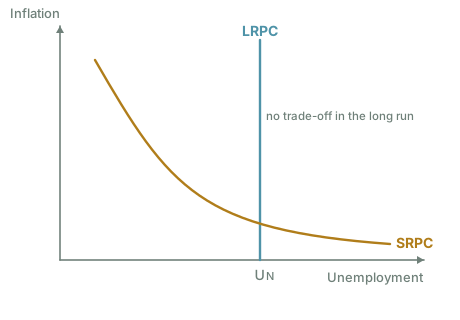
High cyclical unemployment usually reduces wage and demand pressures, which may slow inflation. This relationship is not mechanically fixed and detailed unemployment–inflation trade-off theory belongs later in the course.
15. Evaluation: why the type and duration matter
A strong answer does not discuss “unemployment” as if every case has the same cost.
Type
- Frictional: often short-lived and can improve job matching.
- Seasonal: predictable and concentrated in particular industries and periods.
- Cyclical: reflects deficient demand and large economy-wide output loss.
- Structural: may persist because skills and locations do not match vacancies.
- Technological: can be severe for displaced workers but may coexist with productivity growth and new employment.
Duration
Long-term unemployment generally causes greater skill loss, poverty and fiscal cost than a brief period between jobs.
Scale and concentration
A modest national rate can conceal severe unemployment in one region or age group. Concentrated unemployment can cause cumulative local decline.
Social protection and labour mobility
Benefits, retraining, transport, housing and information systems influence the size of the household and economic costs.
State of the economy
When unemployment is cyclical, unused resources may allow aggregate demand to rise with less immediate inflation than when the economy is near full capacity.
16. Common misconceptions
- “Anyone without a job is unemployed.” Wrong: the person must meet availability and job-search conditions.
- “The unemployment rate is unemployed divided by population.” Wrong: divide by the labour force.
- “A falling unemployment rate always means employment rose.” Wrong: people may have left the labour force.
- “Underemployed workers are unemployed.” Usually wrong: they are counted as employed.
- “Technological unemployment and structural unemployment are identical.” Technology can create structural mismatch, but Cambridge lists technological unemployment separately.
- “Seasonal unemployment is caused by recession.” Wrong: it follows predictable seasonal demand changes.
- “Every consequence is automatic.” Wrong: outcomes depend on type, duration, benefits, mobility, household circumstances and policy.
17. Paper 1 strategy
For data questions:
- identify the numerator and denominator;
- calculate the labour force before calculating the rate;
- distinguish percentage points from percentage change;
- classify the unemployment type from the immediate cause;
- reject distractors that confuse inactivity or underemployment with unemployment.
Percentage-point example
If unemployment rises from 4% to 6%:
- increase = 2 percentage points;
- percentage increase in the rate = (2 ÷ 4) × 100 = 50%.
These are different statements.
18. Paper 2 strategy
For an explanation question:
- cause
- effect on output or labour demand
- type of unemployment
- consequence
For an evaluation question:
- consequence
- condition that strengthens or weakens it
- reasoned judgement
Example plan
Question: Analyse two consequences of a rise in cyclical unemployment.
- Define cyclical unemployment.
- Chain 1: lower employment → lower household income → lower consumption → lower AD and output.
- Chain 2: lower employment and spending → lower tax revenue plus higher benefits → weaker budget balance and opportunity cost.
- Add that the scale depends on the duration of unemployment, benefit system and policy response.
Check you have it
Question 1
A finance company incurs heavy losses and makes an accountant redundant. The accountant seeks a new job through an employment agency which specialises in jobs in accounting. What describes the type of unemployment of the accountant who is seeking a new job?
Answer: A.
19. Topic summary
- Unemployment requires absence of work, availability and active job search.
- Labour force = employed + unemployed.
- Unemployment rate = unemployed ÷ labour force × 100.
- Survey and claimant measures both have strengths and limitations.
- Discouraged workers, underemployment, informal work, sampling and rule changes complicate measurement.
- The five required types are frictional, structural, cyclical, seasonal and technological.
- Consequences affect households, firms, government finances, output, growth, inequality and society.
- Type, duration, concentration and institutional support determine the severity of the effects.
What the syllabus asks for on this topicSyllabus map
Syllabus map
| Syllabus point | Required knowledge | Where it is covered |
|---|---|---|
| 4.5.1 | Meaning of unemployment | Sections 1–2 |
| 4.5.2 | Measures of unemployment and possible difficulties | Sections 3–5 |
| 4.5.3 | Frictional, structural, cyclical, seasonal and technological unemployment | Sections 6–11 |
| 4.5.4 | Consequences of unemployment | Sections 12–15 |

Related CIE 9708 topics
Not the topic you were looking for? Describe what you are stuck on in your own words and we will take you to the notes that answer it.