This is the canonical content source for Topic 4.1. It is designed to support:
- complete revision notes;
- the portal lesson and mastery system;
- the public board-specific SEO page;
- original Paper 1 and Paper 2 practice;
- Codex implementation.
Official syllabus coverage
Students must understand:
- 4.1.1 the meaning of national income;
- 4.1.2 the measurement of national income using Gross Domestic Product
(GDP), Gross National Income (GNI) and Net National Income (NNI);
- 4.1.3 adjustment of measures from market prices to basic prices;
- 4.1.4 adjustment of measures from gross values to net values.
Product mastery map
The official content is divided into nine measurable portal skills:
- explain national income as a flow measured over a period;
- explain the output–income–expenditure identity;
- define and interpret GDP using the domestic-territory boundary;
- derive GNI using net primary income from abroad;
- derive NNI by deducting depreciation;
- compare GDP, GNI and NNI in context;
- convert market-price measures to basic-price measures;
- convert gross measures to net measures;
- complete multi-stage calculations and avoid common accounting errors.

---
The topic in one idea
National income statistics measure the value of economic activity and the<br>income generated from it during a stated period.
The core conversion ladder is:
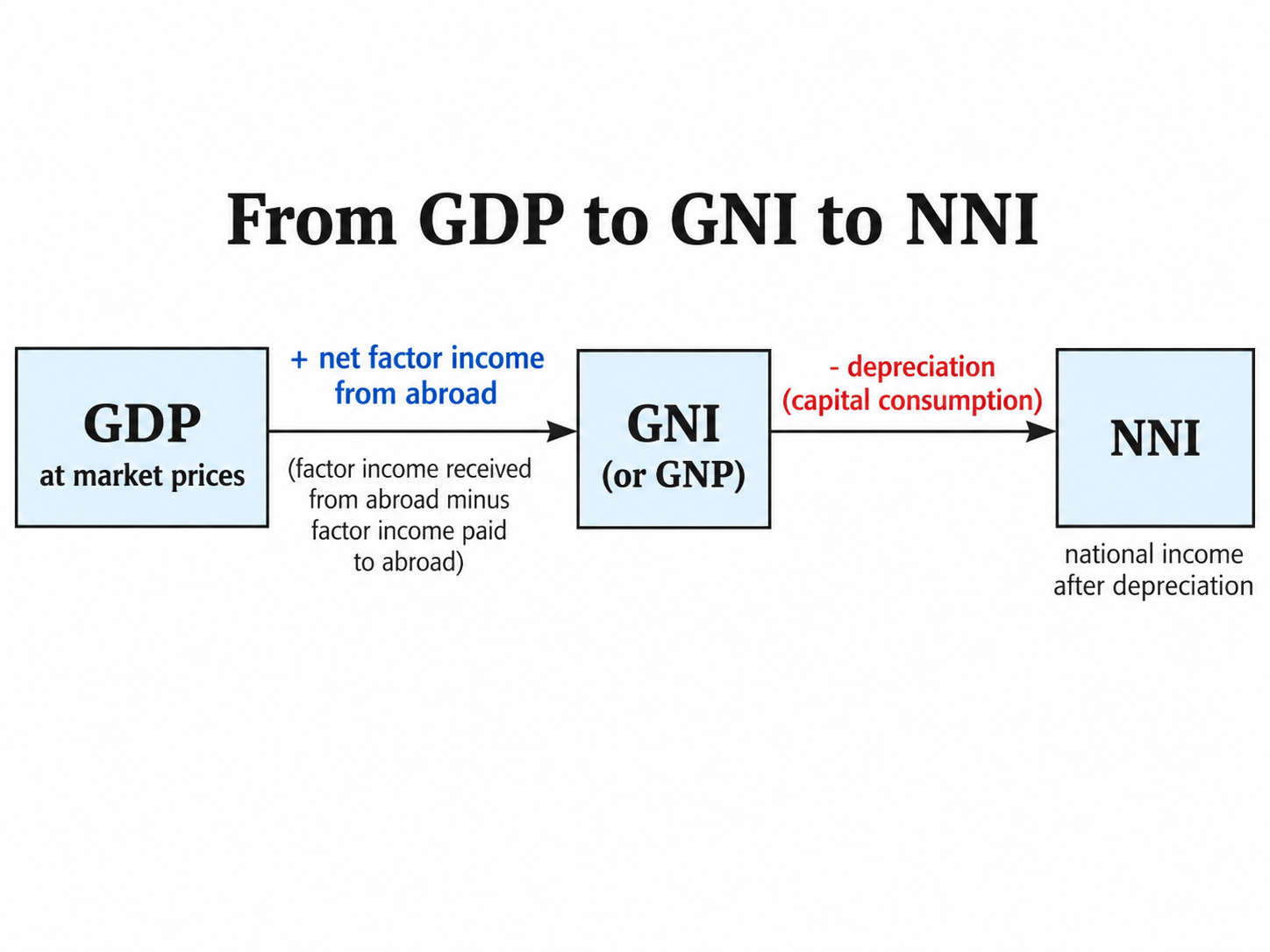
\[ GDP + \text{net primary income from abroad} = GNI \]
\[ GNI - \text{depreciation} = NNI \]
For the price basis:
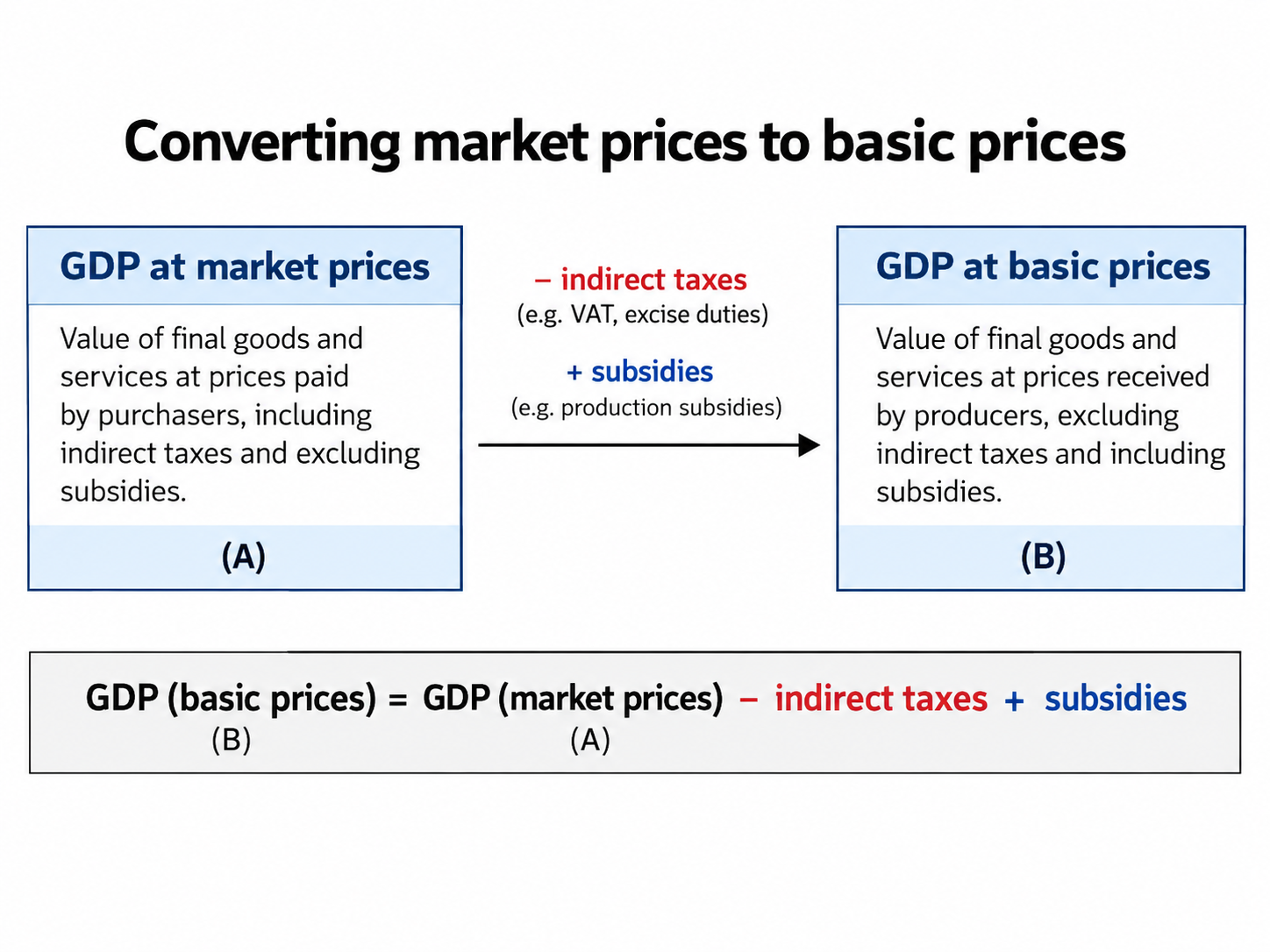
\[ \text{basic prices} = \text{market prices} - \text{taxes on products} + \text{subsidies on products} \]
---
1. Meaning of national income
Definition
National income is the value of the final goods and services produced, and the corresponding income generated, in an economy over a period of time.
The period is usually:
- a quarter;
- a year.
A flow, not a stock
National income is a flow because it is measured per period.
Examples:
- GDP during 2027;
- national income earned in the first quarter;
- annual wages and profits generated by production.
It is not the same as national wealth, which is a stock measured at a point in time.
Why “final” output matters
Only final goods and services should be counted in total output, unless value added is used at each stage.
This avoids double counting intermediate production.
Example
A farmer sells wheat to a mill for $100. The mill sells flour to a bakery for $160. The bakery sells bread to consumers for $240.
Adding all sales gives $500, but this counts the same production more than once.
Correct approaches:
- count the final bread: $240; or
- add value added:
- farmer: $100;
- mill: $60;
- bakery: $80;
- total: $240.
---
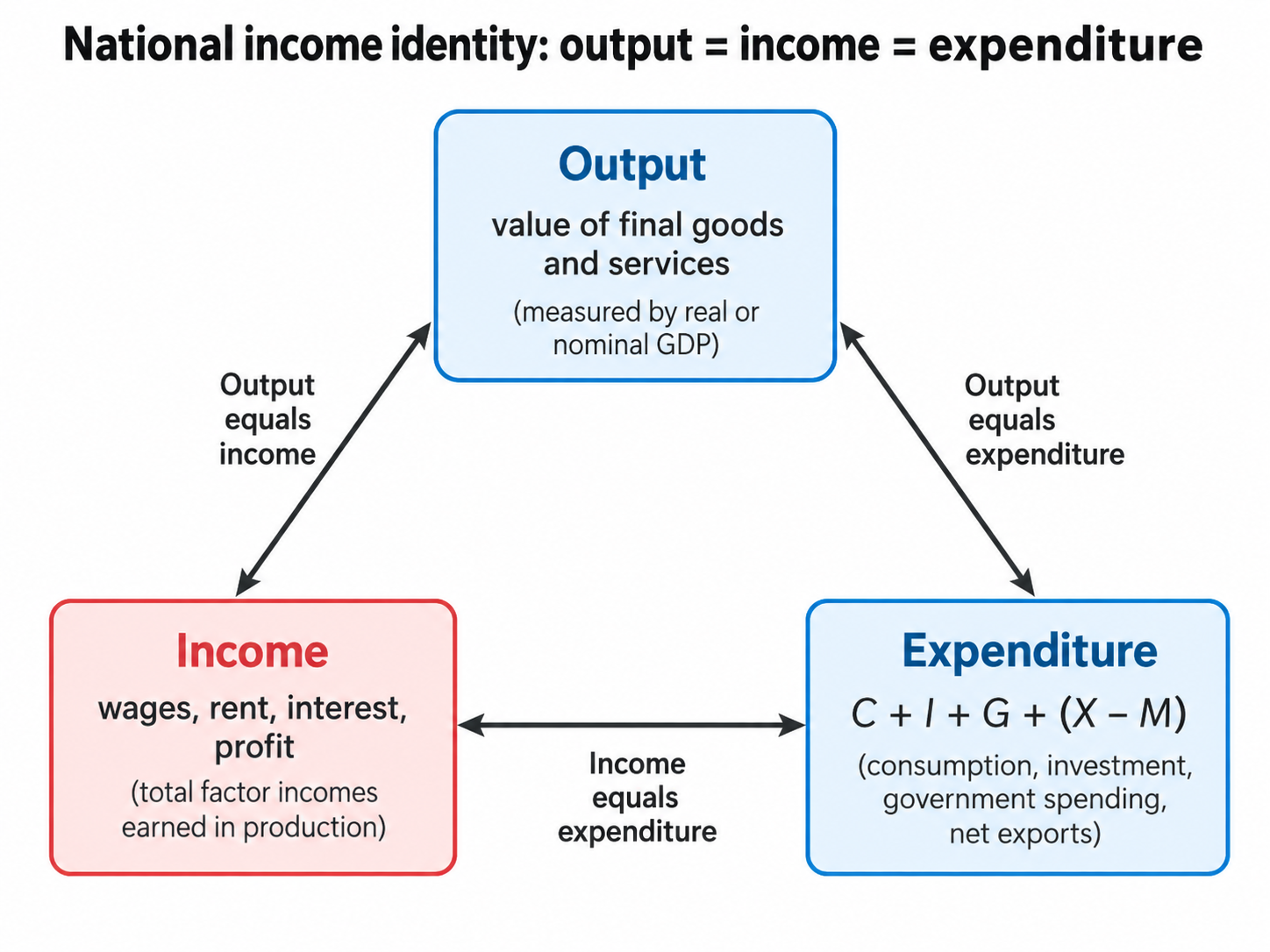
2. Output, income and expenditure are three views of the same activity
Production creates output. Selling that output creates expenditure. The revenue received is distributed as income to factors of production.
Conceptually:
\[ \text{value of output} = \text{income generated} = \text{expenditure on output} \]
Output approach
Adds the value added by producers in the economy.
Income approach
Adds incomes generated by production, such as:
- wages and salaries;
- rent;
- interest in the production accounts;
- profit and mixed income.
Expenditure approach
Adds expenditure on final domestically produced output.
At a simple macroeconomic level this is associated with:
\[ C + I + G + (X - M) \]
The detailed Aggregate Demand formula is studied in Topic 4.3.
Why measured estimates may differ
In theory the three approaches are equal. In practice, statistical agencies use multiple data sources, so initial estimates may differ because of:
- incomplete information;
- timing differences;
- sampling and reporting error;
- later revisions.
A balancing adjustment may therefore be used in official accounts.
---
3. Gross Domestic Product (GDP)
Definition
Gross Domestic Product is the total value of final goods and services produced within an economy's domestic territory during a stated period, before allowing for depreciation.
Break the name into three parts:
- Gross: depreciation has not been deducted;
- Domestic: production takes place inside the economic territory;
- Product: the value of final output produced.
The domestic boundary
GDP is based on where production occurs, not the nationality of the owner.
Included in the GDP of Economy A
- output produced by a foreign-owned car factory located in Economy A;
- services produced by a resident branch of a foreign bank inside Economy A;
- production by domestic and foreign workers operating within Economy A.
Not included in the GDP of Economy A
- output produced by a company owned by residents of A but located in Economy B;
- production occurring outside A's economic territory.
Gross does not mean profit
“Gross” means before depreciation is deducted. It does not mean gross profit.
---
4. Gross National Income (GNI)
Definition
Gross National Income measures the gross primary income received by residents of an economy during a period.
It adjusts GDP for primary income flows between residents and the rest of the world.
Formula
\[ GNI = GDP + \text{net primary income from abroad} \]
where:
\[ \text{net primary income from abroad} = \text{primary income received from abroad}
- \text{primary income paid abroad}
\]
This net balance is sometimes abbreviated in teaching materials as NPIA or NFIA. The meaning matters more than the abbreviation.
Examples of primary income
- wages earned by residents working temporarily in another economy where the
national-accounts residence rules classify the income as cross-border primary income;
- profit distributed to resident owners from production abroad;
- interest and investment income received from abroad;
- corresponding wages, profit or property income paid to non-residents.
GDP and GNI comparison
If net primary income from abroad is positive
\[ GNI > GDP \]
Residents receive more primary income from abroad than non-residents receive from domestic production.
If net primary income from abroad is negative
\[ GNI < GDP \]
Non-residents receive more primary income from domestic production than residents receive from abroad.
If the net balance is zero
\[ GNI = GDP \]
Critical exam distinction
- GDP focuses on location of production;
- GNI focuses on income of residents.
---
5. Net National Income (NNI)
Definition
Net National Income is GNI after deducting depreciation, also called consumption of fixed capital.
Formula
\[ NNI = GNI - \text{depreciation} \]
Depreciation
Depreciation is the reduction in the value of the capital stock caused by:
- wear and tear;
- ageing;
- obsolescence;
- accidental damage included within normal capital consumption estimates.
Examples include the annual loss of productive value of:
- machinery;
- vehicles;
- buildings;
- equipment.
Why NNI can be economically informative
Gross income includes output needed merely to replace worn-out capital. NNI removes that allowance and therefore represents income after maintaining the productive capital stock.
Gross versus net
\[ \text{net measure} = \text{gross measure} - \text{depreciation} \]
\[ \text{gross measure} = \text{net measure} + \text{depreciation} \]
---
6. The GDP–GNI–NNI ladder
| Measure | Core boundary | Depreciation deducted? |
|---|---|---|
| GDP | Production within domestic territory | No |
| GNI | Gross primary income of residents | No |
| NNI | Net primary income of residents | Yes |
Conversion sequence
Start with GDP:
- add net primary income from abroad to obtain GNI;
- deduct depreciation to obtain NNI.
\[ GDP + (\text{income received abroad} - \text{income paid abroad}) = GNI \]
\[ GNI - \text{depreciation} = NNI \]
Worked example 1
An economy has:
- GDP = $800 billion;
- primary income received from abroad = $70 billion;
- primary income paid abroad = $95 billion;
- depreciation = $60 billion.
Net primary income from abroad:
\[ 70 - 95 = -25 \]
GNI:
\[ 800 + (-25) = 775 \]
NNI:
\[ 775 - 60 = 715 \]
Interpretation:
- GNI is below GDP because the economy has a negative net primary-income balance;
- NNI is below GNI because depreciation is deducted.
---
7. Market prices and basic prices
Market prices
Market prices are the prices paid by purchasers in the market. They include taxes on products and reflect subsidies on products.
Examples of taxes on products can include:
- sales taxes;
- value-added taxes;
- excise duties.
Basic prices
The basic price is the amount received by the producer for a unit of output, excluding taxes on that product and including subsidies on that product.
Conversion formula
To convert a stated national-income measure from market prices to basic prices:
\[ \text{measure at basic prices} = \text{measure at market prices}
- \text{taxes on products}
+ \text{subsidies on products} \]
Equivalently:
\[ \text{market prices} = \text{basic prices} + \text{taxes on products}
- \text{subsidies on products}
\]
Net taxes on products
\[ \text{net taxes on products} = \text{taxes on products} - \text{subsidies on products} \]
Therefore:
\[ \text{basic prices} = \text{market prices} - \text{net taxes on products} \]
Why taxes are subtracted
A tax on a product raises the price paid by the purchaser but is not part of the amount retained by the producer as the basic price.
Why subsidies are added
A subsidy allows the purchaser's market price to be lower than the amount the producer effectively receives. The subsidy is therefore added when moving to the basic-price valuation.
Terminology note
Modern national accounts commonly report:
\[ GDP\text{ at market prices} = GVA\text{ at basic prices} + \text{taxes on products}
- \text{subsidies on products}
\]
Cambridge questions may present a national-income measure at market prices and ask for the adjustment to basic prices. Use the data and conversion specified in the question.
---
8. Worked market-price/basic-price calculations
Worked example 2
A measure at market prices is $500 billion. Taxes on products are $45 billion. Subsidies on products are $10 billion.
\[ \text{basic-price measure} = 500 - 45 + 10 = 465 \]
A common wrong answer is $535 billion, produced by adding taxes and subtracting subsidies. That converts in the wrong direction.
Worked example 3: reverse conversion
A measure at basic prices is $620 billion. Taxes on products are $70 billion. Subsidies on products are $15 billion.
\[ \text{market-price measure} = 620 + 70 - 15 = 675 \]
---
9. Gross values and net values
Gross value
A gross measure includes depreciation.
Net value
A net measure excludes depreciation.
Conversion
To convert gross to net:
\[ \text{net} = \text{gross} - \text{depreciation} \]
To convert net to gross:
\[ \text{gross} = \text{net} + \text{depreciation} \]
Worked example 4
GNI is $900 billion and depreciation is $80 billion.
\[ NNI = 900 - 80 = 820 \]
Depreciation is not the same as investment
- gross investment includes replacement of depreciated capital plus any net
addition to the capital stock;
- depreciation is the capital consumed during the period;
- net investment equals gross investment minus depreciation.
The direct calculation required here is the conversion from gross national income to net national income.
---
10. Full multi-stage calculations
Worked example 5
The following data are given, in billions:
- GDP at market prices = 1,200;
- primary income received from abroad = 90;
- primary income paid abroad = 130;
- depreciation = 100;
- taxes on products = 75;
- subsidies on products = 20.
Step 1: Calculate net primary income from abroad
\[ 90 - 130 = -40 \]
Step 2: Calculate GNI at market prices
\[ 1,200 - 40 = 1,160 \]
Step 3: Calculate NNI at market prices
\[ 1,160 - 100 = 1,060 \]
Step 4: Convert NNI to basic prices
\[ 1,060 - 75 + 20 = 1,005 \]
Answer:
\[ NNI\text{ at basic prices} = 1,005 \]
Recommended calculation order
- Write the target measure.
- Identify the starting measure.
- Perform the domestic-to-national adjustment.
- Perform the gross-to-net adjustment.
- Perform the market-to-basic adjustment.
- State units.
- Add one sentence interpreting the sign where relevant.
The adjustments are accounting operations. When all figures refer to the same period and valuation basis, the arithmetic order of independent additions and subtractions may not change the final result. A fixed sequence nevertheless reduces exam mistakes.
---
11. Negative net primary income from abroad
A negative figure does not mean no income is received from abroad.
It means:
\[ \text{income paid abroad} > \text{income received from abroad} \]
Example:
- received = 40;
- paid = 65;
- net primary income from abroad = -25.
Then:
\[ GNI = GDP - 25 \]
Do not remove the negative sign or add the absolute value.
---
12. Selecting the appropriate measure
GDP is useful when the question concerns
- production taking place inside the economy;
- domestic output;
- the scale of economic activity within the territory.
GNI is useful when the question concerns
- gross primary income accruing to residents;
- the effect of foreign ownership of domestic production;
- income residents receive from production and assets abroad.
NNI is useful when the question concerns
- national income after allowing for capital consumption;
- the amount remaining after depreciation is deducted.
Caution
No single statistic is a complete measure of welfare or living standards. Detailed evaluation of economic growth and living standards belongs mainly in later syllabus topics. Here, the priority is accurate construction and interpretation of the measures.
---
13. Common examination traps
Trap 1: Treating national income as a stock
Wrong. It is measured over a period.
Trap 2: Adding the value of every transaction
Wrong. Intermediate goods create double counting. Count final output or value added.
Trap 3: Defining GDP by ownership
Wrong. GDP depends on domestic production location.
Trap 4: Defining GNI as output inside the country
That is GDP. GNI adjusts for cross-border primary income.
Trap 5: Adding income paid abroad
Income paid abroad is subtracted when finding net primary income from abroad.
Trap 6: Assuming GNI must exceed GDP
Wrong. Net primary income from abroad can be negative.
Trap 7: Deducting depreciation twice
GDP and GNI are already gross. Deduct depreciation once to obtain the corresponding net measure.
Trap 8: Confusing depreciation with inflation
Depreciation is consumption of fixed capital, not a rise in the price level.
Trap 9: Converting market prices in the wrong direction
Market to basic:
subtract taxes on products and add subsidies on products.
Trap 10: Subtracting subsidies
When converting market to basic prices, subsidies are added.
Trap 11: Forgetting units
A correct number without “million”, “billion” or the stated currency may lose clarity.
Trap 12: Using transfers as though all were primary income
GNI uses net primary income from abroad. Do not automatically include every cross-border payment.
Trap 13: Calling NNI “GDP minus depreciation” without national adjustment
GDP minus depreciation is a net domestic measure. NNI requires the national primary-income adjustment as well.
Trap 14: Assuming output, income and expenditure differ in theory
They are three accounting views of the same production process, although measured estimates may differ before reconciliation.
---
14. Paper 1 technique
Common tasks include:
- select the correct GDP or GNI boundary;
- identify whether GNI is above or below GDP;
- calculate net primary income from abroad;
- calculate GNI or NNI;
- convert market prices to basic prices;
- convert gross values to net values;
- identify double counting;
- complete a multi-stage table.
Rapid formula check
Before calculating, write:
\[ GNI = GDP + \text{received abroad} - \text{paid abroad} \]
\[ NNI = GNI - \text{depreciation} \]
\[ \text{basic} = \text{market} - \text{taxes} + \text{subsidies} \]
---
15. Paper 2 technique
Four-mark explanation: GDP and GNI
GDP measures gross final output produced within the domestic territory. GNI<br>measures the gross primary income of residents. It is obtained by adding net<br>primary income from abroad to GDP. Therefore GNI may be above or below GDP<br>depending on the direction and size of cross-border primary-income flows.
Four-mark explanation: gross and net
A gross national-income measure includes depreciation. A net measure excludes<br>it. NNI is calculated by deducting consumption of fixed capital from GNI. The<br>deduction recognises that part of gross output is needed to replace capital<br>used up during production.
Six-mark calculation structure
- Show the net primary-income balance.
- Calculate GNI.
- Deduct depreciation.
- Adjust the price basis if required.
- state the final measure and units.
Eight-mark analysis question
Question idea:
Explain why GDP may be greater than GNI in an economy containing substantial<br>foreign-owned production.
Chain:
- foreign firms produce domestically, increasing GDP;
- part of the primary income generated is paid to non-resident owners;
- if income paid abroad exceeds income received from abroad, net primary income
from abroad is negative;
- GNI therefore lies below GDP.
Evaluation extension
The most appropriate measure depends on the question:
- GDP for production inside the territory;
- GNI for gross income accruing to residents;
- NNI for resident income after depreciation.
---
16. Active recall
- Define national income.
- Why is national income a flow?
- State the output–income–expenditure identity.
- Explain double counting.
- Define GDP.
- What does “domestic” mean in GDP?
- What does “gross” mean?
- Define GNI.
- State the GNI formula.
- Define net primary income from abroad.
- When will GNI exceed GDP?
- When will GNI be below GDP?
- Define NNI.
- State the NNI formula.
- Define depreciation.
- Convert market prices to basic prices.
- Why are taxes on products subtracted?
- Why are subsidies on products added?
- Distinguish a gross measure from a net measure.
- Explain why a negative net primary-income balance must retain its sign.
- Which measure is most directly based on production location?
- Which measure is based on residents' gross primary income?
- Which measure deducts capital consumption?
- Why should final output or value added be counted?
- Write the full GDP-to-NNI-at-basic-prices calculation chain.
---
17. One-minute revision summary
National income
A flow of final output, income and expenditure measured over a period.
GDP
Gross final output produced within domestic territory.
GNI
\[ GNI = GDP + \text{primary income received abroad}
- \text{primary income paid abroad}
\]
NNI
\[ NNI = GNI - \text{depreciation} \]
Market to basic prices
\[ \text{basic} = \text{market} - \text{taxes on products} + \text{subsidies on products} \]
Gross to net
\[ \text{net} = \text{gross} - \text{depreciation} \]
Most important exam rule
Write the target measure and every adjustment before inserting numbers.